
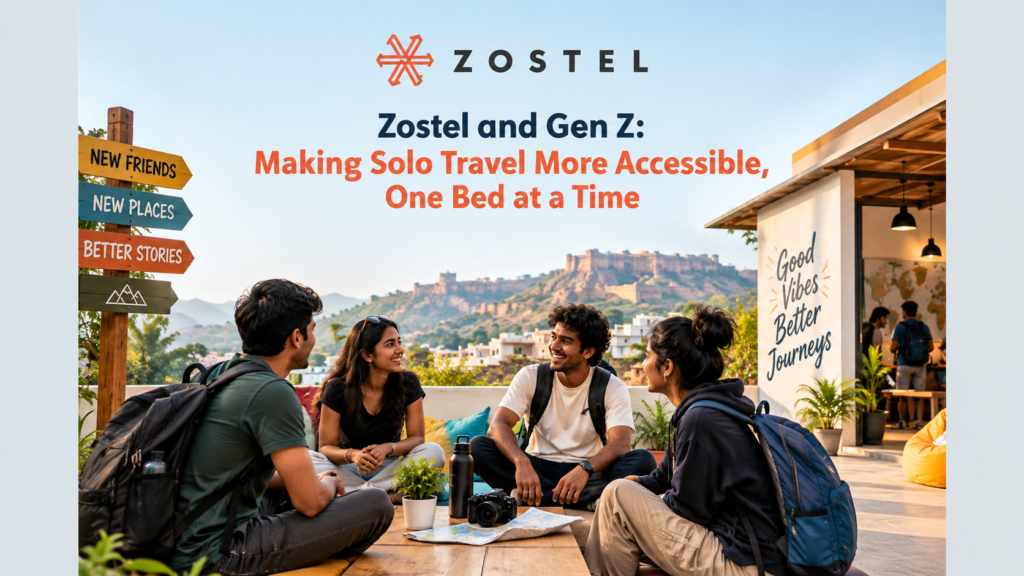
For young Indians who want to explore beyond familiar destinations, affordable accommodation, a sense of safety and the possibility of meeting fellow travellers can make all the difference. Zostel is building its proposition around that opportunity.
For a young Indian planning a first solo trip, choosing the destination may be the easy part.
The more difficult questions often come afterwards. Where should you stay? Will the accommodation fit your budget? Is the location convenient? Will you feel comfortable arriving alone? And if you are travelling without friends, how do you meet people once you get there?
These are practical questions, but they can determine whether a trip happens at all.
For students and young professionals, accommodation is often one of the biggest decisions in travel planning. A hotel may offer privacy and familiar services, but it may consume a significant part of a limited budget. The cheapest available room, meanwhile, may not provide the confidence, comfort or social environment a first-time traveller is looking for.
This is the gap that backpacker hostels seek to address.
Among the Indian brands operating in this space is Zostel, which began in Jodhpur in 2013 and built its proposition around affordable stays, shared spaces and a community of travellers. The company describes its model as bringing people together through accommodation, trips and communal experiences. Its current website lists a network of hostels, while its broader offering includes other types of stays and travel experiences.
For Gen Z, the appeal of such a model goes beyond finding an inexpensive bed. It is about making independent travel feel more achievable: financially, practically and socially.
The first barrier to travel is often the cost of staying somewhere
Travel conversations frequently focus on destinations, flights, scenic routes and experiences. But for someone working within a tight budget, the cost of accommodation can determine the length of a trip, the activities they can afford and sometimes whether they travel at all.
This is particularly relevant for students and people at the beginning of their careers. Their desire to explore may be strong, but their discretionary spending can be limited by education expenses, rent, transport and other priorities.
A hostel offers a different calculation from a conventional hotel. Rather than paying for an entire private room, a traveller can book a bed in a shared dormitory. Depending on the property, private rooms may also be available for those who want greater privacy.
The trade-off is straightforward: guests may share rooms and facilities in exchange for a different price point and a more communal environment.
For a young traveller, that can make a weekend trip or a longer backpacking itinerary more manageable. Money saved on accommodation may be available for local food, transport, sightseeing or an activity that makes the trip memorable.
Of course, hostels are not automatically the cheapest option in every destination or season. Prices vary by property, room type, demand and booking dates. A shared room may also be unsuitable for travellers who prioritise privacy or quiet.
The value proposition lies in offering another choice—one that can work for people who want to travel without allocating most of their budget to where they sleep.
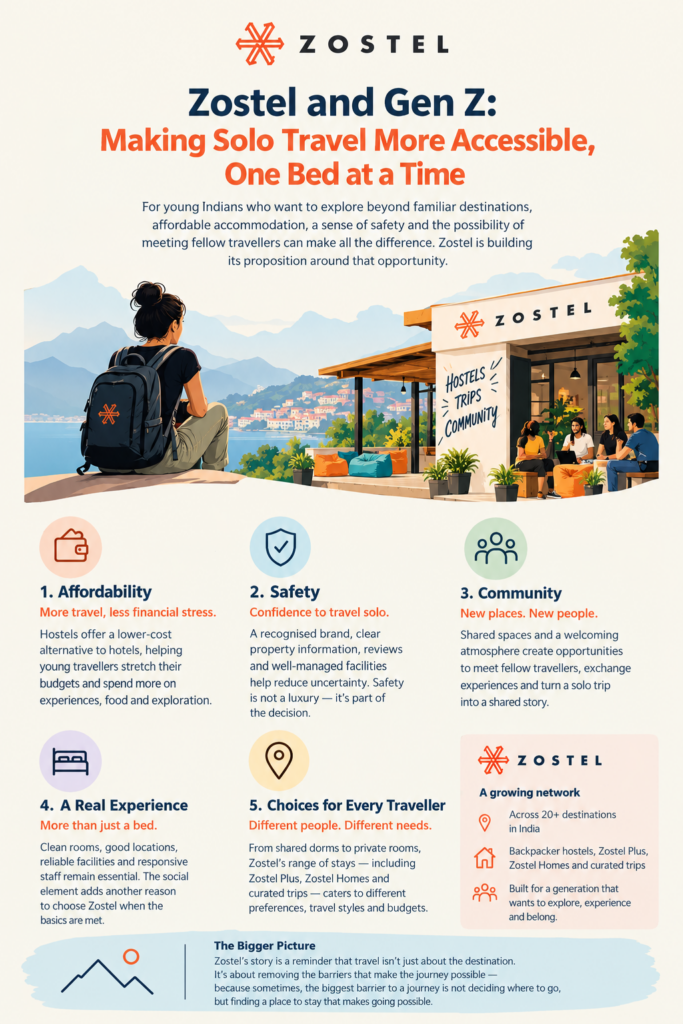
Safety is not a luxury. It is part of the decision.
Affordability alone cannot make independent travel accessible.
For someone travelling alone for the first time, uncertainty about accommodation can be a substantial barrier. Is the property well managed? Will the room and bathroom be clean? Is the location convenient? What happens if a guest feels uncomfortable or needs assistance?
These concerns can be particularly significant for women travelling alone, although safety and reliable service matter to every traveller.
A recognised hostel brand can give a prospective guest more information to evaluate than an unfamiliar listing might provide. A network of properties, published descriptions, booking information and guest reviews can help travellers compare options before making a decision.
But a brand name is not a guarantee of safety.
Zostel operates across different destinations, and the actual experience depends on the individual property, its management, facilities and operating practices. Public traveller reviews include both positive experiences and complaints about particular stays.
That is why the safety question deserves to be treated seriously rather than as a marketing claim.
For a hostel to be a dependable option, travellers need clear information about room arrangements, access controls, storage, staff availability, shared facilities and ways to report problems. Female-only dormitories, where available, may provide an additional choice for women who prefer them.
The larger lesson for the hospitality industry is that making travel accessible involves more than lowering the price. It also requires reducing uncertainty and giving guests confidence in the arrangements they are paying for.
For brands serving young travellers, safety should be an operational responsibility, not merely a line in promotional copy.
Travelling alone does not have to mean being lonely
There is another challenge that rarely appears in a travel budget: the social experience of arriving somewhere alone.
A person may want to visit a new destination but not have friends who can take the same time off, afford the trip or share the same interests. Waiting for the right group can postpone travel indefinitely.
Hostels offer a possible alternative by creating shared spaces where travellers can encounter one another informally.
A conversation in a common room, a recommendation about a local café or an excursion with other guests can change the experience of a trip. A solo traveller can retain the freedom to plan independently while having opportunities to socialise when they want to.
This is central to Zostel’s stated proposition. The company describes its hostels as spaces where travellers can discover a community, exchange experiences and connect with people from different backgrounds.
The distinction is important. The attraction is not necessarily that every guest wants to make new friends. Some travellers prefer solitude, and others may be more comfortable interacting in small groups. A shared accommodation format simply creates the possibility of social interaction without requiring travellers to organise every meeting themselves.
For younger people exploring unfamiliar places, that can make travel feel less intimidating.
It can also create experiences that are difficult to plan in advance: meeting someone from another city, receiving a local recommendation or deciding to explore a place together.
The community, in other words, is not a guaranteed product outcome. It is an opportunity the environment can make easier.
Zostel is selling more than accommodation
The traditional hospitality transaction is easy to define: a guest pays for a room or bed and receives a place to stay.
A backpacker hostel can add another layer to that exchange. Alongside accommodation, it offers access to shared spaces and the possibility of connecting with other travellers.
This changes the way the experience can be evaluated.
A traveller might choose a hostel because the bed is affordable, but remember the stay because of a conversation, a group outing or a recommendation that led to an unexpected discovery.
That does not mean the basics become less important. Cleanliness, comfortable sleeping arrangements, reliable facilities and responsive management remain fundamental. A lively common room cannot compensate for a poorly maintained room or unresolved safety concerns.
Instead, the social element adds another reason to choose a property when the essential requirements are met.
Zostel’s broader portfolio also reflects an attempt to serve different travel preferences. Alongside backpacker hostels, the company describes offerings that include Zostel Plus stays, Zostel Homes and curated trips.
That matters because young travellers are not one homogeneous group. Some may be comfortable in shared dormitories, while others want more privacy. Some want a social atmosphere, while others are interested in a distinctive property or a more independent stay.
The opportunity is to provide different ways to travel without losing the core appeal of discovery and experience.
The rise of experience-led travel creates a larger opportunity
Travel is increasingly discussed as an experience rather than simply a visit to a destination.
A traveller may choose a place because they want to hike, explore local food, discover a cultural neighbourhood, meet other backpackers or spend a few days away from familiar routines.
Accommodation can influence how easily those experiences fit together.
A well-positioned property may help guests access local attractions. Shared spaces can make it easier to exchange recommendations. Staff familiar with the area may help travellers understand transport options or identify activities worth exploring.
For a first-time visitor, this kind of practical support can be valuable. It may reduce the effort required to navigate an unfamiliar destination.
For the operator, it creates an opportunity to become more than a booking in an itinerary. The stay can become part of the overall travel experience.
However, this depends on the individual property and the quality of its service. A hostel should not promise a rich local experience simply because it has a communal lounge or an attractive social-media presence.
The operational challenge is to connect the promise with useful, dependable experiences on the ground.
Social media may inspire the trip. Accommodation helps make it real.
A destination can enter a young traveller’s imagination through a creator’s video, a photograph of a mountain view or a friend’s account of a weekend away.
But inspiration often creates a practical problem: how do you turn that idea into a trip you can afford and manage?
Accommodation is a key part of that transition.
A traveller needs to compare prices, understand the location, check availability and decide whether the property suits their needs. For someone going alone, the decision may also involve evaluating room arrangements, recent reviews and the surrounding area.
This creates an opportunity for hospitality brands to make the planning process clearer.
Useful property information, transparent pricing, accurate photographs and clear booking conditions can help travellers move from considering a trip to making a decision. Recent reviews can provide additional context, although they should be assessed critically rather than treated as definitive proof of quality.
For Zostel, the broader opportunity is to connect its brand identity with the practical decisions that determine whether young people travel.
A compelling destination may create desire. A suitable stay can help turn that desire into a booking.
Accessibility is about more than the price of a bed
The phrase “budget travel” can make affordability sound like a simple race to offer the lowest rate. But younger travellers are balancing several considerations at once.
A student may want to minimise the total cost of a trip. A young professional may be willing to pay somewhat more for convenience. A solo traveller may value a property with a suitable room arrangement and reliable support. Friends travelling together may prefer a private room even if it costs more than a shared dormitory.
In each case, the best option depends on the trade-offs the traveller is willing to make.
This is why affordable hospitality needs to be understood as a combination of price, quality, location, trust and suitability.
A very inexpensive stay may not be good value if the location makes transport costly or if the property does not meet a traveller’s basic expectations. Conversely, a more expensive option may be worthwhile if it provides a better fit for the purpose of the trip.
For brands such as Zostel, the challenge is to make the value proposition clear across different destinations and room types.
For the wider travel industry, it is a reminder that young consumers do not simply want travel to be cheap. They want it to feel achievable and worthwhile.
What Zostel’s story tells us about Gen Z
Zostel’s proposition offers a useful lens through which to understand the changing needs of younger travellers.
First, independence needs practical support. Young people may want to travel on their own terms, but clear information, dependable accommodation and accessible assistance can make that choice easier.
Second, affordability can unlock participation. A lower-cost accommodation option can help travellers allocate more of their budget to the rest of the trip.
Third, community can add value to the stay. Shared spaces and opportunities to meet other travellers can appeal to people who want social interaction without having to organise everything themselves.
Fourth, the experience must deliver on the promise. A recognisable brand and attractive photographs may influence a booking, but cleanliness, service, safety and management shape the actual stay.
Finally, young travellers need choices. Not everyone wants a dormitory, a social atmosphere or a backpacking itinerary. Different room types and stay formats can help serve different preferences.
These lessons are relevant well beyond one hostel chain. They apply to the wider hospitality sector as it considers how to serve people who want to explore more independently while balancing cost, comfort and confidence.
The bigger picture
Zostel began with a proposition that addressed a clear gap in India’s travel market: affordable accommodation designed around backpackers and the possibility of connecting with fellow travellers. Since launching in 2013, it has expanded into a wider network and developed additional stay and travel formats.
Its relevance to younger travellers lies in the problem it is trying to solve.
A trip can be appealing in theory but difficult to execute when accommodation is expensive, travel companions are unavailable or an unfamiliar destination feels daunting. A suitable hostel can reduce some of those barriers by offering another price point, a shared environment and opportunities to connect.
It cannot eliminate every concern, and the quality of the experience depends on the individual property. But it can make a particular kind of travel more accessible to people who might otherwise hesitate.
For a generation discovering new destinations through digital content and increasingly interested in independent experiences, that is a meaningful proposition.
The opportunity for Zostel is to ensure that its promise of affordability and community is consistently supported by reliable hospitality. The opportunity for the wider travel industry is to recognise that young travellers need more than attractive destinations.
They need options that help them get there, stay comfortably and feel confident enough to explore.
Because sometimes, the biggest barrier to a journey is not deciding where to go. It is finding a place to stay that makes going possible.