
For years, brands have relied on celebrities, influencers and professional content creators to reach consumers. But a new group is increasingly finding its way into brand communication: the people who actually work for the company.
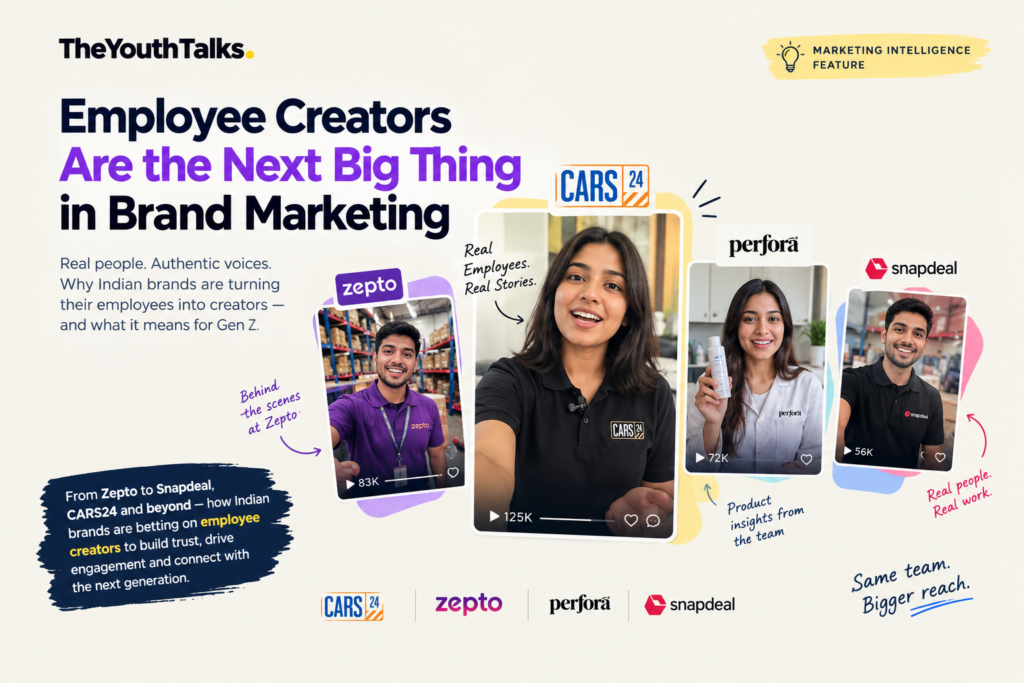
From Zepto employees sharing workplace and creative-process content to Snapdeal turning team members into content creators, Indian businesses are experimenting with a more personal approach to marketing. Meanwhile, CARS24 has taken a related route, putting its senior executives at the centre of campaigns designed to address one of the used-car market’s biggest challenges: consumer trust.
These developments point towards a broader shift in brand communication. Companies are looking beyond conventional endorsements to the people who understand their products, build their businesses and interact with customers.
Known as employee-generated content (EGC), the practice involves employees creating content about their work, products or organisations. It can include product demonstrations, behind-the-scenes videos, professional insights and everyday workplace experiences shared through personal social media accounts.
For marketers targeting Gen Z, the opportunity is worth examining. In a digital environment crowded with sponsored posts and polished campaigns, the people behind a brand may offer a different way to communicate expertise, personality and credibility.
The question is whether companies can turn this potential into a meaningful marketing strategy without making employee participation feel like another corporate obligation.
From Zepto to Snapdeal: Employees Enter the Creator Economy
India already offers examples of businesses exploring employee-led content.
A Mint report published in August 2025 identified Zepto, Zomato, Perfora and fitness startup Spectacom among companies using employees as in-house influencers.
At Zepto, employees have shared content about creative processes, workplace experiences and the business they help build. Such content offers audiences a perspective that differs from the brand’s official promotional material. Employees can explain how ideas develop, show the people behind campaigns and bring everyday organisational experiences into social media storytelling.
Perfora offers another example. The oral-care brand has used employee-created content to communicate product-development knowledge and oral-health information. This approach can connect product education with the people involved in creating the offering.
Snapdeal has gone a step further by incorporating employee creativity into its marketing playbook. In 2025, the value-focused e-commerce marketplace introduced an employee-performed rap video and subsequently involved team members in fashion shows and social media content for its Bharat Swagotsav Sale.
According to Financial Express, the initiative involved more than 60 employee-creators across functions including buying, category management, data analytics and customer service.
These examples suggest that employee participation need not be restricted to corporate announcements or recruitment campaigns. Employees can contribute to consumer-facing content, particularly when their knowledge, personalities or experiences make the subject more interesting.
For brands, this creates another potential source of ideas and voices alongside traditional influencers and advertising agencies.
Why CARS24 Is an Interesting, but Different, Example
The automotive sector offers a useful illustration of how putting identifiable people behind a brand can help communicate trust.
In February 2026, CARS24 introduced its “Family Promises” campaign, featuring India CEO Himanshu Ratnoo. The films promoted the company’s lifetime warranty and 30-day return policy for used-car buyers through humorous references to promises made to family members.
In September 2026, the company introduced “Vikram Ka Vaada”, a campaign featuring co-founder and CEO Vikram Chopra as King Vikram in a contemporary adaptation of the familiar Vikram-Betaal story. Betaal questions him about the concerns buyers and sellers may have when dealing in used cars, while Vikram responds with the company’s assurances and policies.
The creative approach is notable because the executive is not simply delivering a corporate speech. He becomes part of the story through which the company addresses customer doubts.
For a category where consumers may worry about vehicle condition, inspection quality and the consequences of making an expensive purchase, communicating concrete assurances is important. The campaigns place identifiable leadership figures alongside specific product promises.
However, these are professionally produced advertisements, not examples of employees independently creating content on their personal accounts. CARS24 therefore belongs in the wider discussion about people-led brand communication rather than being presented as proof of an employee-creator programme.
The distinction matters. Employee-generated content, executive-led advertising and founder branding can serve related objectives, but they operate differently.
CARS24 illustrates how a brand can make a promise more tangible by putting a leader on screen. Employee creators offer a potentially more distributed model, in which multiple people contribute their expertise and perspectives over time.
The Founder as the Face of the Brand
The move towards identifiable people in brand communication extends beyond employees and executive-led campaigns.
In India, founders such as boAt’s Aman Gupta and Lenskart’s Peyush Bansal have appeared in advertising, bringing their public personas into their companies’ marketing. Anupam Mittal has similarly combined his visibility as an entrepreneur and investor with Shaadi.com campaigns.
Their roles illustrate a wider trend: the founder can become a recognisable character within the brand’s story, rather than remaining behind the scenes.
There is a practical advantage to this approach. A founder may embody the company’s origin, philosophy or product expertise. Their presence can make a business feel more personal, particularly when the company operates in a category where consumers want reassurance about quality or reliability.
But founder-led marketing has limitations. It concentrates attention around one individual, and the brand’s reputation can become closely associated with that person’s public image.
Employee creators offer a different possibility. Instead of relying on one founder or a small group of executives, companies can draw on the diversity of their teams: product specialists, engineers, customer-support professionals, designers and people who understand how customers use the offering.
The result, if managed well, can be a wider range of stories rather than a single corporate personality.
Why This Could Matter for Gen Z Marketing
The appeal of employee creators rests on three potential advantages: expertise, relatability and access.
An employee may be able to explain a product in practical terms, demonstrate how it works or answer questions that a general-purpose influencer might not be equipped to address.
Consider an automotive platform such as CARS24. Product specialists could explain vehicle inspections, used-car buying considerations or the practical meaning of a return policy. At a technology company, employees could demonstrate software applications or explain how a product solves a real problem. At a beauty brand, team members involved in product development could help explain ingredients, formulation choices or usage.
These are potential applications, not claims that every named company currently runs such programmes.
For young consumers, the value lies in receiving useful information through a human voice. However, it would be premature to assume that Gen Z automatically trusts employees more than influencers. An employee is still associated with the company, and audiences may recognise that commercial relationship.
Authenticity therefore depends on the quality and transparency of the content, not merely the identity of the person appearing in it.
Employee-generated content also differs from employee advocacy. Advocacy typically involves employees sharing company news or official campaigns with their own networks. EGC places greater emphasis on employees creating the content themselves.
The distinction is important for marketers seeking to build a sustained creator programme rather than simply encouraging staff to repost corporate announcements.
The Economics and Risks of Employee Creators
Employee-generated content may provide brands with an additional source of creative output, but it should not be mistaken for free content.
Training, equipment, editing, management time, approvals and compensation can all involve costs. Employees also have responsibilities beyond social media production, and participation should remain voluntary.
Companies need clear policies covering confidential information, customer privacy, intellectual property, product claims and the use of employee content in paid campaigns. They should also explain whether content can be reused in advertising and when additional consent or compensation is required.
Disclosure is equally important. The Advertising Standards Council of India’s influencer guidance recognises employment relationships as a material connection that may need to be disclosed in relevant commercial communications.
Brands should not present employees as independent reviewers when they are communicating on their employer’s behalf. Transparency protects both the audience and the employee’s credibility.
Measurement presents another challenge. Views and engagement alone cannot establish whether employee-generated content is more effective than a conventional advertisement or a paid influencer partnership.
Marketers should compare formats using appropriate measures, including audience retention, qualified engagement, customer enquiries, brand recall and conversions where measurable. Recruitment outcomes may be relevant when the objective is employer branding rather than consumer marketing.
The objective is not to replace external creators, but to determine where employee voices add distinctive value.
What Marketers Should Do Next
Indian brands can begin by identifying employees who already enjoy explaining products, sharing professional knowledge or creating content. Participation should be voluntary, supported by basic training and guided by clear boundaries.
The next step is to identify subjects where employees can contribute something genuinely useful. Product demonstrations, practical advice, behind-the-scenes development and answers to customer questions may be more effective than asking every participant to imitate popular influencers.
Brands can then test a small number of formats, compare results against existing campaigns and expand only where there is evidence of value.
CARS24 demonstrates one way to put leadership behind a concrete customer promise. Snapdeal illustrates how employees can contribute directly to campaign creative, while Zepto and Perfora provide examples of companies exploring employee-led storytelling and product communication.
Together, these approaches suggest that brands have more potential storytellers than they may have traditionally recognised.
The next phase of creator marketing may not be defined exclusively by the influencers a company hires. It could also be shaped by the employees who understand its products, the executives who stand behind its promises and the people who can explain what makes the business relevant to customers.
For marketers, the opportunity is not to turn every employee into an influencer. It is to recognise when the people behind a brand have something valuable to say — and give them the freedom, support and credibility to say it well.