






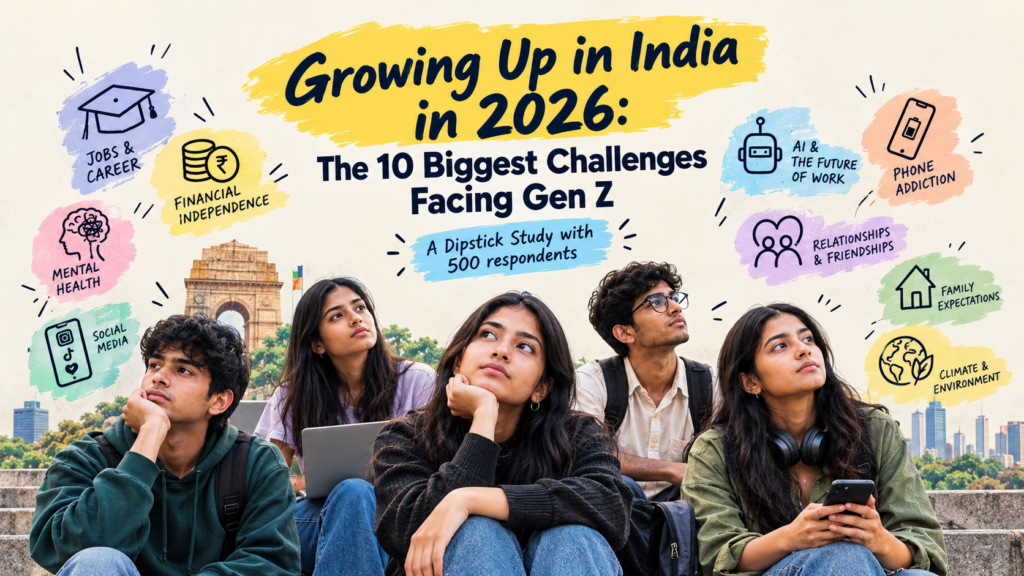
From finding a good job and achieving financial independence to navigating AI, social media and family expectations, young Indians are coming of age in a world full of possibilities — and considerable uncertainty.
There is a familiar criticism levelled at Gen Z: that young people today struggle to deal with pressure, expect too much from life and find adulthood more difficult than previous generations did.
But what if the conversation is looking at the problem from the wrong end?

For a young Indian entering college, preparing for competitive examinations or looking for a first job, growing up can involve navigating several competing expectations at once. They are encouraged to pursue ambitious careers, become financially independent, develop marketable skills, maintain a social life and prepare for a future that is changing rapidly.
At the same time, they are growing up in an environment where professional opportunities can feel fiercely competitive, digital platforms make other people’s lives constantly visible, and artificial intelligence is beginning to change how people learn and work.

The result is a generation with access to more information, career resources and digital opportunities than many of its predecessors, but one that must also figure out how to make sense of them.
So, what are the biggest challenges facing India’s Gen Z in 2026?

There is no single answer. A student preparing for an engineering entrance examination, a graduate searching for a first job and a 25-year-old professional trying to move out of their family home may experience adulthood very differently.
However, ten areas deserve closer attention. They offer a starting point for understanding the pressures young Indians may be navigating as they make the transition from adolescence to adulthood.
1. The fear of not getting a good job
For many young Indians, the pressure to build a successful career begins well before they enter the workforce.
Students spend years preparing for examinations, pursuing degrees, completing internships and acquiring additional certifications. Increasingly, they are also expected to demonstrate practical skills, communicate effectively and understand the technologies relevant to their chosen professions.
Yet completing these milestones does not necessarily guarantee the career they imagined.
The International Labour Organization’s India Employment Report 2024, prepared with the Institute for Human Development, examined the challenges facing young people entering India’s labour market. The report highlighted the importance of education, skills and the transition from education into employment.
For Gen Z, the concern is not simply whether a job will be available. It is whether that job will offer reasonable compensation, opportunities to learn, professional growth and some degree of security.
The distinction matters. A young graduate may find employment but still struggle to find work that matches their qualifications or expectations.
There is also a growing question about the value of educational credentials. If employers increasingly look for practical experience, demonstrable skills and the ability to solve problems, how should students decide which courses, internships and certifications are worth pursuing?
The anxiety around employment, therefore, may begin years before a young person sends their first application.
2. Becoming financially independent is harder than it sounds
Financial independence is often presented as a milestone that follows naturally from getting a job. In practice, the transition can be considerably more complicated.
A first salary brings new possibilities: spending without asking parents for money, buying a phone, travelling with friends, investing, contributing to household expenses or eventually moving into a place of one’s own.
But income also brings new calculations.
How much should a young professional save? Is renting in a major city affordable? How much money should be set aside for emergencies? Is it possible to support one’s family while also building personal financial security?
For young people living away from home, rent, commuting, food and other everyday expenses can consume a substantial share of their earnings. Those living with their families may have fewer immediate expenses but can still face expectations around contributing financially or preparing for future responsibilities.
Social media can add another dimension. Travel, restaurants, gadgets and aspirational lifestyles are constantly displayed online, making it easier to compare one’s financial circumstances with those of peers.
The danger is not that Gen Z necessarily wants to spend more. It is that young people may find themselves trying to reconcile long-term financial goals with the desire to participate in the lifestyles they see around them.
The important question is whether young Indians feel equipped to manage this transition — and whether financial independence feels achievable on their current trajectory.
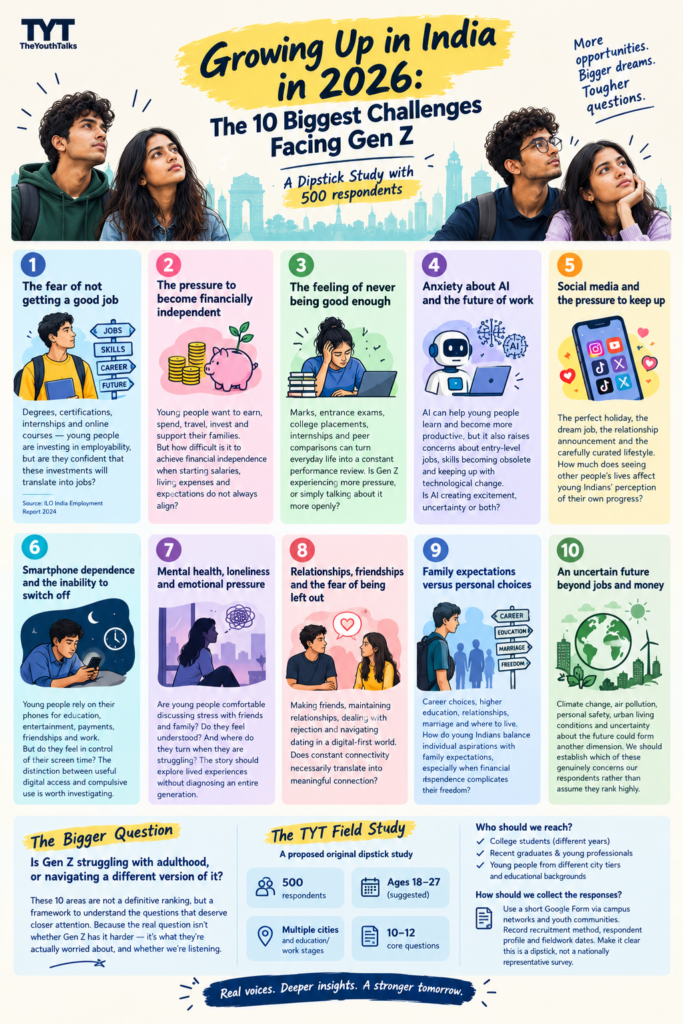
3. The feeling of never being good enough
For students, the pressure may begin with examination results. For graduates, it can shift to college placements, internships and postgraduate admissions. For young professionals, the benchmarks may become salary, promotions, professional networks and the speed of career progression.
The measures change, but the feeling of being evaluated can remain.
Young people are frequently encouraged to improve themselves. Learn another skill. Build a portfolio. Develop a personal brand. Network with industry professionals. Learn to use AI. Start a side project. Make the most of every opportunity.
Individually, these are reasonable suggestions. Collectively, however, they can create the impression that there is always something else a young person should be doing.
The problem becomes more complicated when progress is measured against peers. A friend secures a coveted internship. A former classmate joins a well-known company. Someone from college announces admission to a prestigious university.
Even when these achievements are genuine reasons for celebration, they can prompt uncomfortable questions about one’s own progress.
Am I falling behind? Have I chosen the wrong course? Should I be earning more by now? Have I wasted time?
Not every young person experiences this pressure in the same way. But the expectation to continuously improve is worth examining, particularly in an environment where professional and personal milestones are so visible.
Perhaps the challenge is not ambition itself. It is learning how to pursue ambition without treating every unachieved milestone as evidence of personal failure.
4. Artificial intelligence is opening doors — but changing the rules
Few technologies have entered conversations about education and careers as quickly as generative AI.
Young Indians can use AI tools to learn unfamiliar subjects, write and debug code, prepare for interviews, analyse information and experiment with ideas that once required greater resources or specialist knowledge.
For students and early-career professionals, these capabilities can be valuable. Someone who learns to use the tools effectively may be able to work faster, explore more possibilities and develop skills independently.
But AI also raises difficult questions.
Will some entry-level responsibilities be automated? Will employers expect graduates to be productive from their first day because AI tools are available? Which skills will remain valuable as the technology improves? How should students prepare for jobs whose responsibilities may change before they enter the workforce?
These questions are particularly important for young people because entry-level work has traditionally been one way of acquiring professional experience. If the nature of that work changes, the pathways through which young employees learn and progress may change too.
There is a risk of framing AI purely as a threat or purely as an opportunity. Neither perspective captures the complexity of the transition.
For Gen Z, the challenge may be learning to work with AI while developing the judgement, communication, creativity and problem-solving abilities that technology alone cannot guarantee.
The uncertainty is not just about whether AI will take jobs. It is about understanding what employers will value next — and how to prepare without constantly feeling behind.
5. Social media makes comparison difficult to escape
Social media has become an important part of how young people discover information, follow creators, maintain friendships and participate in culture.
It also makes other people’s lives unusually visible.
A young person scrolling through Instagram may encounter a former classmate travelling abroad, a creator discussing a successful business, a peer celebrating a new job and another person sharing a seemingly perfect relationship.
Each post represents a small part of somebody else’s life. Viewed together, however, they can create an impression that everyone is moving forward, achieving more and enjoying themselves more fully.
The comparison can be especially uncomfortable when a young person’s own life feels uncertain or uneventful.
There is another complication: the same platforms that can intensify comparison also provide entertainment, community, creative opportunities and access to people who share similar interests.
It would therefore be simplistic to conclude that social media is inherently harmful or that young people should simply stop using it.
The more useful question is how they experience it.
Do they find themselves comparing their appearance, income, relationships or achievements with what they see online? Can they distinguish between a curated public image and everyday reality? Does social media leave them feeling connected, inadequate, inspired or some combination of all three?
The answers may reveal more than screen-time statistics alone.
6. Being constantly connected can make switching off difficult
For today’s young adults, a smartphone is rarely just a device for making calls.
It is a classroom, entertainment centre, payment instrument, navigation system, news source, workplace tool and gateway to friendships.
That dependence makes the idea of simply putting the phone away more complicated than it sounds.
A student may need a phone to access course material and communicate with classmates. A young professional may receive work messages outside office hours. Friends coordinate plans through messaging applications, while important updates arrive through digital platforms.
The problem is that the same device also offers an almost endless supply of videos, messages, notifications and other distractions.
A person may pick up a phone to answer one message and find themselves scrolling much longer than intended. Time that was meant for sleep, studying or relaxation can disappear into repeated checking.
However, it is important to distinguish between frequent phone use and genuinely unwanted behaviour. A young person who spends several hours studying or working on a smartphone is not necessarily experiencing the same problem as someone who repeatedly uses it despite wanting to stop.
For TYT, an important question would be whether young Indians feel in control of their digital habits.
Do they believe they spend more time on their phones than they would like? Does their phone use interfere with sleep, concentration or time with other people? Have they tried to change their habits?
The issue is not whether Gen Z uses smartphones. It is whether young people feel they are deciding how to spend their attention.
7. Mental health, loneliness and the difficulty of asking for help
The transition into adulthood can involve uncertainty about education, employment, relationships, money and personal identity.
Managing several of these pressures simultaneously can be difficult, particularly when a young person feels they must appear confident and capable.
Not every struggle is a mental health condition, and it would be misleading to treat an entire generation as emotionally unwell. Nevertheless, understanding how young people experience stress, where they seek support and whether they feel comfortable discussing their difficulties deserves serious attention.
A young person may have hundreds of online contacts but only a handful of people they feel comfortable approaching during a difficult period.
Another may have supportive friends but hesitate to discuss problems with family because they do not want to cause worry. Someone else may want professional support but be unsure where to find it or whether they can afford it.
There can also be pressure to keep functioning regardless of how one feels. Students are expected to meet deadlines, professionals to perform at work and young adults to make decisions about their futures.
The important questions are therefore practical as well as emotional.
Do young Indians feel understood? Do they have someone they can talk to? Are they comfortable asking for help? What prevents them from doing so?
The answers could help distinguish between the pressures young people encounter and the support systems available to them.
8. Relationships and friendships are changing, too
Making friends, navigating romantic relationships and finding a sense of belonging have always been part of growing up.
What may be different today is the extent to which these experiences overlap with digital communication.
Friendships can be maintained across cities through messaging applications and social platforms. People can discover communities beyond their immediate surroundings. Dating platforms can introduce young adults to people they might never otherwise meet.
Yet constant communication does not automatically create emotional closeness.
Messages can be misunderstood. Online interactions can make rejection feel immediate. Social plans can become another source of comparison when young people see groups of friends spending time together without them.
Dating can introduce its own uncertainties around expectations, commitment and communication. Meanwhile, young adults may be trying to understand what they want from relationships while balancing education, careers and family expectations.
It would be a mistake to assume that digital relationships are less meaningful than offline ones. For many people, online communities are important sources of friendship and support.
The more interesting question is whether young people feel connected to others in ways that meet their emotional needs.
Do they find it easy to make new friends? Do they have people they can rely on? Do digital platforms help relationships flourish, or sometimes make them more difficult to navigate?
These are questions worth asking rather than answering on behalf of an entire generation.
9. Personal choices do not always align with family expectations
In India, decisions about education, careers, relationships and where to live are often made within a family context.
Family support can be a significant advantage. Parents may finance higher education, provide accommodation, offer career guidance and help young adults navigate uncertainty.
At the same time, family involvement can complicate decisions when individual ambitions differ from parental expectations.
A student may want to pursue a creative career while their family prefers a conventional profession. A young graduate may want to move to another city but feel uncomfortable leaving their parents. Someone may want to delay marriage, choose a partner independently or take a career risk that their family considers impractical.
Financial dependence can make these decisions harder. A young person who relies on their parents for tuition, accommodation or everyday expenses may have less freedom to act on personal preferences.
This is not necessarily a conflict between a traditional generation and a modern one. Families may disagree because they have different experiences of financial security, professional risk and what constitutes a successful life.
Many young adults also value their families’ opinions and actively seek their guidance.
The challenge is finding a balance between personal agency and family responsibility.
Understanding how Gen Z negotiates that balance could reveal a distinctly Indian dimension of growing up that a US-focused account of generational problems might not capture.
10. Uncertainty about the world young people will inherit
For young Indians, the future is shaped by more than careers and personal finances.
Air pollution, extreme heat, climate change, urban infrastructure, public safety and the cost of living can all influence everyday decisions and long-term expectations.
The importance of these issues will vary considerably by location and circumstance. A student in a city struggling with poor air quality may experience environmental concerns differently from someone living elsewhere. Personal safety may shape how a young woman plans her commute, social life or working hours.
These experiences should not be collapsed into one universal Gen Z concern. They are distinct issues that deserve attention in their own right.
Nevertheless, they raise a broader question: how confident do young people feel about the conditions in which they will build their adult lives?
Optimism about personal opportunity can coexist with uncertainty about the wider environment. A young person may believe they can build a successful career while worrying about the quality of life available in the city where they hope to live.
Understanding those concerns requires looking beyond individual choices to the social and economic conditions in which those choices are made.
The bigger question: Is Gen Z struggling with adulthood, or navigating a different version of it?
The ten areas explored here are not a definitive ranking of India’s biggest Gen Z problems. They are a framework for understanding the questions that deserve closer examination.
Some young Indians may be most concerned about employment. Others may be focused on financial independence, examinations, relationships or the expectations placed on them by their families.
For many, these issues will overlap. A difficult job search can affect financial independence. Financial insecurity can delay decisions about moving out or getting married. Social comparison can intensify worries about professional progress. Uncertainty about AI can influence decisions about education and skills.
That interconnectedness matters because it is rarely possible to understand a young person’s experience through one issue alone.
It also cautions against dismissing generational concerns as a lack of resilience. Young people have always faced difficult transitions, but the institutions, technologies and economic conditions surrounding those transitions change over time.
The question is not whether adulthood was easier for one generation than another. It is what young people today are navigating, how those pressures affect their decisions and what support might help.
Listening to young Indians, rather than speaking for them
At TheYouthTalks, these questions offer an opportunity to go beyond generalisations about Gen Z.
A structured dipstick study of young Indians could help establish which concerns respondents themselves prioritise, how their experiences differ by age and employment status, and what they believe older generations misunderstand about their lives.
Such research would not, by itself, establish the experience of every young Indian. Its value would depend on who participates, how questions are framed and how transparently the findings are presented.
But it could provide a useful starting point for a more grounded conversation.
Because before we decide that Gen Z is too anxious, too dependent on its phones or too impatient with the realities of adult life, there is a more important question to ask:
What, exactly, are young Indians worried about — and have we taken the time to listen?
About the study
Growing Up in India, 2026 is an original dipstick study by TheYouthTalks involving 500 respondents aged 18–27 across multiple cities and different stages of education and work. The study explored young people’s experiences, concerns and perspectives through 10–12 core questions.
The findings reflect the responses of the participants surveyed. They offer an exploratory snapshot of the experiences and viewpoints of these young Indians and should not be interpreted as nationally representative estimates of India’s entire 18–27 population.