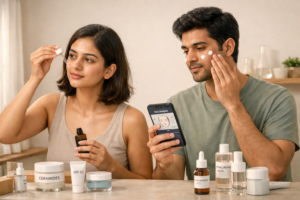

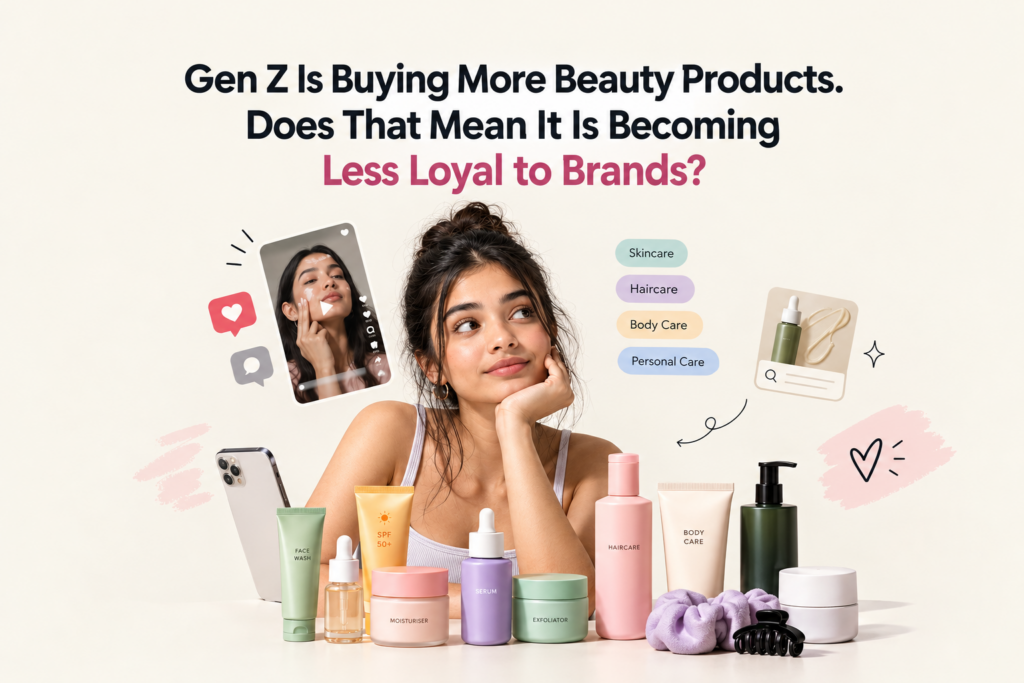
India’s young consumers are expanding their skincare, haircare and personal care routines. For beauty brands, the opportunity is growing — but so is the challenge of turning product trials into repeat purchases.
A few years ago, a basic skincare routine for many young consumers might have meant a face wash, a moisturiser and perhaps a sunscreen. Today, the conversation around beauty can involve serums, exfoliants, specialised haircare, body care and products designed for increasingly specific concerns.
The change is not simply about buying more products. It is about how young consumers think about beauty itself.
Social media has made skincare routines, ingredient discussions, product comparisons and beauty recommendations more visible. A consumer can discover a new product through a creator, learn about its intended benefits, compare it with alternatives and decide whether it deserves a place in their routine.
But that creates an interesting challenge for beauty companies. As consumers become more engaged with the category, do they also become more committed to the brands they buy?
Not necessarily.
India’s Gen Z beauty consumer may be willing to spend on skincare and personal care while remaining open to experimentation. The category can become a regular part of their lives even as individual brands compete repeatedly for attention, trust and the next purchase.
For the beauty industry, that distinction could shape how companies approach product development, marketing and customer retention.
A bigger beauty market, a more involved consumer
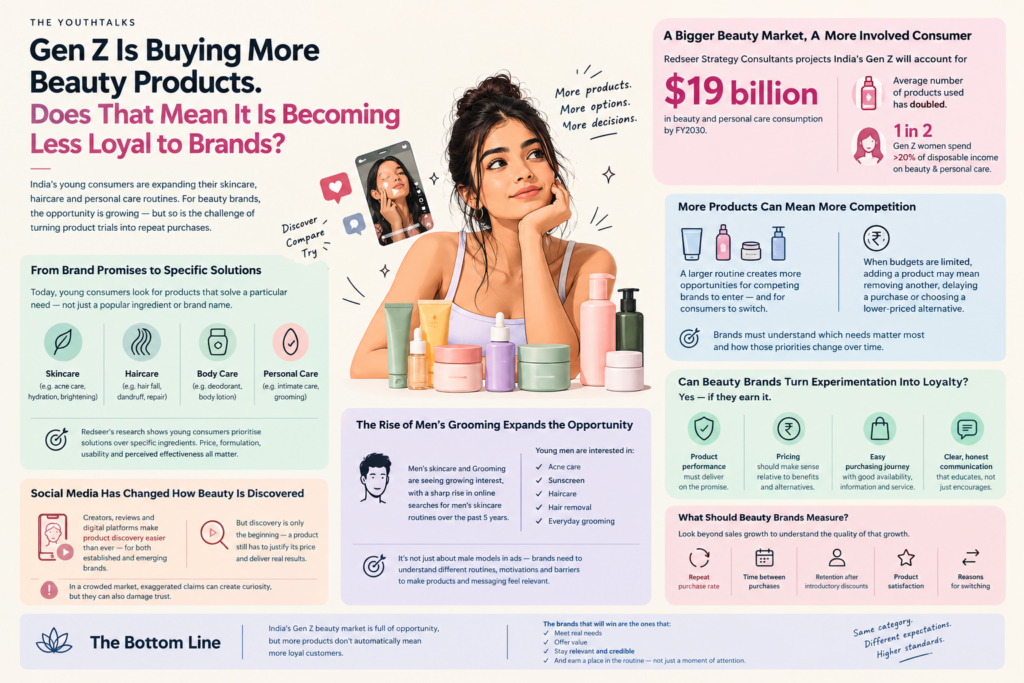
Redseer Strategy Consultants’ report, The Indian Consumer at 2030: Redefining Aspirations, Choices, and Markets, developed with Fireside Ventures, projects that India’s Gen Z consumers will account for nearly $19 billion in beauty and personal care consumption by FY2030.
The report also highlights the growing complexity of young consumers’ routines. It describes a shift towards more products across skincare, haircare and body care, alongside increasing experimentation with solutions suited to individual needs.
One finding cited in the research is that the average number of products used by this demographic has doubled.
The report also states that one in two Gen Z women allocates more than 20% of disposable income to beauty and personal care.
These findings point to a substantial opportunity for beauty companies. Consumers who pay greater attention to personal care may explore more categories, use products more regularly and become interested in solutions for specific concerns.
Yet the growth of a routine should not be confused with loyalty to any one brand.
A consumer can use more skincare products without buying all of them from the same company. They can remain interested in haircare while switching shampoos. They can continue purchasing sunscreen while comparing formulations, prices and textures.
The category expands, but the competition for each purchase remains intense.
From brand promises to specific solutions
One of the more interesting changes in beauty consumption is the emphasis on what a product is supposed to do.
Consumers may look for a moisturiser that suits their skin, a shampoo designed for a particular hair concern or a sunscreen that fits comfortably into their daily routine.
The decision increasingly involves evaluating whether the product addresses a particular need.
Redseer’s analysis describes young consumers as prioritising solutions over specific ingredients. The implication is that brand preference may depend heavily on whether a product delivers the expected result.
This does not mean ingredients or brand reputation have become irrelevant. Rather, they form part of a wider evaluation that can include price, formulation, usability and perceived effectiveness.
For a beauty company, this changes the task of communicating value.
A product name, attractive package or popular ingredient may help attract attention. But the brand must also explain why the product is appropriate for the consumer and what realistic benefits it offers.
The more specific the need, the more closely consumers may compare competing solutions.
A consumer looking for an everyday sunscreen, for example, may consider price, texture, ease of application and how the product fits into their routine. If another product appears to offer a better combination, switching may seem entirely reasonable.
The brand has to earn the purchase rather than assume that familiarity will secure it.
Social media has changed how beauty is discovered
Beauty has always been influenced by advertising, personal recommendations and cultural ideas about appearance. Digital platforms have added new layers to that process.
Young consumers can encounter product demonstrations, creator reviews, skincare routines and discussions about particular concerns without actively searching for them.
This creates a discovery environment in which established brands and emerging companies can compete for attention.
A smaller company may reach a consumer who has never heard of it. An established brand may find that its familiar reputation is no longer sufficient to prevent customers from considering alternatives.
But discovery is only the beginning.
A product that appears compelling in a short video still has to justify its price and deliver an experience that meets expectations. The distance between a persuasive demonstration and a satisfactory real-world result can determine whether a consumer buys again.
Beauty marketing therefore operates on two levels: winning attention and building confidence.
Creators can help consumers discover products and understand their intended uses. Brands can use educational content to clarify routines and explain product differences. But communication needs to remain credible, particularly when claims relate to skin concerns, hair health or other personal care outcomes.
In a crowded market, exaggerated promises may generate curiosity, but they can also undermine trust.
The rise of men’s grooming expands the opportunity
The Gen Z beauty story is also becoming broader in terms of who participates in the category.
Redseer’s report highlights increasing interest in men’s skincare and grooming, alongside changing attitudes towards personal appearance. It cites a sharp rise in online searches for men’s skincare routines over the preceding five years.
This suggests that beauty and personal care should not automatically be treated as categories intended primarily for women.
Young men may be interested in acne care, sunscreen, hair removal, haircare and products that help them maintain their appearance. Their needs can create opportunities for companies willing to communicate in ways that feel relevant rather than relying on outdated assumptions about who uses personal care products.
For brands, this is not simply a matter of placing male models in advertising. It requires understanding different routines, motivations and barriers to purchase.
Some consumers may want a simple, practical routine. Others may enjoy experimenting with products. Still others may enter the category through a specific concern and gradually expand their usage.
The challenge is to make products and information accessible without assuming that every consumer wants the same experience.
At the same time, greater participation should not be interpreted as evidence that traditional beauty standards have disappeared. Consumers can embrace new products while still experiencing pressure around appearance.
A credible beauty brand needs to understand that distinction.
More products can mean more competition
A consumer who uses five beauty products creates more potential purchase occasions than someone who uses two. But those additional purchases do not automatically translate into stronger relationships with individual companies.
In fact, a larger routine can create more opportunities for competing brands to enter.
A consumer might buy cleanser from one company, sunscreen from another and haircare from a third. They may choose a serum based on a recommendation and later replace it with a product that seems more suitable.
This creates a complex commercial environment.
Beauty brands are not only competing against direct alternatives. They are also competing for space in routines that may already contain several products, each serving a different purpose.
The challenge becomes particularly significant when consumers have limited budgets. Adding a product may require removing another, delaying a purchase or choosing a lower-priced alternative.
Companies therefore need to understand not just how many products consumers use, but which needs matter most and how those priorities change over time.
The most effective strategy may not be to persuade consumers to buy an ever-growing number of products. It may be to become particularly useful within a routine they already value.
Can beauty brands turn experimentation into loyalty?
Experimentation is not necessarily the enemy of loyalty.
Consumers may try several brands before finding a product they genuinely like. Once they discover something that performs consistently, fits their budget and is easy to repurchase, they may continue using it.
The opportunity for brands is to make that experience dependable.
First, product performance must support the promise made in marketing. Consumers need a credible reason to believe that the product is worth buying again.
Second, pricing should make sense relative to the product’s benefits and the alternatives available. Premium positioning can work, but the consumer needs to understand what justifies the additional cost.
Third, brands should make the purchasing journey straightforward. Product availability, clear information and reliable service can influence whether consumers repurchase or try something else.
Finally, communication should help consumers make informed choices. Educational content can be valuable when it explains product use, limitations and suitability rather than simply encouraging people to purchase more.
These principles are especially important in beauty, where individual needs vary and products that work well for one person may not suit another.
Brands cannot guarantee loyalty. They can, however, give consumers compelling reasons to stay.
What should beauty brands measure?
If product usage is expanding, beauty companies need to look beyond sales growth to understand the quality of that growth.
An increase in first-time purchases may indicate successful discovery, but it does not establish whether consumers are satisfied. Growth in the number of products used may indicate deeper engagement with the category, but it does not reveal which brands are retaining customers.
Useful measures include repeat-purchase rates, the time between purchases, customer retention after introductory discounts, product satisfaction and the reasons consumers give for switching.
Companies should also examine differences between categories and consumer groups. A sunscreen, a shampoo and a specialised serum have different usage patterns and purchase cycles.
The aim is to understand what brings consumers back, not to assume that all repeat purchases reflect the same kind of loyalty.
This can also help companies distinguish between customers who switch because of price and those who switch because a product does not meet their expectations. Each requires a different response.
The future belongs to brands that earn their place in the routine
India’s Gen Z beauty market presents a substantial opportunity, supported by changing personal care habits and a wider range of products available to consumers.
But the opportunity should not be reduced to the assumption that more products automatically mean more loyal customers.
A consumer can become more interested in skincare while remaining open to new brands. They can invest in grooming without developing an attachment to a particular company. They can build a detailed routine while treating each purchase as a fresh decision.
For beauty businesses, the objective is not simply to become part of that routine once. It is to remain useful, relevant and credible enough to stay there.
That requires more than visibility or an appealing launch. It requires products that meet expectations, prices that make sense and communication that respects consumers’ ability to compare alternatives.
The next phase of India’s beauty market may be defined by how much young consumers are willing to spend. But for individual brands, a more immediate question will matter just as much: when the consumer is ready to buy again, why should they choose you?