





For generations of Indian families, the path to a “good life” has been remarkably clear.
Study hard. Get into a good college. Earn a degree. Get a stable job. Build a career.
For many students, that journey still makes perfect sense.

But something is changing.
Ask a Gen Z student in India what they want from college today, and the answer may not simply be a famous name on their résumé.

They are increasingly asking tougher questions.
How much will this degree cost? What job will it actually get me? What skills will I have when I graduate? Could I learn this somewhere else? And do I really need to spend three or four years following a traditional path to get where I want to go?

These questions don’t mean Indian Gen Z is suddenly anti-college.
Far from it.
Education remains one of the country’s most powerful routes to mobility. For millions of young Indians, a degree can still mean access to better jobs, greater independence and opportunities their parents may never have had.
But Gen Z is growing up in a very different India from previous generations.
They have access to global courses from their bedrooms. They can learn coding from YouTube, build portfolios on the internet, earn professional certifications, freelance while studying, use AI as a learning tool and apply for jobs in companies they may never physically visit.
The college degree is still important.
But it is no longer the only thing in the room.
India’s Degree Race Is Getting More Complicated
India has never been short of academic ambition.
Every year, millions of students compete for places in some of the country’s most prestigious institutions. IITs, IIMs, AIIMS and leading universities carry enormous cultural weight.
And there is a reason for that.
A recognised institution can open doors. It can provide networks, mentors, internships, campus recruitment and credibility in a competitive job market.
But the obsession with getting into the “best” college can sometimes make the conversation about higher education unnecessarily narrow.
A student may spend years preparing for an entrance exam without asking a more basic question:
What kind of work do I actually want to do?
Someone who wants to become a doctor needs a very different educational pathway from someone who wants to work in digital marketing.
A future engineer needs a different foundation from a future animator.
A student interested in cybersecurity may need a combination of formal education, certifications and practical projects.
A budding entrepreneur may benefit from business education—but could learn just as much from actually building something.
The point isn’t that degrees don’t matter.
It’s that the value of a degree increasingly depends on what it enables you to do.
Gen Z Is Growing Up With a Different Definition of Success
For previous generations, education was often about acquiring credentials.
For today’s young Indians, it is increasingly about acquiring options.
They want to know whether a course can lead to a job, whether a skill can create income, whether an internship can provide experience and whether a qualification will still matter five years from now.
This is partly economic.
Indian families make significant investments in education, and students are increasingly aware that those investments have consequences.
But it is also cultural.
Gen Z has grown up watching people create careers outside traditional pathways.
The internet has made it possible to discover careers that didn’t exist—or weren’t widely visible—to previous generations.
Content creators, UX designers, product managers, data analysts, esports professionals, AI specialists, community managers, independent consultants and digital entrepreneurs are now part of the career conversation.
Not every new-age career is stable, and social media often makes unconventional success look easier than it really is.
Still, the psychological shift is significant.
Young Indians are seeing more than one definition of a successful career.
The Three-Year Degree Isn’t the End of Learning
There is another important change taking place.
Education is becoming less linear.
The old model was simple:
School → College → Degree → Job
The emerging model could look very different:
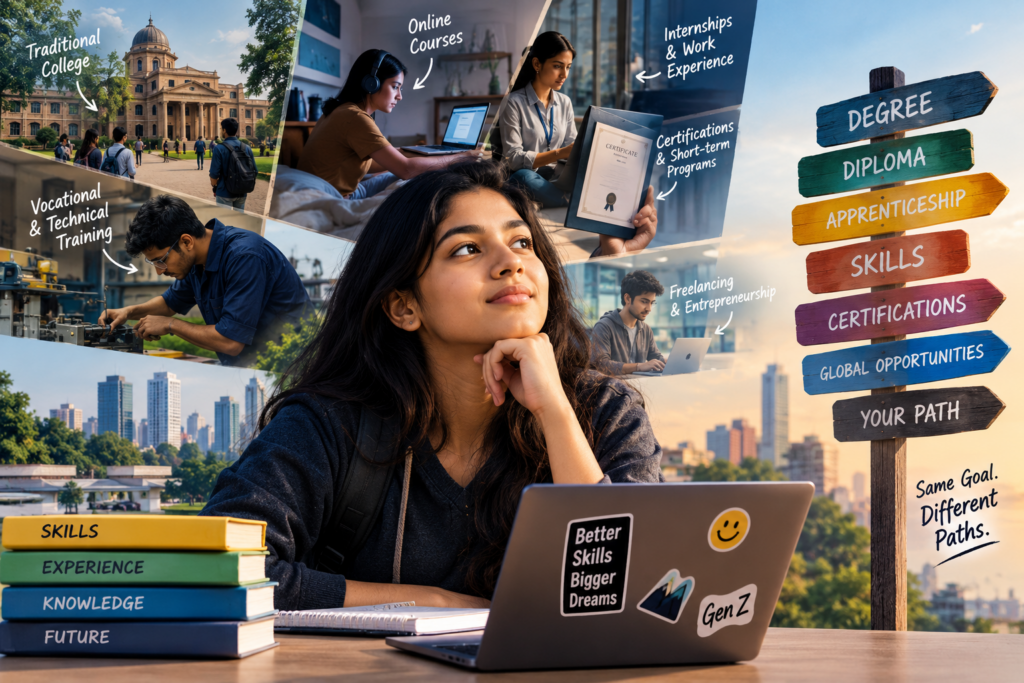
School → College → Internship → Certification → Job → Upskilling → New qualification
Or:
College → Online course → Portfolio → Freelance work → Full-time job
Or even:
Diploma → Apprenticeship → Employment → Degree later
For young Indians, this flexibility could become increasingly important.
A student doesn’t necessarily have to know at 18 exactly what they want to do at 28.
They may discover an interest in data analytics during college. They may move towards product design after an internship. They may realise they prefer entrepreneurship to a corporate career.
A flexible education system should allow those changes without making students feel that one wrong decision at 18 has permanently determined their future.
What Can India Learn From Community Colleges?
This is where the American community college model offers an interesting lesson—not necessarily because India should copy it, but because it challenges the assumption that higher education must follow one prestigious template.
Community colleges in the United States can offer relatively affordable programmes, career-oriented education and pathways into four-year universities.
For some students, they provide a lower-cost way to begin higher education before transferring to a university.
The broader lesson is more relevant to India:
There should be more respected pathways into higher education and employment.
India already has institutions and routes that serve some of these purposes, including polytechnics, Industrial Training Institutes, skill-development programmes, diploma courses and vocational education.
But social perception matters.
A degree from a traditional college is often treated as inherently more respectable than a technical or vocational qualification—even when the latter may provide a clearer route into a particular career.
That hierarchy needs to be questioned.
A country as large and diverse as India cannot afford to define “success” through a single educational template.
Not Everyone Needs the Same Kind of College
Imagine two 18-year-olds.
The first wants to become a doctor. For them, a highly structured academic pathway is essential.
The second wants to become a professional designer. They may still benefit enormously from college, but their portfolio, software skills, internships and ability to solve real design problems could be just as important.
Now consider a third student who wants to become an electrician, automotive technician or specialised healthcare professional.
A hands-on technical programme may make more sense than pursuing a conventional degree simply because society considers it more prestigious.
This is the part of the conversation India needs to have more openly.
Different careers require different forms of education.
Treating every student as though they should follow the same route is convenient for the system—but not necessarily for the student.
AI Is Making the Question Even More Urgent
Then there is artificial intelligence.
For Indian Gen Z, AI is arriving at almost exactly the moment they are entering higher education and the workforce.
That creates both anxiety and opportunity.
AI can already assist with coding, writing, research, design, analysis and administrative work. Some entry-level tasks that once helped graduates gain experience may increasingly be automated or transformed.
That means students need more than a certificate.
They need the ability to use what they know.
A computer science graduate who understands AI tools, can build projects and solve problems may have a very different profile from someone who simply completed the required coursework.
A marketing graduate who understands analytics, consumer behaviour, content strategy and AI-assisted workflows may stand out differently from someone whose education ends with a textbook.
The question universities and students need to confront is therefore not:
“Will AI replace degrees?”
It is:
“What should a degree teach when AI can already provide some of the answers?”
That is a much harder—and more useful—question.
But Let’s Not Pretend College Doesn’t Matter
There is a danger in taking the “skills over degrees” argument too far.
Not every online course is valuable.
Not every certification is recognised by employers.
Not every bootcamp leads to a job.
And not everyone can teach themselves everything they need to know.
Universities provide things that the internet cannot easily replicate: structured learning, academic depth, laboratories, research opportunities, peer communities, mentors and networks.
For many careers, formal qualifications remain essential.
And for many students, college is also a period of personal growth.
You meet people outside your existing social circle. You learn to live independently. You discover interests you didn’t know you had.
Those experiences matter.
The goal shouldn’t be to convince every Indian student to skip college.
It should be to make sure every student understands why they are choosing it.
The Prestige Trap
Perhaps the most difficult conversation is about prestige.
Indian students are often told to aim as high as possible.
There is nothing wrong with ambition.
But ambition can become a trap when students choose institutions, courses or careers primarily because of their social status.
A degree should not be considered successful simply because the college has a famous name.
The more useful questions are:
- What will I learn?
- What will it cost?
- What opportunities will it create?
- What skills will I graduate with?
- What does the employment market look like?
- Can I build experience while studying?
- Will this qualification help me adapt if the job market changes?
These aren’t cynical questions.
They are practical ones.
And practicality may be one of Gen Z’s defining characteristics.
India Doesn’t Need Fewer Ambitious Students. It Needs More Pathways.
India’s demographic scale makes this especially important.
There isn’t one “right” educational route that can serve hundreds of millions of young people.
Some students will thrive at research universities.
Others will thrive in professional colleges.
Some will prefer vocational training.
Some will learn through apprenticeships.
Some will build careers through a combination of degrees, certifications, internships and work experience.
And many will move between these pathways throughout their lives.
That shouldn’t be seen as failure.
It should be seen as flexibility.
The future of education may not be about deciding between college and no college.
It may be about creating an ecosystem where a student can move between different forms of learning without being permanently labelled by the first choice they make.
The Real Question Isn’t “Do I Need a Degree?”
For Indian Gen Z, that may ultimately be the wrong question.
The better question is:
“What combination of education, skills and experience will help me build the life I want?”
Sometimes the answer will be a four-year university degree.
Sometimes it will be a three-year undergraduate programme followed by professional qualifications.
Sometimes it will be a diploma, apprenticeship or technical programme.
Sometimes it will be a degree plus online learning and internships.
And sometimes the smartest decision may simply be choosing a different college—not because it is more prestigious, but because it is a better fit.
The traditional college system isn’t disappearing.
But the monopoly it once had over the definition of a successful education is beginning to loosen.
And perhaps that is a good thing.
Because India’s young people don’t all need the same future.
They need more ways to build one.
For Gen Z, the future of education may not be about collecting the most impressive degree.
It may be about building the most useful combination of knowledge, skills, experience and adaptability.
The question isn’t whether college is worth it.
The question is whether the college—and the path leading to it—is worth it for you.