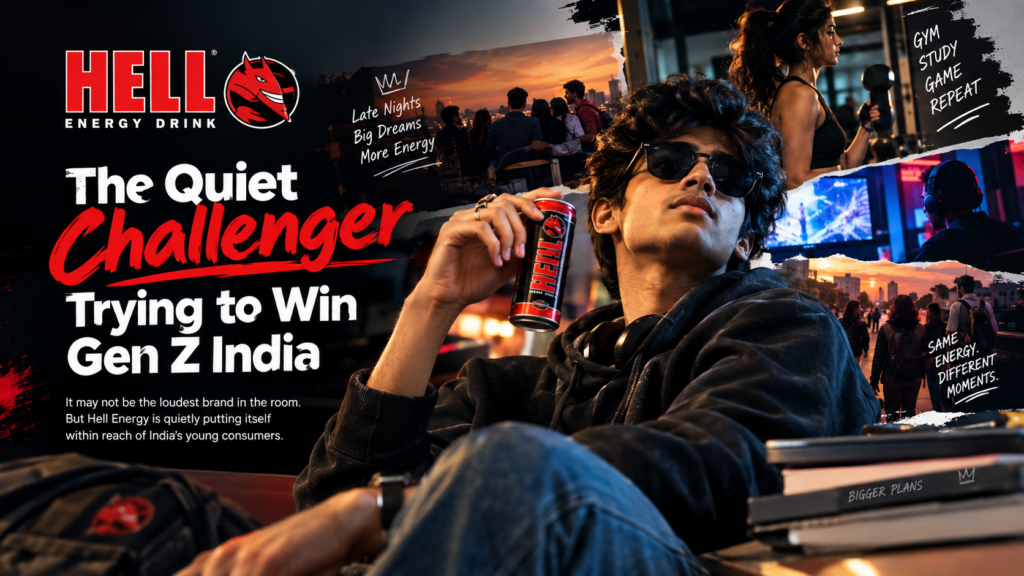
It may not have the cultural noise of Red Bull or the mass visibility of Sting. But Hell Energy is quietly putting itself within reach of India’s young consumers. The bigger question now is whether Gen Z will simply buy it — or actually choose it.
There is a strange thing happening with Hell Energy in India.
You may not remember seeing an advertisement for it.
You may not have a favourite Hell campaign.
You may not have seen creators talking endlessly about it.
And yet, walk into enough neighbourhood stores, college-area shops, supermarkets or quick-commerce apps and the brand begins to appear.
A sleek can.
A foreign-sounding name.
An accessible price.
And increasingly, a place in the energy-drink consideration set.
That makes Hell interesting from a Gen Z perspective.
Because the brand’s Indian journey isn’t really about becoming the loudest energy drink in the room.
It is about getting close enough to India’s young consumers to be considered in the first place.
And that raises a much more interesting question:
Can a brand become a Gen Z brand without first becoming a cultural phenomenon?
The first battle isn’t loyalty. It’s trial.
When Hell Energy entered India around 2018–19, it entered a category already shaped by powerful international brands.
Red Bull had spent years building associations with performance, adventure and extreme sports. Other global and domestic players were competing across different price points.
Hell took a more accessible route.
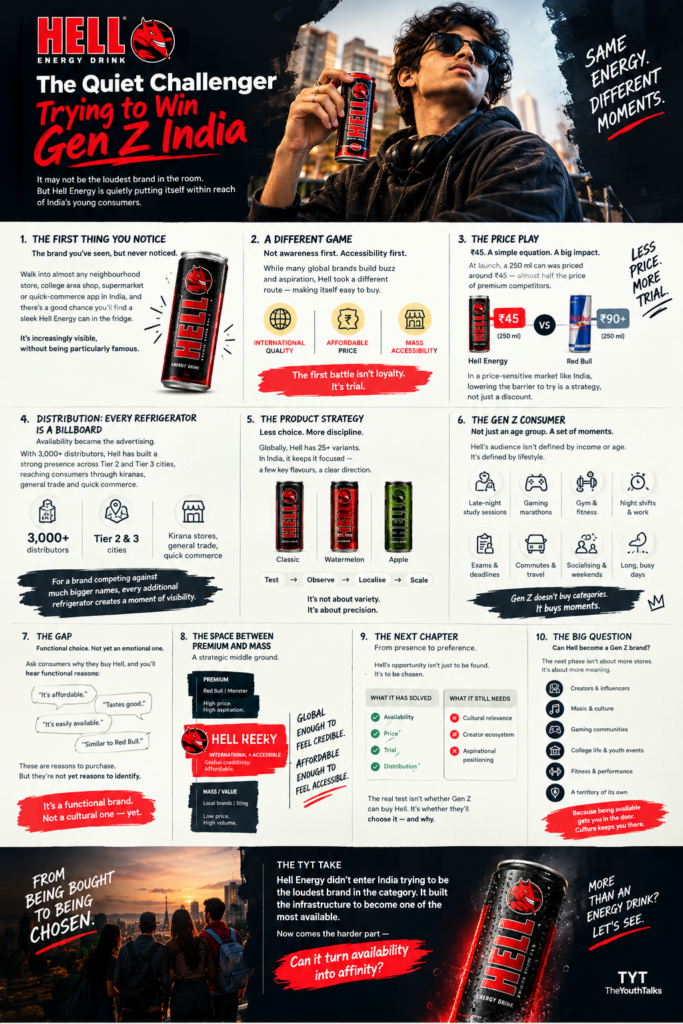
At launch, its 250 ml can was priced at around ₹45 according to contemporary reporting — substantially below premium competitors.
That matters when your consumer is young.
For a college student or early-career professional, the difference between an unfamiliar product costing ₹40–50 and a premium alternative costing considerably more can determine whether the first purchase happens at all.
And that first purchase matters.
A consumer doesn’t need to love a new brand before trying it.
They simply need a reason to say:
“Why not?”
For Hell, affordability may have created exactly that permission.
It transformed the product from something aspirational to something experimentable.
And Gen Z is particularly interesting in this context because younger consumers are often willing to discover brands through trial, social recommendation, convenience and everyday experiences rather than relying only on established brand hierarchy.
Hell didn’t necessarily have to convince a young Indian consumer that it was the coolest energy drink.
It had to make trying it easy.
Then came the availability game
This is where distribution becomes important — but not as the story itself.
It becomes the infrastructure underneath the Gen Z story.
Hell has built a reported network of more than 3,000 distributors in India, with a presence extending beyond the country’s biggest metros into Tier 2 and Tier 3 markets.
Its products have been available through traditional retail, kirana stores, general trade and digital channels.
For a young consumer, that creates something incredibly powerful:
proximity.
The product is there when the need appears.
A student doesn’t necessarily plan an energy-drink purchase three days in advance.
The purchase might happen at 11 PM before an assignment deadline.
After a late gym session.
During an all-night gaming session.
On the way to college.
During exam preparation.
While working a night shift.
Or simply because a friend picked up a can and said, “Try this.”
This is why distribution is more than logistics.
Availability creates occasions.
And occasions create trial.
Hell’s challenge — and opportunity — is that it may now be reaching more of these moments than its cultural visibility suggests.
Gen Z doesn’t buy categories. It buys moments.
This could be one of the most interesting ways to understand the energy-drink opportunity in India.
“Gen Z” is not a single consumer.
A 19-year-old engineering student, a 23-year-old gamer and a 25-year-old early-career professional may have completely different lifestyles.
But they may occasionally share the same need.
More energy. More time. More output.
The category therefore has the potential to be built around moments rather than demographics.
Late-night study.
Gaming.
Fitness.
Work.
Travel.
Socialising.
Exams.
Deadlines.
Night shifts.
Hell’s positioning around energy and fast-paced living gives it access to these occasions.
But simply being present in a moment doesn’t automatically make a brand culturally relevant.
And that is where the story gets more complicated.
What does Hell actually mean to Gen Z?
There is a big difference between a brand being accepted and a brand being loved.
Ask a consumer why they might buy Hell and the answer can be perfectly positive:
“It’s affordable.”
“It tastes good.”
“It’s easily available.”
“It’s similar to more expensive energy drinks.”
These are meaningful purchase drivers.
But they are mostly functional.
They answer:
Why should I buy this?
They don’t necessarily answer:
What does this brand say about me?
That second question is where youth brands become much more powerful.
Some brands become associated with a lifestyle, a community, a cultural movement or a particular idea of who their consumer wants to be.
For an energy drink, that can mean sport, gaming, music, performance, adventure, nightlife or some other cultural territory.
Hell’s Indian story appears to have been stronger on accessibility and availability than on a clearly owned cultural territory.
And that may be the biggest opportunity sitting in front of the brand.
The challenge isn’t becoming younger. It’s becoming relevant.
There is an easy trap for brands trying to win Gen Z.
Use young creators.
Add slang.
Launch an Instagram campaign.
Sponsor a college event.
Collaborate with a musician.
Make the packaging louder.
But none of those things automatically create youth relevance.
Gen Z can tell the difference between a brand participating in youth culture and a brand simply advertising to young people.
The harder task is finding a cultural space where the brand genuinely belongs.
For Hell, the possibilities are broad.
Gaming could be one.
Music could be another.
Fitness and performance offer another route.
College culture could create a particularly natural connection.
Night-time youth culture is another interesting territory.
The question isn’t whether Hell can participate in all of these.
It is:
Which one can Hell make its own?
The Red Bull problem isn’t price. It’s meaning.
Hell doesn’t necessarily need to beat established competitors by copying their playbook.
That could actually weaken its distinctiveness.
The bigger challenge is understanding what consumers associate with different brands.
A consumer might buy one energy drink because it is premium.
Another because it is affordable.
Another because it is familiar.
But the strongest brands often give consumers something beyond the product.
They become shorthand for an attitude.
That is the point Hell has not fully had to solve yet.
Its first job was getting into the market.
Its next job may be getting into the consumer’s identity.
That is a much harder problem.
From being bought to being chosen
This is perhaps the most important distinction in Hell’s Indian journey.
Being bought because you’re available is one kind of success.
Being chosen because you represent something is another.
Hell appears to have made considerable progress on the first.
Its accessible pricing lowers the barrier to trial.
Its distribution puts the product within reach.
Its focused portfolio gives consumers a manageable set of choices.
Its growing presence creates familiarity.
But the next stage requires something different.
Availability → Trial → Preference → Identity
That is the journey from product to brand.
And the last step is usually the hardest.
Because once consumers have tried a product, they have choices.
Why should they return?
Why should they recommend it?
Why should they post about it?
Why should they associate it with their lifestyle?
Why should it become their brand?
Those are cultural questions, not distribution questions.
The opportunity is already sitting inside Gen Z’s everyday life
The good news for Hell is that it doesn’t necessarily have to manufacture a new consumer behaviour.
Young Indians already have energy-intensive lifestyles.
They study late.
Work late.
Create content.
Game.
Exercise.
Travel.
Socialise.
Build side hustles.
Prepare for competitive exams.
Move between college, work and home.
The brand therefore has an existing landscape of moments to participate in.
The opportunity is to move beyond saying:
“We give you energy.”
And towards something more culturally meaningful:
“We understand what you’re doing with that energy.”
That is a much more interesting brand proposition.
Because energy isn’t really the product story.
What the consumer does with that energy is.
The quiet challenger may be entering its most interesting phase
There is something fascinating about Hell’s relatively quiet growth.
It hasn’t needed to dominate the cultural conversation to build a presence.
It has focused on price.
It has focused on distribution.
It has made the product accessible.
It has put itself in front of consumers.
And perhaps that is exactly what a challenger needs to do first.
But there is a limit to being the brand consumers can easily find.
Eventually, a brand has to become the brand they actively look for.
That is where Hell’s next chapter could become much more interesting.
The question is no longer simply:
Can Gen Z buy Hell?
Increasingly, the infrastructure exists for them to do so.
The more important question is:
Will Gen Z choose Hell when they have a choice?
And an even harder one follows:
Will they choose it because it is affordable and available — or because it feels like a brand made for people like them?
That is the difference between a product gaining distribution and a brand gaining cultural relevance.
Hell may have quietly solved the first problem.
Now comes the much bigger one.
Can the quiet challenger become part of the conversation?
Because Gen Z doesn’t just ask whether a brand is available.
It asks whether the brand belongs.