
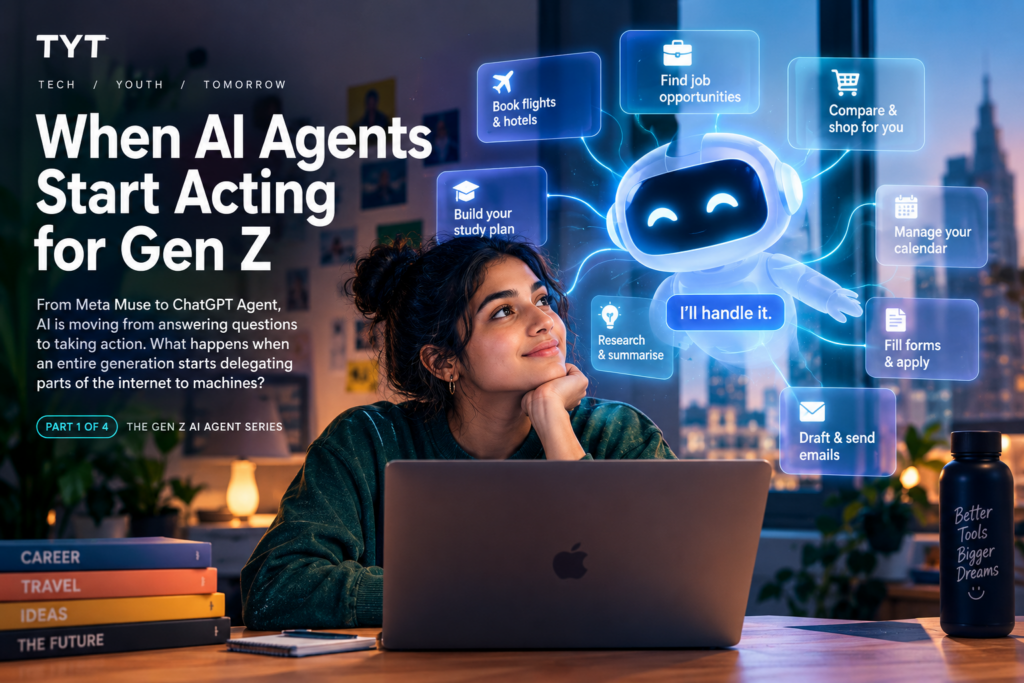
From Meta Muse to ChatGPT Agent, AI is moving from answering questions to taking action. What happens when an entire generation starts delegating parts of the internet to machines?
For most of the internet’s history, humans have been the operators.
We searched for information. We opened websites. We compared products. We filled forms. We booked flights. We sent emails. We applied for jobs. We negotiated prices. We clicked “buy.”
Artificial intelligence changed the first part of that equation.
We began asking machines to find information, explain things, write for us and make recommendations.
Now something more consequential is happening.
AI is beginning to act.
The emergence of AI agents marks a shift from software that responds to instructions to software that can pursue a goal, navigate digital environments, use tools and complete a sequence of actions on a person’s behalf.
And for Gen Z — a generation that has grown up with smartphones, apps, social platforms and increasingly AI — this could represent a much bigger behavioural change than the arrival of another chatbot.
The question is no longer simply:
“What can AI tell me?”
It is becoming:
“What can I ask AI to do for me?”
From chatbot to agent
The distinction sounds subtle, but it is fundamental.
Ask a conventional AI assistant:
“Find me five good hotels in Tokyo.”
It can research them, compare them and give you a list.
An agent can potentially take the next steps.
It can search websites, compare availability, check prices, consider your preferences, fill forms and — depending on the system and the permissions you have granted — proceed toward a booking.
The human moves from being the operator to being the supervisor.
OpenAI’s ChatGPT agent, introduced in 2025, was built around this idea. It can use its own virtual computer, interact with websites, run code, conduct research and complete multi-step tasks. OpenAI describes it as combining research capabilities with the ability to actually take actions on a computer, while retaining user confirmation for consequential actions.
Google has been exploring a similar direction through Project Mariner, a browser-based research prototype designed to perform tasks such as looking up information, making bookings, shopping and conducting research. Google has also demonstrated multiple agents working on different tasks simultaneously.
Perplexity has taken the concept further with its agentic computer capabilities, designed to execute workflows, automate browser actions, perform research, connect to applications and run tasks in the background.
The technology is still evolving rapidly.
But the direction is becoming clear.
AI is moving from answering to executing.
Then came Muse
Meta’s introduction of Muse in September 2026 makes this transition particularly interesting.
Meta isn’t positioning Muse simply as another chatbot. It calls it a personal AI agent designed to take work off people’s plates and turn goals into action plans.
The distinction is right there in Meta’s description: users tell Muse what needs to get done, and Muse can take action.
It can open a browser, fill out forms, send emails, book travel and negotiate on a person’s behalf. For longer tasks, Meta says Muse can continue working after the user closes the app and return when something changes or when it needs approval — such as before sending an email or making a purchase.
That is a different relationship with technology.
You don’t necessarily need to know which website to visit.
You don’t necessarily need to know which button to click.
You can increasingly describe the outcome you want.
And the machine figures out the route.
Meta has also built Muse around a dedicated cloud environment called Muse Secure VM, which houses the agent and a user’s connected data. Meta says the system includes a separate security layer, permission controls and an audit trail, while requiring user approval for sensitive actions.
That last point is important.
Because once software can act in the real world, the question of permission becomes as important as intelligence.
The Gen Z internet could be very different
Think about how young people use the internet today.
A student looking for an internship might:
Search Google.
Open LinkedIn.
Search job boards.
Read descriptions.
Compare companies.
Modify a CV.
Write a cover letter.
Fill an application.
Track the response.
Now imagine saying:
“Find internships suitable for my profile. Only show me companies where I meet at least 70% of the requirements. Track new openings every morning and prepare applications for my approval.”
The interaction has changed completely.
The student isn’t navigating six platforms.
The student has given an objective to an agent.
The same logic could apply to travel:
“Find me a three-day trip to Bangkok under ₹30,000 including flights and accommodation.”
Shopping:
“Find me a pair of running shoes under ₹6,000 that are suitable for my training and available in my size.”
Education:
“I have an exam in six weeks. Build a study plan, monitor my progress and adjust it based on where I’m struggling.”
Personal administration:
“Find all my subscriptions, identify the ones I don’t use and prepare cancellation requests.”
Career development:
“Monitor opportunities in product management and tell me when something matches my experience.”
The common thread is simple:
The user expresses intent. The agent handles execution.
From clicks to intent
For decades, the web has been built around clicks.
Search engines send people to websites.
Websites compete for attention.
Brands compete for clicks.
E-commerce companies optimise conversion funnels.
Creators compete for views.
But agents introduce a different possibility.
The future interaction could increasingly look like:
Human → Agent → Internet → Action
rather than:
Human → Search → Website → Click → Compare → Action
That has enormous implications.
If an AI agent is comparing ten products for you, you may never visit nine of those websites.
If an agent is finding your next job, you may never browse hundreds of job listings.
If an agent is planning your holiday, you may never spend three nights comparing hotels.
If an agent is monitoring prices, you may not even know which websites it checked.
The internet could therefore become less about where humans go and more about what machines can discover, understand and act upon.
That has implications for search, advertising, e-commerce, media, recruitment and almost every business that currently depends on human attention.
But there is a catch: agents can act on the wrong instruction too
The biggest difference between an AI that gives you a wrong answer and an AI that takes a wrong action is consequence.
A chatbot giving you the wrong hotel recommendation is annoying.
An agent booking the wrong hotel is expensive.
An agent sending the wrong email can damage a relationship.
An agent making an unauthorised purchase creates a financial problem.
An agent accessing information it shouldn’t have accessed creates a privacy problem.
And there is an even more technical risk: prompt injection.
AI agents increasingly consume information from websites, documents, emails and other external sources. Those sources can contain instructions designed to manipulate the agent’s behaviour. OWASP identifies prompt injection, excessive agency, tool misuse, data exposure and goal hijacking among the important risks associated with agentic systems.
This creates an unusual security problem.
A webpage isn’t just something the agent reads anymore.
It can potentially become something that influences what the agent does next.
That is why the emerging agent ecosystem is increasingly being built around permissions, least-privilege access, confirmation checkpoints and audit trails. Meta’s Muse, for example, requires approval for certain sensitive actions and gives users an audit trail of activity.
The more capable the agent becomes, the more important those controls become.
What should Gen Z actually delegate?
This may ultimately become the most important question.
There is a difference between automation and delegation of judgment.
A young person can reasonably ask an agent to:
- compare flight prices
- organise a calendar
- summarise research
- monitor job openings
- prepare a shopping list
- track prices
- research companies
- organise files
- draft routine emails
These are largely repetitive or information-heavy tasks.
But should an agent decide:
- whether you should leave college?
- whether you should move countries?
- whether you should take a particular career?
- whether you should end a relationship?
- whether you should make a major financial commitment?
- what you fundamentally value?
Those questions are different.
The agent may provide information.
It may even provide a useful framework.
But the decision belongs to the person.
And this distinction will become increasingly important as agents become better at sounding confident.
Capability does not automatically equal wisdom.
The risk isn’t that Gen Z will use too much AI
It may be that Gen Z will use AI extremely well.
The more interesting question is whether they will learn to delegate intelligently.
Imagine two people with equally capable agents.
The first says:
“Do everything for me.”
The second says:
“Handle repetitive work. Bring important decisions to me. Never make irreversible decisions without asking. Don’t access information you don’t need. Show me what you did.”
The second person isn’t using less AI.
They are using it with better boundaries.
That may become a new form of digital literacy.
Not simply knowing how to prompt AI.
But knowing:
what to delegate, what to supervise and what to keep human.
The next interface may be intent
The smartphone made computing portable.
Social media made it personal.
Generative AI made it conversational.
Agents could make computing delegated.
That is the larger significance of Muse and the growing ecosystem around agentic AI.
The winning interaction may no longer be:
“Which app should I open?”
It may become:
“What do I want to accomplish?”
And that is a profound shift.
For Gen Z, it could mean fewer hours spent navigating the internet and more time directing machines to navigate it.
It could make young people dramatically more productive.
It could also change how they learn, shop, travel, work, communicate and build businesses.
But it raises an equally important question:
If AI increasingly handles the doing, what happens to the human capacity for deciding?
That is the conversation that needs to happen next.
Because the future of AI agents may not be about replacing Gen Z.
It may be about giving every young person something closer to a digital workforce of one.
And the real advantage may belong not to those who give their agents the most control — but to those who know exactly where that control should stop.
This is Part 1 of TYT’s four-part series: When AI Agents Start Acting for Gen Z
Part 2: What Is Gen Z Already Delegating to AI Agents?
Part 3: What Should Gen Z Never Leave Entirely to an AI Agent?
Part 4: When Gen Z Gives AI the Work, What Businesses Will They Build?