

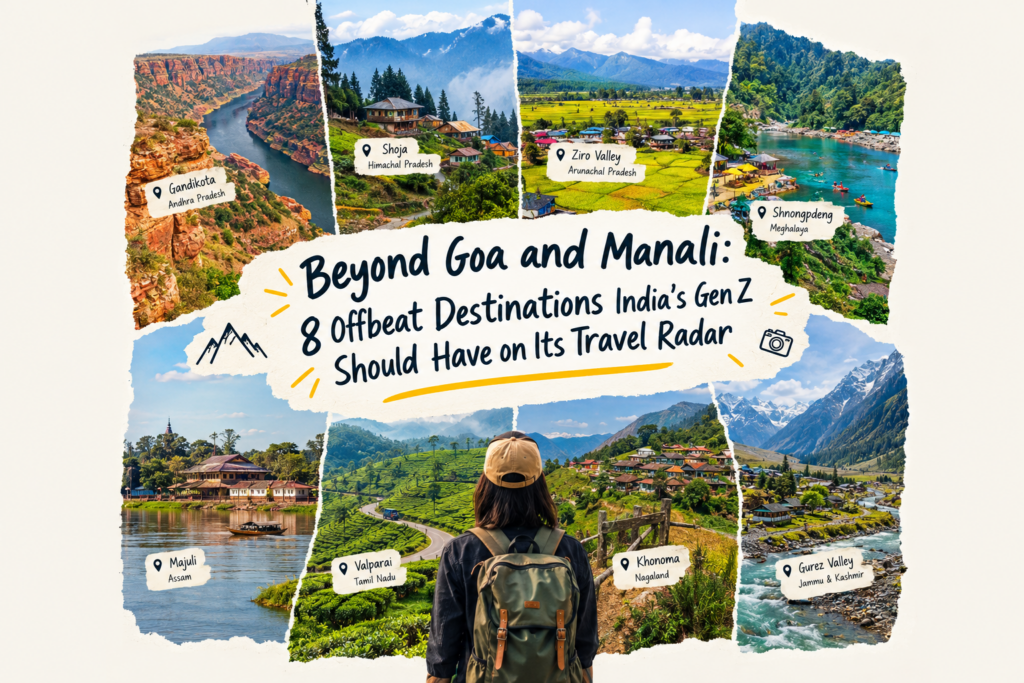
From dramatic river gorges and remote Himalayan valleys to music festivals and culturally rich villages, these eight destinations offer young Indian travellers a different way to explore the country.
For years, the familiar Indian holiday circuit has revolved around a handful of destinations. Goa for beach holidays, Manali for mountain escapes, Jaipur for heritage, and Rishikesh for adventure. These places continue to attract travellers, but India’s geography offers considerably more than its best-known tourist hotspots.
A new generation of travellers has plenty of reasons to explore beyond the conventional itinerary. Some want to spend a few days in the mountains rather than squeeze multiple attractions into a weekend. Others seek unusual landscapes, local food, music festivals, outdoor adventures or experiences that feel more personal than a crowded tourist destination.
Social media has also made unfamiliar places easier to discover. A photograph of a turquoise river, a video of a mountain village or a recommendation from another traveller can inspire someone to consider a destination they might never have encountered otherwise.
However, discovering a place online and experiencing it responsibly are two different things. Local communities, accessibility, seasonal conditions and the environmental impact of tourism matter just as much as the photographs.
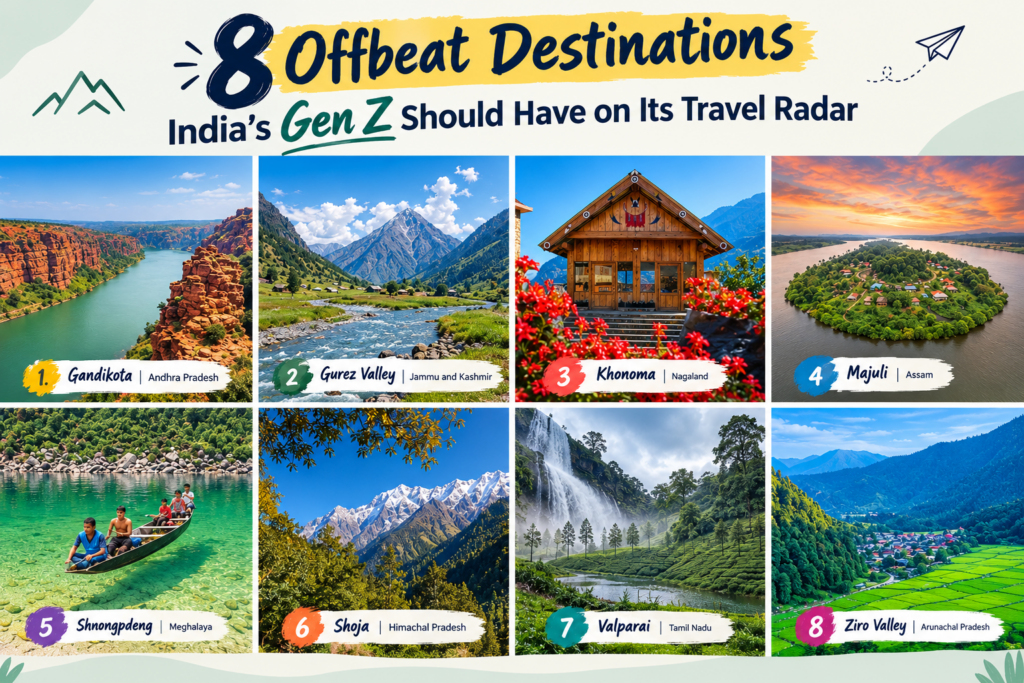
For young Indians looking to plan their next trip differently, here are eight destinations worth putting on the travel radar.
1. Gandikota, Andhra Pradesh: The canyon adventure closer to home
Why it deserves attention: Dramatic landscapes, camping and road-trip potential.
<image-placeholder>Gandikota’s red sandstone gorge and the Penna River</image-placeholder>
India’s most memorable landscapes are not necessarily found in the Himalayas. Gandikota, in Andhra Pradesh, is a striking example. Often described as India’s Grand Canyon, the destination is known for its rocky gorge overlooking the Penna River, rugged terrain and the remains of a historic fort.
The appeal lies in the combination of natural scenery and history. Visitors can explore the fort complex, admire the canyon from its viewpoints and plan outdoor activities around the surrounding landscape. Camping and adventure experiences offered by local operators can add another dimension to the visit.
For young travellers, Gandikota could be an alternative to the familiar hill-station holiday. It offers a setting for a road trip with friends, landscape photography and a short break built around exploration rather than shopping or sightseeing in a city.
The destination also illustrates an opportunity for domestic tourism: travellers do not always need to fly to another country or visit a famous international landmark to experience an unusual landscape.
Best suited for: Friend groups, road-trip enthusiasts, photography lovers and adventure seekers.
Travel consideration: Conditions can be extremely hot in summer. Check activity availability and safety arrangements before booking outdoor experiences.
2. Shoja, Himachal Pradesh: A mountain escape without the usual crowds
Why it deserves attention: Forest trails, village stays and a slower pace of travel.
<image-placeholder>Shoja village, with traditional mountain homes and forested Himalayan slopes</image-placeholder>
Manali and Shimla remain popular choices for Himalayan holidays, but travellers seeking a quieter experience may want to consider Shoja.
Located in Himachal Pradesh’s Seraj region, Shoja is a small mountain settlement surrounded by forested slopes and Himalayan scenery. Its appeal is less about a packed itinerary and more about the atmosphere: misty mornings, walks through the hills, local homestays and time away from busy urban routines.
For young professionals and students, a destination like Shoja can offer a different kind of break. Rather than moving between multiple attractions, travellers can spend their time walking, reading, talking to local residents or simply enjoying the surroundings.
It is also suited to smaller groups who prefer homestays and independent travel over large resorts and organised sightseeing tours.
The important distinction is that a quieter destination is not necessarily untouched. Even small mountain communities can experience pressure on water, waste management and local infrastructure as tourism grows.
Best suited for: Couples, small groups, nature lovers and travellers seeking a digital detox.
Travel consideration: Mountain roads can be challenging, particularly during bad weather. Check road conditions and accommodation access before travelling.
3. Ziro Valley, Arunachal Pradesh: Where music meets mountain culture
Why it deserves attention: Music festivals, indigenous heritage and distinctive landscapes.
<image-placeholder>Ziro Valley’s green fields, surrounding hills and outdoor music festival setting</image-placeholder>
Ziro Valley brings together several elements that can make a destination particularly appealing to younger travellers: natural beauty, cultural experiences and music.
Located in Arunachal Pradesh, the valley is known for its green landscapes, rice fields and the cultural heritage of the Apatani community. It is also associated with the Ziro music festival, which has helped introduce the region to audiences interested in independent music and outdoor festival experiences.
For travellers accustomed to mainstream concerts and conventional holidays, Ziro presents a different combination. The journey can include music, local food, village visits and opportunities to learn about the region’s traditions.
The destination also highlights the connection between culture and tourism. Festivals can introduce new visitors to a region, but the long-term value of tourism depends on how well the resulting economic opportunities reach local communities.
Young travellers visiting Ziro should approach its cultural heritage with curiosity and respect, rather than treating the valley simply as a picturesque festival backdrop.
Best suited for: Independent music fans, culture enthusiasts, photographers and adventurous travellers.
Travel consideration: Festival dates, transport and accommodation need advance planning. Indian visitors should check the applicable entry-permit requirements for Arunachal Pradesh before travelling.
4. Shnongpdeng, Meghalaya: A riverside adventure in Northeast India
Why it deserves attention: Clear river waters, camping and outdoor experiences.
<image-placeholder>Clear waters of the Umngot River near Shnongpdeng, with boats and green hills</image-placeholder>
Meghalaya has become an attractive option for travellers interested in waterfalls, dramatic landscapes and experiences beyond conventional hill stations. Shnongpdeng offers another reason to explore the state.
Situated near Dawki, Shnongpdeng is known for the Umngot River and the outdoor activities available in the surrounding area. Depending on conditions and local operators, visitors can explore boating, kayaking, camping and other riverside experiences.
The destination’s appeal is easy to understand. Instead of spending an entire holiday moving between viewpoints, travellers can build a trip around being outdoors. A riverside stay, a day on the water and time spent exploring nearby villages can become the main event rather than a stop between tourist attractions.
For groups of friends, this kind of destination offers a combination of adventure and shared experiences. It can also encourage visitors to discover more of Meghalaya beyond its most frequently photographed locations.
But the region’s natural beauty is also its most important asset. River conditions, responsible waste disposal and the quality of local tourism operations should be part of the travel decision.
Best suited for: Adventure seekers, camping enthusiasts, friend groups and nature photographers.
Travel consideration: Water clarity and river conditions vary with the season and weather. Activities should be undertaken only with appropriate safety arrangements.
5. Majuli, Assam: Discovering the slower side of travel
Why it deserves attention: River-island life, crafts and cultural immersion.
<image-placeholder>Majuli’s rural landscape, traditional Assamese homes and Brahmaputra river scenery</image-placeholder>
Not every memorable trip needs an adrenaline activity or an extraordinary landscape. Sometimes, the attraction is the opportunity to experience a place at a different pace.
Majuli, an island in the Brahmaputra River in Assam, offers a distinctive combination of rural scenery, Assamese cultural traditions and historic Vaishnavite monastic institutions known as satras.
Visitors can explore traditional crafts, learn about local cultural practices and experience village life in a setting that differs significantly from India’s major tourist cities.
For younger travellers interested in slow travel, Majuli offers an alternative to itineraries built around ticking off attractions. The experience can be shaped by conversations, local food, craft traditions and time spent understanding the community.
It also presents an important perspective on tourism: a destination’s value cannot always be measured by the number of attractions it contains. Cultural continuity, local livelihoods and the everyday lives of residents can be equally significant.
Majuli’s riverine geography, however, also makes it vulnerable to erosion, flooding and environmental change. Travellers should remain mindful of local conditions and support businesses that contribute to the local economy.
Best suited for: Solo travellers, culture enthusiasts, slow-travel seekers and photographers.
Travel consideration: Ferry services and access can be affected by weather and river conditions. Confirm transport arrangements before departure.
6. Valparai, Tamil Nadu: A different kind of South Indian hill holiday
Why it deserves attention: Tea plantations, forest landscapes and scenic drives.
<image-placeholder>Valparai’s rolling tea plantations and winding roads through the Anamalai Hills</image-placeholder>
South India’s hill destinations often bring Ooty and Kodaikanal to mind. Valparai offers another option for travellers who want mountain scenery without following the most familiar route.
Located in Tamil Nadu’s Anamalai Hills, Valparai is surrounded by tea plantations, forested areas and winding mountain roads. The surrounding landscape is also associated with rich biodiversity, making the region interesting for travellers who enjoy nature and wildlife.
The appeal is particularly strong for people who enjoy the journey as much as the destination. Scenic drives, plantation landscapes and quieter accommodation can form the basis of a relaxed holiday.
For young travellers planning a long weekend or a trip with friends, Valparai could provide a refreshing alternative to crowded tourist centres. It also offers opportunities to learn about plantation landscapes and the relationship between local livelihoods and the surrounding environment.
As with any destination located close to sensitive natural habitats, wildlife viewing should be responsible. Visitors should avoid disturbing animals, entering restricted areas or treating forest roads as guaranteed wildlife-spotting routes.
Best suited for: Road-trip enthusiasts, nature lovers, photographers and travellers seeking a peaceful getaway.
Travel consideration: Check local road and forest-access rules, especially when planning travel around wildlife areas.
7. Khonoma, Nagaland: A journey into community-led tourism
Why it deserves attention: Naga heritage, village experiences and conservation.
<image-placeholder>Khonoma village in Nagaland, surrounded by green hills and traditional architecture</image-placeholder>
Travel can be an opportunity to discover landscapes, but it can also provide a deeper understanding of the communities that inhabit them.
Khonoma, near Kohima in Nagaland, is known for its Naga heritage and conservation history. Its surrounding hills, village setting and traditional culture offer an experience different from the conventional resort holiday.
For young Indians who want to understand more of the country’s cultural diversity, the village offers an opportunity to engage with local traditions and learn about community approaches to protecting the environment.
Community-led tourism can be particularly valuable in destinations such as this. When visitors choose locally run accommodation, guides and experiences, more of the economic benefit can remain within the community.
However, the idea of responsible tourism should extend beyond spending money locally. Visitors also need to respect privacy, seek permission before photographing people and understand that a village is a living community, not an attraction created solely for tourists.
Khonoma could appeal to a generation increasingly interested in experiences with meaning, provided the trip is planned with cultural sensitivity.
Best suited for: Culture enthusiasts, responsible travellers, photographers and people interested in community conservation.
Travel consideration: Check current entry requirements, local guidance, transport options and accommodation availability before travelling to Nagaland.
8. Gurez Valley, Jammu and Kashmir: For those willing to go farther
Why it deserves attention: Remote Himalayan scenery, traditional settlements and road-trip potential.
<image-placeholder>Gurez Valley’s mountain landscape, traditional wooden homes and Kishanganga River</image-placeholder>
For travellers prepared to put more effort into planning, Gurez Valley offers a different perspective on Kashmir.
Located in northern Jammu and Kashmir, Gurez is known for its dramatic mountain scenery, the Kishanganga River and traditional settlements. The surrounding landscape creates an experience that feels very different from a conventional stay in Srinagar or a visit to the region’s better-known tourist spots.
The destination can appeal to young travellers who value the journey itself: winding mountain roads, changing landscapes and the opportunity to experience a less familiar part of the region.
Its appeal also comes with practical considerations. Remote destinations require more careful planning than established tourist centres, particularly when it comes to transport, weather, accommodation and access.
Gurez should therefore be approached as a destination for informed travel rather than a spontaneous detour. Checking current local conditions and following official travel advisories are essential.
For those who plan well, it offers an opportunity to experience a different side of the Himalayas while appreciating the communities that call the valley home.
Best suited for: Experienced travellers, landscape photographers, small groups and adventure-minded explorers.
Travel consideration: Access can be seasonal and subject to security restrictions. Verify current permissions, road conditions and local advisories before making plans.
What is driving interest in offbeat travel?
These eight destinations are very different from one another. Some are suited to outdoor adventure, some to cultural exploration, and others to a slower holiday. Yet they share a quality: they offer experiences that cannot easily be replicated by visiting the usual tourist attractions.
For younger travellers, several factors may be contributing to the appeal of such trips.
1. The desire for more distinctive experiences
A destination can become attractive because it offers something different from the usual holiday template. A music festival in a mountain valley, a riverside camping experience or a stay in a culturally rich village can give a trip a stronger identity.
2. Social media as a discovery tool
Travel videos, creator recommendations and photographs can introduce lesser-known destinations to people who may never have considered visiting them. But online visibility should not be confused with proof of sustained visitor growth.
3. The appeal of small-group travel
Some offbeat destinations lend themselves to trips with a few friends rather than large organised tours. Shared road journeys, local stays and outdoor activities can become as important as the destination itself.
4. An interest in local culture and nature
Destinations such as Majuli and Khonoma offer opportunities to learn about local communities, while Valparai and Gurez appeal through their natural landscapes. Responsible travel can combine discovery with a greater appreciation of the places being visited.
5. The search for a different pace
Not every young traveller wants a holiday filled with activities. Places such as Shoja and Majuli offer the possibility of slowing down, spending time outdoors and stepping away from busy routines.
These are plausible motivations, not proof that every member of Gen Z travels this way. Understanding the scale of the trend requires evidence from booking platforms, travel operators and young travellers themselves.
The opportunity — and responsibility — of discovering somewhere new
Offbeat travel is not automatically sustainable travel. A destination that becomes popular overnight can face problems with waste, water supply, traffic, fragile habitats and pressure on local communities.
Travellers can make better choices by booking legitimate local operators, respecting community rules, avoiding litter, following wildlife guidelines and researching seasonal conditions. They should also recognise that quieter destinations may have limited transport, medical facilities and accommodation.
For the travel industry, the opportunity is to develop experiences that create value for visitors without compromising the places that attract them in the first place.
For young Indians, it is an invitation to explore the country with greater curiosity. The next memorable holiday may not require a passport, an expensive resort or a visit to an already familiar hotspot. It may simply require choosing a different route.
The takeaway: Gandikota, Shoja, Ziro Valley, Shnongpdeng, Majuli, Valparai, Khonoma and Gurez Valley each offer a different reason to travel beyond India’s conventional holiday circuit. Whether they become the next big destinations for Gen Z remains to be established, but they are all worth considering for travellers who want to see more of India.
Editorial note: This feature identifies destinations worth exploring; it does not claim that all eight have experienced a verified Gen Z tourism boom. Destination-specific visitor trends should be confirmed with current booking data, tourism authorities or local operators before publication.