
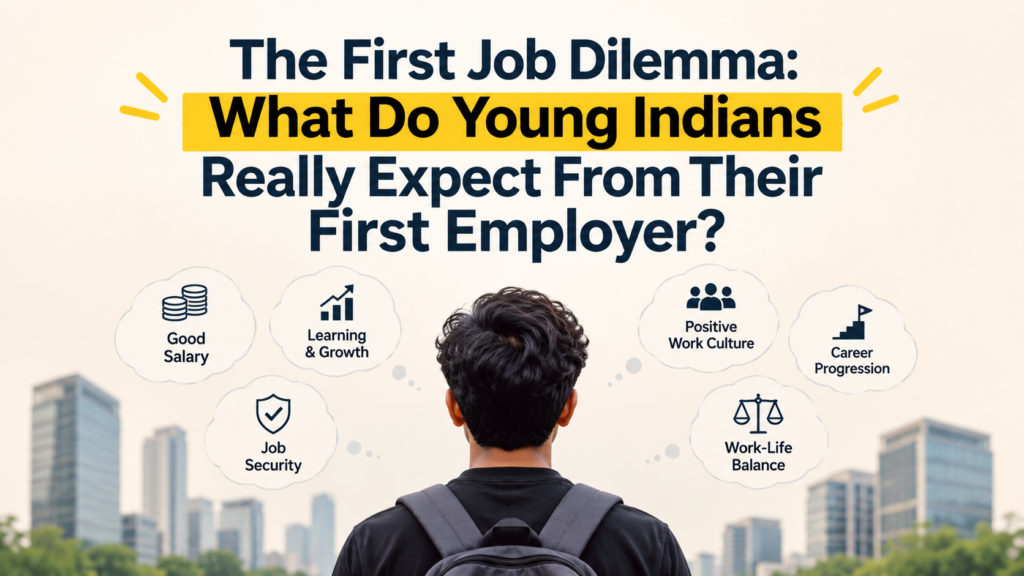
For India’s graduating workforce, the first job is about more than a monthly salary. Young professionals are looking for financial independence, practical learning, job security and a workplace that gives them a credible start to their careers. But are employers meeting those expectations?
For a college student preparing to enter the workforce, the first job represents much more than the end of an academic journey. It is the beginning of financial independence, professional identity and the transition into adult responsibilities.
There is excitement around receiving that first offer letter, but there is also uncertainty. Will the job provide an opportunity to learn? Will the salary be enough to manage expenses? Will the organisation offer a supportive manager? Is there a future beyond the first designation?
For employers, hiring fresh graduates is often about identifying candidates who have the right qualifications, demonstrate potential and can adapt to the demands of the workplace. For young applicants, however, the decision is more personal. They are choosing an organisation that could shape their professional confidence, skills and career direction.
And the expectations are changing.
Young Indians are not necessarily looking for the most glamorous first job or the highest designation. Increasingly, they appear to be weighing several factors together: financial security, learning opportunities, workplace culture, stability and the possibility of career progression.
The challenge is that these expectations are emerging in a competitive employment market, where employers are also becoming more selective about the skills they expect from fresh graduates.
The first-job decision begins before the offer letter
The expectations of first-time job seekers are visible in a 2025 All Things Talent survey of 1.5 lakh fresh graduates across India.
The findings reveal that entering the workforce is accompanied by considerable uncertainty. As many as 44% of respondents were concerned about lacking job-relevant experience, while 25% were worried about limited career opportunities. Another 9% identified inadequate access to upskilling opportunities as a concern.
These numbers highlight a challenge that has long existed between higher education and employment: students may complete their degrees, but many still feel underprepared for the practical demands of a professional role.
The concern is understandable. A graduate may have studied programming, marketing, finance or business management for several years, but the expectations of an employer can extend well beyond academic knowledge.
Companies may expect candidates to communicate effectively, work in teams, understand business problems, use industry tools and take responsibility for assignments.
The first-job dilemma therefore begins even before someone joins an organisation. Young applicants are trying to find an employer who will not only hire them but also help bridge the gap between what they have studied and what the workplace expects.
Salary matters, but the first employer is also a learning choice
Compensation remains an important consideration when choosing a first job. For someone entering the workforce, a salary represents the beginning of financial independence and the ability to contribute towards personal or family responsibilities.
However, the first job is also an investment in future employability.
Deloitte’s 2025 Global Gen Z and Millennial Survey, which included 505 Gen Z respondents in India, found that 94% considered on-the-job learning and practical experience helpful for career growth. The same proportion identified industry-specific knowledge and expertise as important for career advancement.
The finding is relevant to fresh graduates because the value of a first job is not always measured by the salary received in the first month. It can also be measured by the skills acquired, the exposure gained and the opportunities that become available afterwards.
An entry-level role that offers structured training, experienced colleagues and meaningful assignments may help a young professional build a stronger foundation than a job that offers a slightly higher salary but little opportunity to develop.
This does not mean young Indians are willing to compromise indefinitely on compensation. Rather, the first-job decision involves balancing immediate financial needs with the longer-term value of the opportunity.
For employers, this means that explaining what a fresher will learn and how the role can develop may be as important as communicating the compensation package.
MNCs, startups or government jobs: Where do freshers see their future?
The type of organisation a young person joins can also influence the first-job decision.
A multinational company may offer structured training, established processes, a recognisable employer brand and the opportunity to work within large teams. A startup may provide wider responsibilities, faster exposure to different functions and the chance to work closely with founders or senior leaders.
Government employment, meanwhile, continues to represent stability and a structured career path for many Indian job seekers.
The All Things Talent survey found that 37% of fresh graduates preferred multinational companies, compared with 21% who preferred startups. Another 19% favoured public-sector employment.
These preferences challenge the assumption that younger professionals are universally attracted to fast-moving startups or unconventional career paths.
For many first-time job seekers, the appeal of an established organisation lies in the predictability and structure it can offer. A recognised employer can also provide an environment in which fresh graduates learn professional processes, understand organisational expectations and develop a network.
Startups offer a different proposition, but the attraction may depend on the role, quality of leadership, financial stability and the opportunities available to learn.
The choice is therefore not simply between a traditional employer and a new-age company. It is about what kind of first professional experience a young person believes will prepare them for the future.
The office is not necessarily the enemy
The debate around Gen Z and remote work has created an impression that young professionals entering the workforce primarily want work-from-home opportunities.
But the first-job experience may be more nuanced.
The All Things Talent survey found that 37% of fresh graduates actively preferred fully office-based roles, while only 15% were looking for fully remote opportunities.
This is an interesting finding because the first few months of employment often involve learning things that are difficult to capture in a training manual.
Understanding how colleagues communicate, observing how experienced professionals handle clients, asking questions, receiving feedback and developing professional confidence can all be part of the early-career experience.
For a fresher, being physically present with a team may provide access to informal learning and everyday interactions that are less easily replicated in a remote environment.
That does not mean every graduate wants to work from an office five days a week. It suggests that flexibility and physical workplace access should not be treated as opposing preferences.
Employers may find that new employees value flexibility while also appreciating the opportunity to interact with colleagues, managers and mentors as they learn to navigate professional life.
Skills over pedigree: What freshers believe employers should value
Another important finding from the All Things Talent survey concerns how young applicants view the relationship between academic qualifications and actual ability.
As many as 71% of respondents believed performance matters more than educational pedigree, while only 12% placed greater emphasis on degrees.
This is an important distinction. It does not suggest that qualifications have become irrelevant. Rather, it reflects the growing importance of being able to demonstrate practical capabilities.
A graduate may have a degree from a well-known institution, but employers increasingly want to understand what the candidate can actually do.
Can a software graduate write and debug code? Can a marketing graduate analyse campaign performance? Can a business graduate interpret data, communicate recommendations and work with clients?
Mercer | Mettl’s India Graduate Skill Index 2025 provides another perspective on this challenge. Its assessment of more than one million students across over 2,700 campuses estimated that 42.6% of Indian graduates were employable in 2024, compared with 44.3% in 2023.
The report also points to the growing importance of a combination of technical and non-technical capabilities, including critical thinking, communication and learning agility.
These findings reveal a gap that neither students nor employers can afford to ignore.
Young graduates need opportunities to develop practical skills before and during their first jobs. Employers, meanwhile, need to assess potential and learning ability rather than rely entirely on academic credentials.
The first manager can shape the first career
A first job is also the first experience of working under a professional manager.
For many graduates, this relationship can influence how confidently they approach responsibilities, how comfortable they feel asking questions and how quickly they learn to navigate the workplace.
A supportive manager can help a new employee understand expectations, correct mistakes and gradually take on more challenging work. An inaccessible manager or a workplace that expects freshers to figure everything out independently can make the transition considerably harder.
Deloitte’s 2025 India survey found that 91% of Gen Z respondents considered mentorship and guidance from experienced colleagues helpful for career growth. Yet the survey also identified a gap between what young employees expect from managers and what they report receiving.
This matters particularly at the beginning of a career. A fresher may have the technical knowledge to complete an assignment but lack the professional experience to understand how to prioritise work, communicate a problem or handle feedback.
The first manager is often the person who helps bridge that gap.
For employers, this suggests that onboarding should extend beyond orientation sessions and compliance training. Fresh graduates need clear expectations, regular feedback, accessible mentors and opportunities to understand how their work contributes to the organisation.
What young employees expect from the first workplace
The first-job experience is not defined by salary, training or workplace location alone. It is shaped by how these elements come together.
Young employees want to know whether their work will be recognised, whether they will be given opportunities to develop and whether they can see a future within the organisation.
The 2026 Naukri Gen Z Work Code report, based on more than 23,000 Gen Z professionals across over 80 industries, found that 50% considered work-life balance the most important factor in a job offer beyond salary. It also found that 57% defined career growth primarily through learning new skills on the job rather than promotions.
These findings cover a wider Gen Z professional population, not exclusively fresh graduates. Nevertheless, they provide useful context for understanding the expectations that new entrants may bring into the workplace.
The implication is that employers cannot assume a competitive salary or a recognised brand name will be sufficient to create a positive first-job experience.
The quality of work, the manager’s approach, opportunities to learn and the ability to maintain a sustainable routine all contribute to whether a young employee sees the organisation as a place to build a career.
What employers need to get right
For companies hiring fresh graduates, the first-job experience offers an opportunity to build a relationship with talent much earlier in its career.
A few changes could make a meaningful difference.
Make the role clear before hiring. Candidates should understand their responsibilities, expected working arrangements, compensation and the skills they are likely to develop. Transparent communication can help prevent mismatched expectations.
Invest in practical onboarding. Fresh graduates need more than presentations about company policies. They benefit from structured learning, real assignments, feedback and opportunities to understand how their function operates.
Make mentorship accessible. Managers and experienced colleagues should have a defined role in helping new employees navigate their first professional responsibilities.
Show what comes next. A clear view of possible career paths, skills required for progression and opportunities for internal mobility can help employees understand the long-term value of joining.
Treat freshers as developing professionals. Young employees may need guidance, but they also need responsibility. Giving them meaningful assignments and allowing them to contribute ideas can help build confidence and engagement.
The first job should not be treated as a test that young employees must pass without support. It should be an environment in which both the individual and the organisation invest in building capability.
The first job is the beginning of a relationship
For India’s young workforce, the first job remains an important milestone. It offers financial independence, professional exposure and the opportunity to begin building a career.
But the expectations surrounding that first opportunity are becoming more considered. Young people want an employer that offers more than a designation and a salary. They want to understand what they will learn, who will guide them, how their work will be valued and whether the organisation can help them become better professionals.
Employers, at the same time, are looking for graduates who are skilled, adaptable, communicative and ready to contribute in a changing workplace.
The opportunity lies in bringing these expectations closer together.
A good first employer does not need to promise an immediate promotion or an extraordinary career journey. It needs to provide a fair starting point, meaningful work, practical learning and the support to grow.
Because a first job is not just the first line on a young Indian’s résumé. It is often the first experience that shapes what they expect from work, what they believe they can achieve and the kind of professional they eventually become.