
A few years ago, becoming a content creator largely meant learning how to make something people wanted to watch. It required an idea, a camera or smartphone, an understanding of an audience and the persistence to keep publishing until a community began to form.
Today, the job description is becoming considerably more complicated.
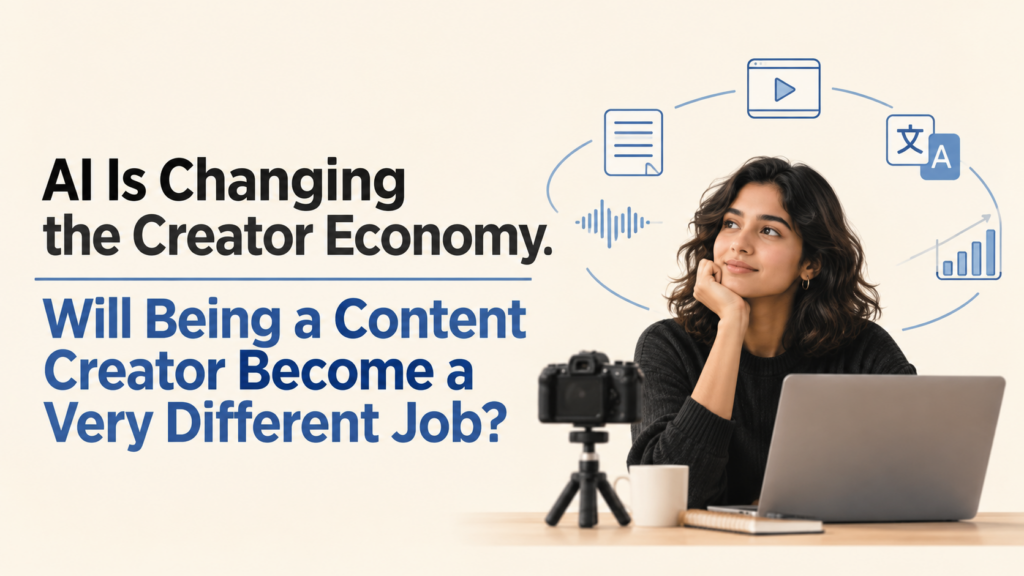
Creators are using artificial intelligence to write scripts, edit videos, generate images, analyse audience behaviour, translate content, identify trends and plan their next posts. Brands and agencies are using AI to discover influencers, evaluate campaign performance, negotiate collaborations and automate tasks that once required substantial manual effort.
The technology is changing not just how content gets made, but also how the business of being a creator works.
And this raises an important question for India’s growing creator economy: when AI can produce content faster and cheaper, what exactly will make a human creator valuable?
The answer may have less to do with the ability to produce more videos and more to do with qualities that technology cannot easily manufacture: a distinctive point of view, personal experience, creativity, credibility and the ability to build relationships with an audience.
AI may change the creator’s job. It does not necessarily make the creator less important.
Creators are already using AI. The real question is what they use it for
The adoption of AI within the creator economy is no longer a distant possibility.
Kolsquare’s November 2026 report, Beyond the Hype: AI for Influencer Marketing, cites its research showing that 84% of influencer marketers and 72% of creators already use AI or automation tools.
The applications range from campaign analytics and audience research to scripting, editing and workflow automation.
For creators, the appeal is understandable. Producing content consistently is demanding. A single video can involve researching a subject, developing a concept, writing a script, shooting footage, editing, adding subtitles, creating thumbnails, publishing and then analysing performance.
AI tools can reduce the time spent on several of these activities.
A creator can use an AI assistant to structure a research brief, generate initial script ideas, translate subtitles into different languages or organise a content calendar. Editing tools can automate repetitive production work. Analytics tools can help identify patterns in audience behaviour.
For someone working independently, without a large production team, these capabilities can make a meaningful difference.
But there is a distinction between using AI to improve the process of creating content and using AI to replace the creative thinking behind it.
The first can make a creator more productive. The second risks making their work indistinguishable from thousands of other pieces of content.
The creator’s job is becoming less about production alone
The traditional understanding of a content creator often centred on production: shoot a video, edit it, publish it and grow an audience.
That model is evolving.
A successful creator increasingly has to think like a researcher, storyteller, entrepreneur, community manager and sometimes even a small media company.
They need to understand what their audience cares about, identify subjects worth exploring, develop a recognisable voice, manage commercial partnerships and maintain relationships with followers.
AI can assist with several of these responsibilities, but it does not automatically make the underlying decisions.
A tool can suggest ten topics based on trending searches. It cannot reliably determine which one fits a creator’s identity, which subject deserves a more thoughtful treatment or which trend would damage the credibility they have spent years building.
It can generate a script. But a script is not necessarily a story.
It can recommend a posting schedule. But it cannot guarantee that an audience will care about what is being published.
This distinction is becoming important as content production becomes easier. When everyone has access to similar tools, the ability to generate more content is unlikely to remain a meaningful competitive advantage for long.
The differentiator may increasingly be the judgement behind the content.
AI could make independent creators more powerful
There is another side to this change.
AI could lower the operational barriers that have traditionally made it difficult for independent creators to compete with larger production teams.
Consider a creator who produces educational videos in India. Earlier, translating every video into multiple languages, preparing subtitles, creating different formats and managing a publishing calendar could require additional people and time.
AI-assisted tools can make much of this work easier.
A technology creator could produce a detailed video and use AI tools to create shorter clips, generate subtitles, translate parts of the content and prepare supporting material for different platforms.
A small fashion or beauty creator could use AI for research, planning and editing without having to hire a full production team.
A regional-language educator could potentially reach audiences beyond their immediate linguistic community through translation and dubbing tools, provided the output is accurate and the creator retains control over the meaning and cultural context.
This could make the creator economy more accessible to people who have ideas and expertise but limited production resources.
It may also help creators operate more like independent businesses, with better control over their workflows and more time to focus on their audiences.
But there is a qualification: access to AI tools does not automatically create a successful creator business. Distribution, differentiation, audience trust and commercial sustainability still matter.
The danger: when everyone can create, originality becomes harder to find
The same technology that lowers production barriers also increases competition.
If creators can generate scripts, images, captions and videos at unprecedented speed, audiences are likely to encounter even more content.
The challenge then becomes attention.
Kolsquare’s report opens with a striking observation about this growing abundance. It cites a Bain survey in which 95% of organisations said they use AI, but only 6% said it was delivering substantial results. It also describes how the falling cost of content production is contributing to increasingly crowded feeds.
For creators, the problem is not simply that AI can produce content. It is that many people are using similar tools, often drawing on similar prompts, formats and trends.
The result can be a flood of material that looks polished but feels interchangeable.
A creator who relies entirely on AI-generated scripts may find that their videos sound like everyone else’s. Someone who uses AI to imitate popular formats may gain short-term visibility but struggle to develop a distinctive identity.
This is where personal experience becomes important.
A creator discussing their first job, a difficult career decision, a product they have used for months or a skill they have learned brings a perspective that is rooted in their own experience.
AI can help communicate that experience. It cannot honestly claim to have lived it.
The more synthetic content audiences encounter, the more valuable a recognisable human voice may become.
What happens to the business of influencer marketing?
The changes are not limited to creators. Brands and influencer marketing agencies are also rethinking how they work.
AI can scan large numbers of creator profiles, analyse audience data, identify potential matches, automate outreach and generate campaign reports. Tasks that once required significant manual effort can increasingly be handled through software.
Kolsquare’s report describes an experiment by influencer marketing agency BeInfluence that illustrates both the opportunity and the limitation.
The agency compared ten creators selected by AI with ten selected by its own team. The AI system chose two large accounts to meet the campaign’s reach objective. The human team selected smaller creators who matched the reach, reached different audiences and generated more engagement.
This was an agency experiment, not proof that human selection always outperforms AI. But it demonstrates a limitation of relying too heavily on automated selection.
Numbers can help identify creators who meet a brief. They cannot fully establish whether a creator genuinely understands a subject, whether their personality fits a brand or how strong their relationship is with their community.
The report quotes BeInfluence’s Bruno Durbecq on the importance of human judgement in creator selection. Its broader recommendation is to let AI handle data-heavy groundwork while people retain responsibility for strategy, casting, creative judgement and creator relationships.
That division of work may become increasingly important.
For agencies, the value they offer clients may shift away from simply maintaining databases and managing campaign administration towards providing better strategic judgement, creative direction and relationship management.
For creators, it could mean that the way brands evaluate and select them becomes more data-driven, but not necessarily more impersonal.
Will AI change how creators get paid?
One of the less discussed implications of AI is its potential impact on creator compensation.
Today, creator fees are often negotiated around a combination of audience size, engagement, content format, production effort, usage rights and the expected value of a campaign.
But as AI changes both content production and distribution, these calculations may become more complicated.
If a creator can produce a video with AI-assisted editing in half the time, should the fee fall? Not necessarily. The value of the work is not simply the number of hours spent editing. It also reflects the creator’s expertise, audience relationship, creative contribution and the commercial rights being granted.
There is another emerging consideration.
As discussed in the previous article in this series, detailed creator content may continue to be discovered or cited by AI-powered search systems long after the original campaign.
A product review commissioned by a brand could potentially remain useful for years. Its commercial life may extend well beyond the initial publication date.
This raises questions about usage rights, content ownership and compensation.
Should a creator’s fee account for extended usage? Should brands have to negotiate separately for the right to repurpose content across platforms? What happens when an old video continues to generate value long after the campaign has ended?
Kolsquare’s report identifies creator pay and long-term content rights as areas that may need to be reconsidered as AI changes how content is forecast, measured and discovered.
The industry will need clearer agreements that distinguish between the creator’s production fee, the brand’s usage rights and the continuing value of the creator’s intellectual and creative contribution.
The skills creators may need in the AI era
If AI takes over more repetitive production tasks, creators may need to invest in a different set of skills.
1. Storytelling and original thinking
The ability to identify an interesting subject, develop a compelling narrative and communicate a distinctive perspective will remain central. AI can help with structure, but creators need to bring the ideas and judgement.
2. Research and subject knowledge
Creators who understand their categories will have an advantage over those who simply reproduce trending formats. Whether the subject is technology, finance, fashion, education or wellness, expertise and accuracy will matter.
3. AI literacy
Creators do not necessarily need to become technology specialists. But they should understand how to use AI tools effectively, recognise their limitations, verify generated information and protect their own creative voice.
4. Community building
An audience is not the same as a community. Creators who listen, respond, build conversations and develop meaningful relationships may have a more durable professional asset than those who focus exclusively on follower growth.
5. Commercial and business understanding
Creators increasingly need to understand contracts, brand briefs, disclosure, usage rights, pricing and the value of their intellectual property. As the industry becomes more sophisticated, treating content creation as a business will become increasingly important.
These skills are not entirely new. What is changing is their relative importance.
When production becomes easier to automate, the human capabilities surrounding it may become more valuable.
What this means for India’s next generation of creators
India is particularly interesting in this context because its creator ecosystem is not limited to established celebrities or professional influencers.
It includes college students, early-career professionals, regional-language storytellers, educators, gamers, technology enthusiasts, independent reviewers and people building communities around very specific interests.
For many young Indians, content creation is already a side project, a source of income, a career aspiration or a way to establish professional credibility.
AI could lower the barriers to entering this space. A student with a smartphone and a clear area of interest may be able to produce better research, editing and multilingual content without a large budget.
But the opportunity also comes with a warning.
If the internet becomes increasingly crowded with AI-assisted and AI-generated content, simply knowing how to use the latest tool will not be enough. The creators who build lasting careers will need to offer something beyond production efficiency.
They will need to develop expertise, a point of view and a relationship with an audience that cannot be replicated simply by entering a prompt.
This also creates an opportunity for colleges, skilling institutions and employers. Content creation is increasingly connected to communication, digital marketing, research, video production, community management and entrepreneurship. AI literacy should therefore be accompanied by storytelling, critical thinking, media literacy and an understanding of commercial rights.
The objective should not be to train every young person to become an influencer. It should be to help them understand the wider range of skills and professional opportunities emerging around the creator economy.
The future creator may be a one-person media business
The most likely outcome is not a world without human creators. It is a creator economy in which the nature of the work changes.
AI will increasingly handle parts of the production process, data analysis and administration. Creators may be able to work with smaller teams, publish across more formats and reach audiences in different languages.
But as content becomes easier to produce, the value of originality, credibility and community may rise.
Kolsquare’s report reaches a similar conclusion: AI can take on technical tasks such as editing, subtitling and translation, giving creators more time for creativity, originality and relationships with their communities.
That is a more useful way to think about the future than asking whether AI will replace influencers.
The bigger question is whether creators will use AI to become more distinctive—or simply use it to produce more of what everyone else is already making.
For brands, the implication is equally important. The next generation of successful creator partnerships may depend less on how much content a creator can deliver and more on the quality of their voice, the trust they have built and the value they bring to a community.
For young Indians considering content creation as a career, the message is not to avoid AI. It is to learn how to use it without outsourcing the very qualities that make their work worth following.
The creator economy may become more automated. But influence, at its core, will still depend on people choosing to listen to other people.
And that is something no content-generation tool can guarantee.
Source note: This article draws on Kolsquare’s November 2026 report, Beyond the Hype: AI for Influencer Marketing, including its references to Kolsquare’s research on AI adoption among marketers and creators, the BeInfluence creator-selection experiment and its discussion of creator skills, compensation and human judgement. These are international industry findings and should not be interpreted as a survey of Indian creators.