
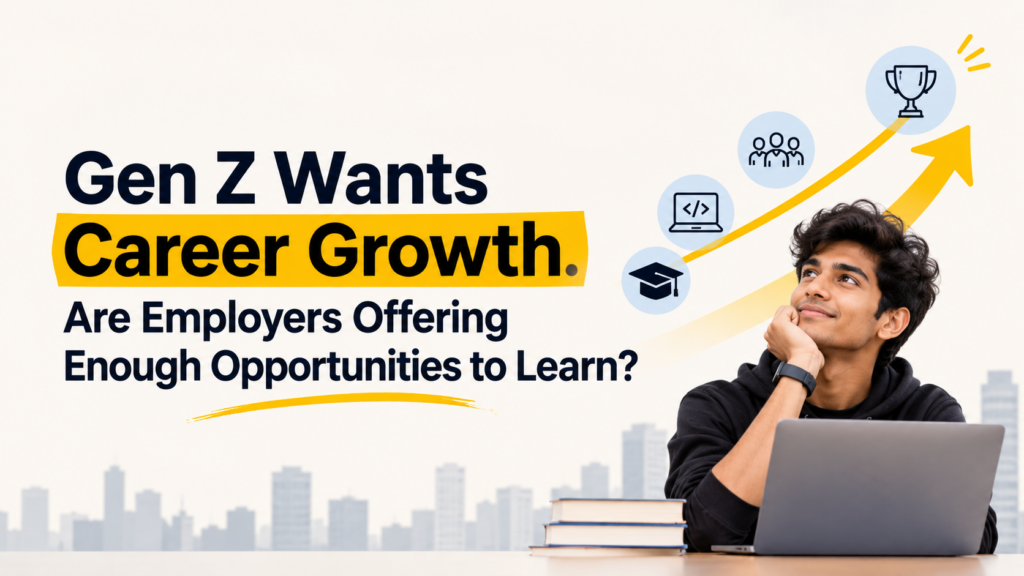
Young professionals are investing time in developing new skills, but the bigger question is whether workplaces are giving them the experience, mentorship and opportunities needed to turn that learning into career progress.
A young employee completes an online certification in data analytics after work. Another spends weekends learning generative AI tools. A marketing executive experiments with new digital platforms, while an engineering graduate builds small projects to strengthen their technical portfolio.
For many young professionals, learning is no longer confined to classrooms, training sessions or the first few months of a new job. It has become an ongoing activity, driven by the need to remain relevant in a workplace where technology, business models and job requirements are changing rapidly.
But there is an important question employers need to consider: if young employees are investing so much time in developing their capabilities, are organisations providing enough opportunities to apply those skills, learn from experienced colleagues and progress in their careers?
The issue is not simply whether companies offer training programmes. It is whether employees are getting meaningful opportunities to grow.
For India’s Gen Z workforce, career development increasingly involves a combination of practical experience, continuous learning, mentorship and exposure to new responsibilities. And this is creating an opportunity for employers to rethink what professional growth should look like.
Learning is becoming a career priority
The emphasis young professionals place on learning is reflected in Deloitte’s 2025 Global Gen Z and Millennial Survey, which included 505 Gen Z respondents and 304 millennials in India.
As many as 94% of Indian Gen Z respondents identified on-the-job learning and practical experience as helpful tools for career growth. The same proportion highlighted industry-specific knowledge and expertise as important for career advancement, while 91% identified technical skills related to their field as important.
The findings also reveal that young professionals are not looking at learning through a single channel. Mentorship and guidance from experienced colleagues were considered helpful by 91% of Indian Gen Z respondents. Professional networks and communities received the same response, while 90% highlighted peer learning, collaboration and formal training programmes.
These findings suggest that career development is not just about completing courses or collecting certificates. Young employees value opportunities to learn by doing, interact with experienced professionals and develop capabilities through everyday work.
The survey also found that 85% of Indian Gen Z respondents were developing skills to advance their careers at least once a week.
In other words, learning is already part of their routine. The question is whether their employers are keeping pace.
Career growth does not always mean a promotion
One reason the conversation around career development needs to change is that professional growth is often measured too narrowly.
In many organisations, career progression is associated with promotions, salary revisions, new designations and movement into managerial positions. These remain important, but they do not represent every form of professional advancement.
A young employee may want to become better at data analysis, take responsibility for a larger project, understand a different business function or gain exposure to clients. Another may want to develop leadership skills without necessarily moving into a management role immediately.
Naukri’s 2026 report, The Gen Z Work Code: What Drives, Engages, and Retains Them, based on a survey of more than 23,000 Gen Z professionals across over 80 industries, found that 57% defined career growth as learning new skills on the job rather than receiving promotions.
The finding is worth considering. It suggests that employers may need to look beyond traditional promotion cycles when assessing whether employees feel they are progressing.
For a generation entering industries where job roles are evolving quickly, the ability to acquire new capabilities can be as important as moving up an organisational hierarchy.
A professional who learns to work with new AI tools, manages a cross-functional assignment or develops expertise in a specialised area may be making meaningful career progress even without a change in designation.
The missing link: learning opportunities at work
Organisations have invested in learning management systems, online course subscriptions, workshops and employee development programmes. These initiatives can be useful, particularly when employees need to understand new technologies or build foundational knowledge.
However, access to learning content does not automatically translate into career development.
An employee may complete a course in artificial intelligence but never get an opportunity to use AI tools in a real project. A marketing professional may learn about analytics but continue working on assignments that offer little exposure to data-driven decision-making. An engineer may complete multiple certifications without getting the responsibility to work on a more complex product or system.
This creates a gap between learning and application.
The Deloitte survey’s emphasis on practical experience is particularly relevant here. While 94% of Indian Gen Z respondents considered on-the-job learning helpful for career growth, 91% also valued mentorship and guidance from experienced colleagues.
The implication for employers is straightforward: learning needs to be built into the work itself.
Giving young employees ownership of meaningful assignments, allowing them to participate in cross-functional projects, involving them in client interactions and encouraging them to experiment with new tools can make development more tangible.
A training programme may teach someone what to do. A real assignment helps them understand how to do it when deadlines, customers, budgets and business priorities are involved.
Are managers prepared to become mentors?
The immediate manager often has the greatest influence on whether a young employee gets opportunities to learn.
A manager who explains decisions, offers constructive feedback and gradually increases an employee’s responsibilities can accelerate professional development. Equally, a manager who focuses only on task completion may leave employees unsure about how to improve or what they need to do to progress.
Deloitte’s 2025 India findings reveal a gap between expectations and experience. While 62% of Gen Z respondents believed managers should provide guidance and support to team members, only 44% said this reflected their actual experience.
Similarly, 50% believed managers should teach and mentor employees, while 43% said they experienced this in practice.
This difference deserves attention. It suggests that organisations may need to equip managers with the skills and time required to develop younger employees, rather than assuming that technical expertise or seniority automatically translates into effective mentoring.
Mentorship does not necessarily require a formal programme or a senior leader assigned to every new employee. It can happen through regular feedback, project reviews, knowledge-sharing sessions and conversations about career goals.
But it does require managers to see employee development as part of their responsibility, rather than an additional activity to be addressed when time permits.
The pressure to keep up with changing skills
The urgency around learning is also being shaped by technology.
Artificial intelligence, automation and new digital tools are changing how work is performed across functions. Tasks that once required significant manual effort can increasingly be supported by software, while new roles are emerging around data, AI implementation, cybersecurity, product development and digital operations.
For young professionals, this creates both opportunity and uncertainty.
Learning a new tool may improve productivity today, but the underlying skills required for a role could change again within a few years. Employees therefore need more than short-term training in specific software. They need the ability to adapt, solve problems, communicate effectively and understand how technology can be applied to business challenges.
Deloitte’s 2026 India survey adds another dimension to this shift. It found that 93% of Indian Gen Z respondents use AI in their day-to-day work. The findings indicate how rapidly AI is becoming part of the working environment for young professionals.
This makes the role of employers particularly important. Organisations cannot expect employees to independently keep up with every new technology while providing no time, tools or practical opportunities to experiment.
A meaningful learning culture should give employees access to relevant tools, encourage responsible experimentation and allow them to apply what they learn to actual business problems.
What happens when employees have to learn outside work?
There is another side to this conversation.
When employees do not find sufficient development opportunities within their organisations, they may turn to online courses, independent projects, professional communities, certifications and external mentors.
This can be positive. Independent learning demonstrates initiative and helps individuals take ownership of their careers.
However, it also raises a question about how much responsibility for professional development is being transferred to employees.
If a young professional has to spend evenings and weekends learning the skills required to perform their current role more effectively, while the organisation offers little time or guidance, the arrangement may eventually become difficult to sustain.
The challenge is not to discourage self-learning. It is to create a balance in which organisations provide the environment and resources for development, while employees remain active participants in their own growth.
Companies that make learning part of working life may also be better positioned to identify internal talent and prepare employees for future roles.
What employers can do differently
The findings point towards a more practical approach to employee development.
First, organisations need to move beyond training participation as a measure of success. Completing a course is useful, but employers should also examine whether employees are applying new skills and taking on more complex responsibilities.
Second, managers should have a clearer role in mentoring. Regular development conversations, constructive feedback and opportunities to learn from experienced colleagues can make professional growth more visible.
Third, companies should create opportunities for internal mobility and cross-functional exposure. Employees who can explore different projects and functions may discover capabilities and interests that are not being used in their current roles.
Finally, organisations need to make learning time realistic. Encouraging employees to upskill while maintaining the same workload and deadlines can turn development into another source of pressure. Learning needs to be supported by time, access and opportunities to practise.
The future belongs to workplaces that help people grow
Gen Z’s emphasis on learning should not be mistaken for an expectation that employers must constantly provide new courses, promotions or incentives. Professional development remains a shared responsibility. Employees need to show curiosity, initiative and a willingness to build their capabilities.
But organisations also have a responsibility to create the conditions in which that effort leads somewhere.
A young employee who learns a new skill should have a reasonable opportunity to apply it. Someone who demonstrates potential should be considered for more challenging assignments. And employees who want to progress should be able to understand what capabilities and experiences will help them get there.
The larger opportunity for employers is to recognise that career growth is not an annual conversation conducted during performance reviews. It is shaped by the work people do every day, the people they learn from and the opportunities they receive.
Gen Z is not simply asking employers to offer more training. It is asking whether the workplace can become a place where learning translates into real professional growth.
And for organisations competing to attract and retain the next generation of talent, that may become one of the most important measures of an employer’s value.