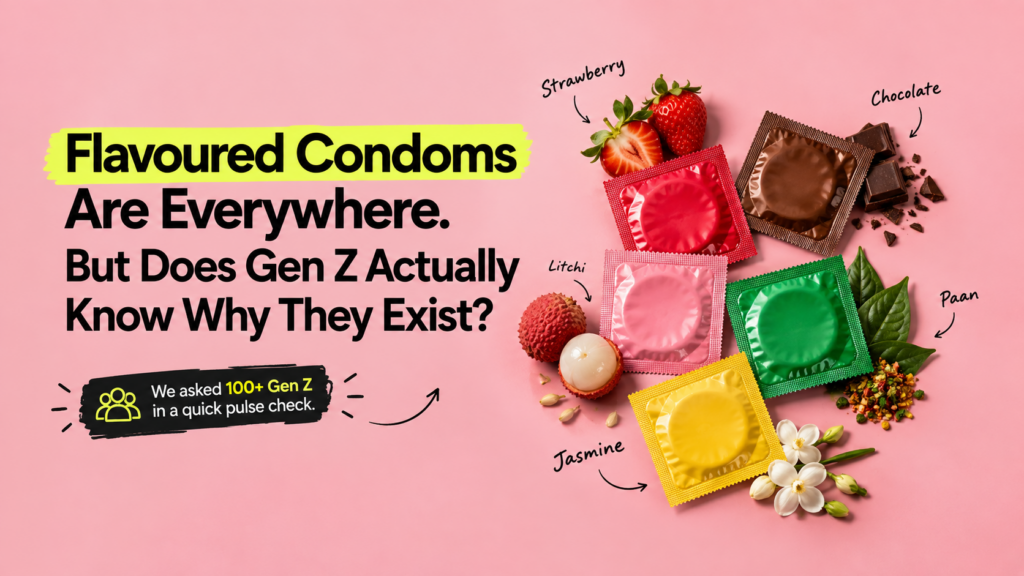
Strawberry. Chocolate. Litchi. Paan. Jasmine.
Walk into an Indian pharmacy or browse an online store and condoms are no longer simply about being ribbed, dotted, thin or extra-safe.
They can be strawberry-flavoured.
Chocolate-flavoured.
Litchi-flavoured.
Paan-flavoured.
Jasmine-flavoured.
Even combinations such as strawberry and vanilla are now being sold.
The Indian condom market has quietly transformed from a category largely associated with contraception and protection into one that increasingly talks about taste, texture, pleasure, experimentation and personal choice.
But there is an interesting question hiding behind this colourful shelf:
Does Gen Z actually know why flavoured condoms exist?
For a generation that has grown up with unprecedented access to information about relationships, sex and sexual wellness, the answer may not be as obvious as the packaging suggests.
And that makes flavoured condoms an unexpectedly interesting Gen Z consumer story.
We asked Gen Z. The answer was surprising.
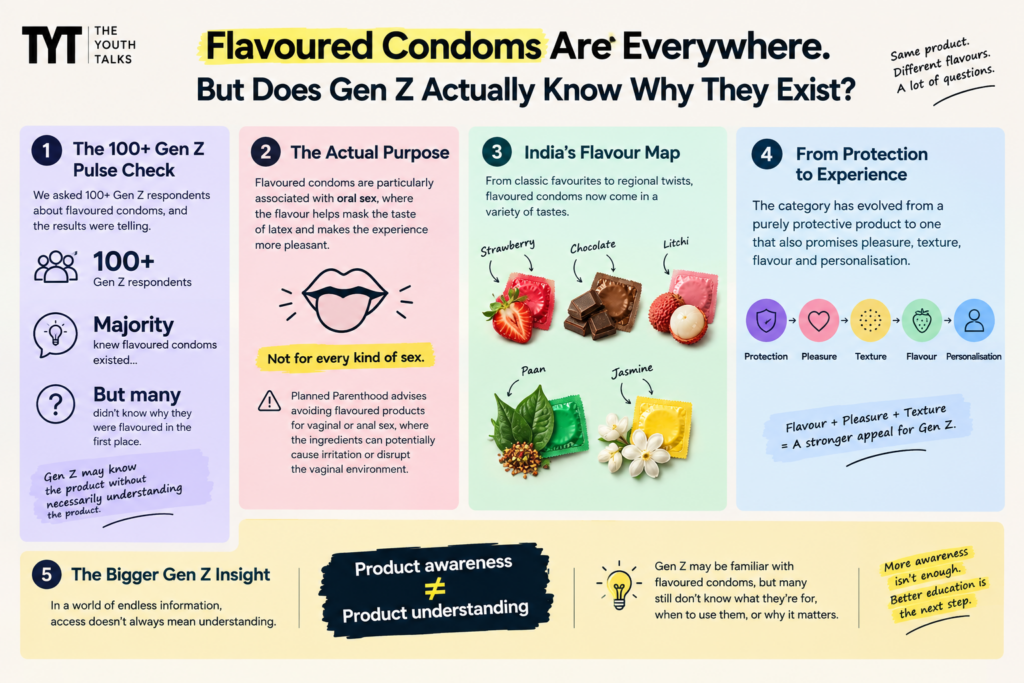
In a small TYT pulse check with 100+ Gen Z respondents, the majority knew that flavoured condoms existed — but didn’t know why they were flavoured in the first place. Many were unaware of their specific association with oral sex. The sample is informal and not representative, but it points to an intriguing gap: Gen Z may know the product without necessarily understanding the product.
1. So, what exactly is a flavoured condom?
At the simplest level, it is a condom with flavouring added to the product, usually alongside lubricant and sometimes other design features such as dots, ribs or contours.
The flavour is not necessarily there simply to make penetrative sex “taste better.”
Flavoured condoms are particularly associated with oral sex, where the flavour can mask the taste of latex and make the experience more pleasant.
Planned Parenthood specifically notes that flavoured condoms are made for oral sex. It also advises avoiding flavoured products for vaginal or anal sex where the ingredients can potentially cause irritation or disrupt the vaginal environment.
That distinction matters.
Because the name “flavoured condom” tells you what it tastes like.
It doesn’t necessarily tell you what it was designed for.
And that is where the Gen Z knowledge question begins.
2. What does Gen Z actually think it is for?
There is a fascinating disconnect between product awareness and product understanding.
A young consumer can recognise “strawberry condom” without necessarily knowing why a condom would need to be flavoured in the first place.
Is it:
- simply about novelty?
- about making sex more fun?
- about masking the smell or taste of latex?
- specifically about oral sex?
- or just another variation of a conventional condom?
The category itself doesn’t always make the distinction particularly obvious.
Look at the way brands communicate.
Manforce, for example, currently sells strawberry, chocolate, litchi and other flavoured variants, while combining flavour with claims around texture, stimulation and pleasure. Its strawberry product is positioned around flavour and “stimulating” dots, while its chocolate product combines flavour with dots and contours.
The consumer therefore encounters flavour + pleasure + protection as one proposition.
The specific sexual-health purpose can become secondary.
That is potentially one of the most interesting things to investigate among young Indians.
Gen Z may be more familiar with the product than with the reason behind the product.
3. Does everyone know that flavoured condoms are particularly associated with oral sex?
Probably not.
And that isn’t necessarily surprising.
Sexual-health education in India has historically focused much more heavily on contraception, pregnancy prevention and sexually transmitted infections than on the practical details of different forms of sexual activity.
The commercial market, meanwhile, has taken a different route.
It has increasingly sold condoms as products of experience.
That means a young consumer can encounter flavoured condoms through advertising, e-commerce or pharmacy shelves without necessarily receiving a detailed explanation of when the product is appropriate.
This is where the distinction between marketing knowledge and sexual-health knowledge becomes important.
A consumer might know that strawberry exists.
They might know that chocolate exists.
They might even have a preference.
But do they know what makes a flavoured condom different from an ordinary condom?
And do they know whether it should be used in exactly the same way?
Those are very different questions.
4. Not every condom is interchangeable
This is perhaps the most important practical point in the entire story.
“Condom” is not a single product category with identical specifications.
There are latex and non-latex condoms.
Lubricated and unlubricated condoms.
Flavoured and unflavoured condoms.
Thin, ribbed, dotted and textured varieties.
And products containing different lubricants or additional ingredients.
The fact that something is sold as a condom does not automatically mean that every formulation is suitable for every type of sexual activity.
Planned Parenthood specifically cautions that flavoured products can cause irritation and other problems when used vaginally or anally, depending on the ingredients. Consumers should therefore follow the manufacturer’s instructions and use products for their intended purpose.
That makes this more than a quirky flavour story.
It becomes a consumer-awareness story.
Because Gen Z is often described as a generation that researches everything.
But how much of that research happens when it comes to sexual wellness?
5. Strawberry and chocolate still dominate — but India has added its own flavour map
This is where the Indian market becomes particularly fascinating.
Strawberry and chocolate may sound like predictable global flavours.
But Indian condom marketing has gone considerably further.
Mankind Pharma MD Rajeev Juneja said in a 2025 interview that chocolate and strawberry were among the highest-selling flavours, while also describing regional preferences: jasmine was particularly popular in southern India, while paan had a more concentrated market in parts of northern India.
The company’s current product portfolio includes flavours such as strawberry, chocolate, litchi and paan.
This is an important clue about Indian consumer marketing.
The industry isn’t simply importing Western ideas of flavour.
It is localising the category.
Think about the difference between:
Strawberry
and
Paan.
One is a universally familiar confectionery/fruit flavour.
The other is deeply rooted in Indian taste culture.
Jasmine introduces another kind of localisation — not just taste, but a culturally familiar scent and association.
This is essentially the same principle that FMCG companies have used for decades:
If consumers understand a flavour, they may understand the product more easily.
6. From protection to experience
The bigger transformation may not actually be about flavour.
It may be about what condoms are being asked to represent.
For decades, the most straightforward condom proposition was:
Protection.
Protection from pregnancy.
Protection from sexually transmitted infections.
Responsible sex.
Then the category began adding:
Pleasure.
Thinness.
Texture.
Dots.
Ribs.
And eventually:
Flavour.
The evolution is visible in the way condom companies themselves describe their products.
Mankind has previously described Manforce’s strategy as moving the conversation around condoms beyond birth control and towards pleasure. Its current portfolio continues to organise products around flavours, textures and different experiences.
A 2022 Quartz report similarly described India’s condom market as moving towards products designed to appear more “cool” and experiential, with younger consumers increasingly targeted with flavours and other variations.
That is a significant marketing shift.
The condom is no longer being presented only as something that prevents something.
It is increasingly presented as something that adds something.
And that is a very Gen Z-friendly marketing proposition.
7. Why does India have paan and jasmine condoms?
Because personalisation works.
Indian consumers don’t all consume the same food, entertainment, fashion or beauty products.
Why should intimate products be any different?
A strawberry condom gives you a familiar global flavour.
A litchi condom gives you something recognisably Indian.
A paan flavour takes localisation even further.
Jasmine introduces regional cultural familiarity.
This is not entirely different from what has happened across India’s consumer economy.
Global products enter the country.
Indian consumers adopt them.
Brands observe differences in taste.
Then products get localised.
The result is a product that feels less imported and more culturally familiar.
The flavoured condom category is therefore an unusual example of hyperlocal consumer marketing in an intimate category.
8. And this is where Gen Z gets interesting
Gen Z has grown up with personalisation as a default.
Spotify playlists are personalised.
Instagram feeds are personalised.
Food delivery apps remember preferences.
Fashion is increasingly individualised.
Beauty brands sell routines rather than one-size-fits-all products.
Even entertainment is increasingly built around niche identities and tastes.
So why shouldn’t intimate products follow the same trajectory?
The question isn’t whether Gen Z wants “more flavours.”
It is whether Gen Z increasingly expects products to adapt to individual preferences rather than asking consumers to adapt to standard products.
Flavoured condoms are an unusually literal example.
The basic product remains the same.
But the experience can be customised around taste, texture, sensation and novelty.
And that is precisely the territory modern consumer brands understand extremely well.
The bigger Gen Z question
There is another reason this category deserves attention.
Gen Z is simultaneously one of the most digitally informed generations and one of the generations growing up amid enormous amounts of contradictory information.
TikTok.
Instagram.
YouTube.
Pornography.
Reddit.
Influencers.
Online pharmacies.
Quick commerce.
Search engines.
Friends.
Doctors.
Parents.
All of these can become sources of sexual-health information.
But they don’t necessarily provide the same information.
And commercial packaging is not sexual-health education.
That distinction matters.
A strawberry condom can tell you it tastes like strawberry.
It may tell you it is lubricated.
It may tell you that it has dots or other textures.
But the consumer still has to understand how and when the product should actually be used.
That is where the category’s marketing story meets a much bigger Gen Z issue:
access to information is not necessarily the same as understanding.
So, does Gen Z actually know why flavoured condoms exist?
That’s the question worth asking.
Not because Gen Z is uninformed.
And certainly not because young Indians need another lecture about sex.
But because the flavoured-condom category reveals an interesting contradiction in modern consumer culture:
We have made the product increasingly sophisticated while the conversation around the product can remain surprisingly basic.
Young consumers can choose between strawberry, chocolate, litchi, paan and jasmine.
They can choose thin, dotted, ribbed or textured.
They can buy them discreetly online.
They can have them delivered quickly.
But how many actually know what differentiates one type from another?
And how many understand the specific purpose and limitations of flavoured products?
That is a question worth measuring rather than assuming.