
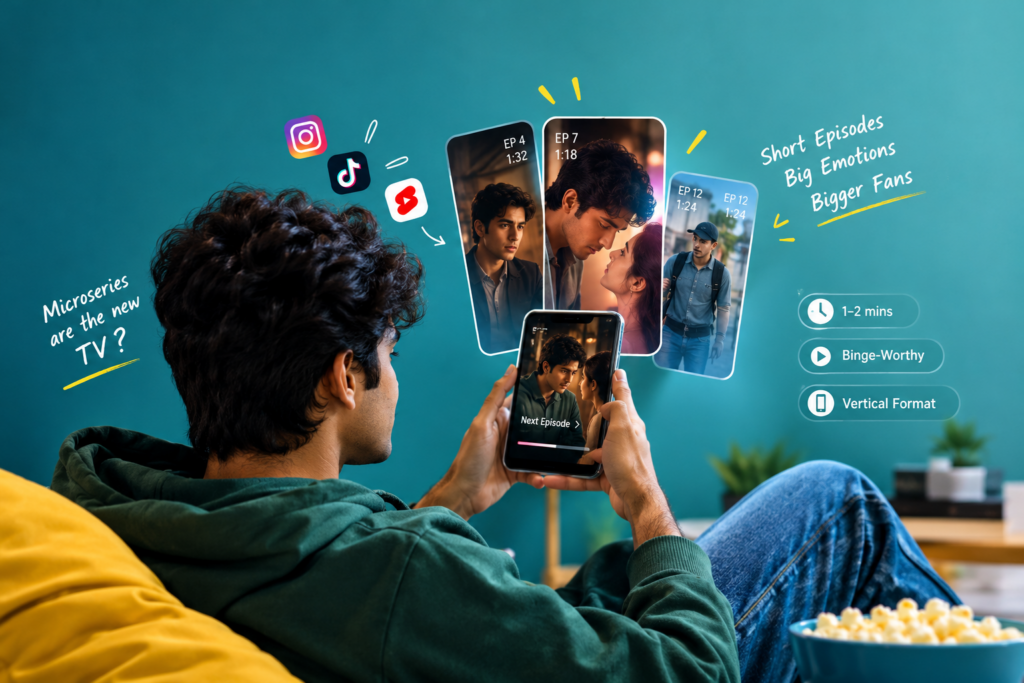
From one-minute romances and family dramas to cliffhanger-led vertical shows, microseries are opening a new chapter in India’s mobile entertainment economy. The opportunity lies not just in getting viewers to watch, but in keeping them invested in the story.
A love affair begins. A secret is revealed. A family member walks in at precisely the wrong moment. Just as the situation becomes impossible to ignore, the screen cuts to black. The next episode promises answers, but the viewer must decide whether to continue watching.
The entire sequence might take less time than it takes to finish a cup of tea.
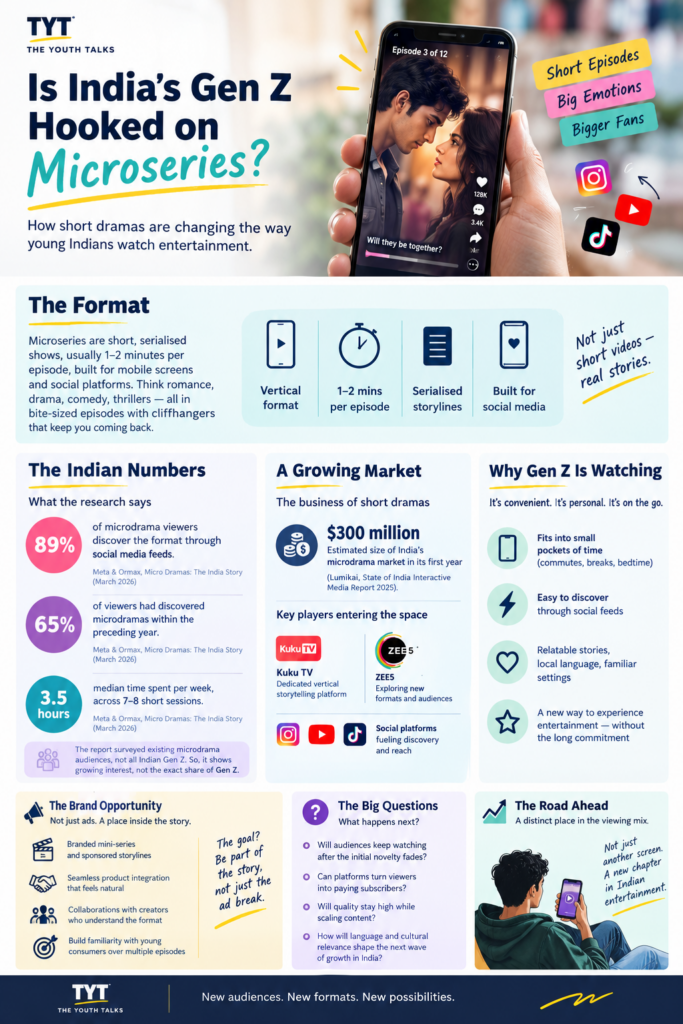
Welcome to the world of microdramas, a rapidly emerging entertainment format that is reimagining how stories are created, distributed and consumed on smartphones. Built around short, serialised episodes, often lasting one or two minutes, these shows compress the emotional highs, conflicts and cliffhangers of conventional television into bite-sized viewing experiences.
For India, where smartphones have become a primary gateway to digital entertainment, the format presents an intriguing question: could the next generation of television viewers increasingly follow their favourite fictional characters through vertical videos rather than conventional television screens?
The early numbers suggest that the opportunity is worth paying attention to. And for brands hoping to reach young Indians, microdramas could eventually offer something more valuable than another few seconds of attention: a place inside a story.
From endless scrolling to stories worth following
Short-form video is hardly new to Indian audiences. Instagram Reels, YouTube Shorts and other video feeds have made brief, easily consumed content a familiar part of everyday digital life.
Microdramas, however, are built around a different proposition.
A Reel can deliver a joke, a dance performance or a self-contained skit. A microdrama asks viewers to return for the next instalment. Its characters have continuing storylines, its conflicts develop over time, and its episodes are often designed to end at precisely the moment when viewers most want to know what happens next.
The format borrows familiar techniques from television serials and streaming dramas, but packages them for a mobile-first audience.
Romance, betrayal, family conflict, revenge and aspirational lifestyles are natural fits for this structure. The stories are easy to enter, the episodes demand relatively little time, and the narrative hook encourages viewers to keep going.
This does not necessarily mean audiences are abandoning longer entertainment. Instead, microdramas may be creating another layer in an already crowded viewing day: a format that fits between classes, during commutes, over lunch breaks or in the minutes before sleep.
For younger audiences accustomed to switching between messaging, social media, gaming and video, that flexibility could prove particularly attractive.
The Indian numbers tell an interesting story
In March 2026, Meta and Ormax Media released Micro Dramas: The India Story, a study examining how audiences discover and engage with this emerging format.
The research combined 50 in-depth interviews with 2,000 personal interviews among microdrama audiences aged 18–44 across 14 Indian states. Its findings offer one of the clearest snapshots of the category’s early development in the country.
According to the report, 89% of microdrama viewers discover the format through social media feeds. Furthermore, 65% said they had discovered microdramas within the preceding year.
The findings suggest that social platforms are doing more than distributing short videos. They are helping audiences discover an entirely different form of entertainment, often without viewers actively searching for a show.
The study also found that viewers spend a median of 3.5 hours a week watching microdramas, typically across seven to eight short sessions. Approximately 90% of viewing takes place alone.
These are significant signals for an industry still finding its feet. Discovery appears to be happening through familiar digital habits, while consumption is spread across multiple short sessions rather than concentrated in a single viewing appointment.
There is, however, an important distinction. The research surveyed existing microdrama audiences, not all Indian Gen Z. It therefore cannot establish what proportion of young Indians watches these shows.
Nevertheless, it offers evidence that the format is attracting viewers and beginning to establish recognisable consumption patterns.
Source: Meta and Ormax Media, Micro Dramas: The India Story.
A new entertainment business is taking shape
The commercial opportunity extends beyond individual shows.
According to Lumikai’s State of India Interactive Media Report 2025, India’s microdrama segment reached an estimated $300 million in its first year of meaningful adoption. The market has also attracted growing interest from entertainment companies, investors and specialist platforms.
The figure should be understood as a market estimate rather than proof that every part of the business is already profitable. Still, it indicates that short scripted entertainment is becoming a category that companies are willing to invest in.
Platforms such as Kuku TV have helped bring dedicated vertical storytelling into India’s digital entertainment landscape. Established media companies are also exploring the format, looking for ways to develop new audiences and experiment with alternative forms of content distribution.
The appeal for producers is straightforward. Shorter episodes create opportunities to experiment with pacing, storytelling and production economics. A show can be designed specifically for the mobile screen rather than adapted from a conventional television format.
But producing a series of short episodes is not simply a matter of cutting a longer programme into smaller pieces.
The writing must work differently. Characters need to become compelling quickly. Scenes must establish their purpose almost immediately, and each episode needs to deliver enough satisfaction to reward viewers while creating a reason to return.
The challenge is to make a short story feel complete enough to be enjoyable, yet unfinished enough to sustain interest.
Is Gen Z the audience to watch?
Young Indians are an obvious audience for mobile-first entertainment, but their interest should not be taken for granted.
Gen Z has access to an extraordinary range of content. A viewer can move from an international streaming series to a creator’s commentary, a gaming video, a podcast clip or a friend’s recommendation within minutes.
Microdramas must compete in that environment, where attention is fragmented and switching costs are almost negligible.
Their advantage may be convenience. A conventional series asks viewers to commit time to a longer episode. A microdrama offers a smaller initial commitment, potentially making it easier to try something unfamiliar.
Social feeds also reduce the effort involved in discovering new content. A viewer may encounter a dramatic scene without knowing the show’s title or the platform behind it. If the story is compelling, that initial exposure can become the beginning of a viewing habit.
Yet discovery and sustained engagement are different things. A dramatic clip may attract millions of views without persuading viewers to follow the full series. The real test is whether audiences develop an attachment to characters and storylines, rather than merely stopping to watch a particularly engaging moment.
For platforms, this means that strong hooks may win the first view, but writing quality, cultural relevance and consistent storytelling will determine whether viewers return.
The brand opportunity: becoming part of the story
For marketers, microdramas introduce a potentially interesting alternative to conventional digital advertising.
Much of social media advertising competes for attention in the middle of an audience’s existing activity. A microdrama, by contrast, creates a narrative environment in which a brand might participate.
Imagine a fictional college romance in which the characters use a particular food-delivery service, a coming-of-age story involving a first salary and a personal finance app, or a workplace comedy in which a technology product becomes part of everyday life.
If the integration feels natural, the brand becomes part of the viewing experience rather than an interruption.
There is also scope for branded mini-series, sponsored storylines and collaborations with creators who already understand the language of short-form storytelling. For brands targeting young consumers, such formats could create opportunities to build familiarity over several episodes rather than relying on a single impression.
However, the approach comes with risks. Audiences are quick to recognise forced product placement, and a brand that overwhelms the story may undermine the very engagement it is trying to create.
Measurement will also matter. Views and episode completions alone cannot establish whether a series improved brand recall, consideration or purchase intent. Advertisers will need to distinguish entertainment performance from actual marketing outcomes.
The opportunity, therefore, is not simply to put a product inside a short drama. It is to create a story that audiences genuinely want to watch, with the brand playing a credible role in it.
What happens when the novelty wears off?
For all the excitement surrounding microdramas, the category faces several unanswered questions.
Will audiences continue watching when the initial novelty fades? Can platforms persuade viewers to pay for episodes when so much short-form entertainment is available free of charge? And can producers maintain quality while releasing enough content to keep audiences engaged?
Language and cultural relevance will be equally important in India. Stories that resonate with audiences in one region may not translate directly to another. Regional languages, familiar social settings and locally recognisable characters could help productions connect with viewers beyond metropolitan markets.
There is also a creative challenge. Cliffhangers are effective, but a format built entirely around escalating drama risks becoming repetitive. The long-term winners are likely to be those that combine compelling hooks with credible characters, satisfying payoffs and stories worth remembering.
For Gen Z, the question is not whether a screen can deliver entertainment in one minute. It already can. The question is whether a one-minute episode can create enough emotional investment to make someone return tomorrow.
The next chapter of mobile entertainment
Microdramas do not need to replace television or streaming platforms to become significant. They only need to establish a distinct place in the daily entertainment habits of audiences.
India’s early market data suggests that the building blocks are already emerging: social feeds are driving discovery, dedicated platforms are investing in the format, and viewers are spending meaningful amounts of time following short, serialised stories.
What remains uncertain is how deeply the habit has penetrated Gen Z specifically, and whether today’s curiosity will translate into lasting loyalty.
For entertainment companies, that uncertainty represents a creative challenge. For advertisers, it is an invitation to rethink how stories and brands can work together. And for anyone studying young India’s changing media habits, it is a development worth watching closely.
The future of television may not be a single screen or a single format. It may be a collection of viewing experiences competing for different moments of the day.
And increasingly, some of those stories may be only a minute long.