
For years, influencer marketing operated on a relatively straightforward proposition: the bigger the creator’s audience, the greater the potential reach for a brand. Follower counts became shorthand for influence. Campaign proposals were built around impressions, engagement rates and the promise of visibility. And in a crowded digital marketplace, brands often gravitated towards creators who could put their message in front of the largest possible audience.
That equation is beginning to look less convincing.
As social media becomes increasingly saturated with content, artificial intelligence makes creator discovery and campaign planning more data-driven, and consumers encounter an endless stream of sponsored recommendations, brands are being pushed to ask a more important question: not simply how many people follow a creator, but how many people actually listen?
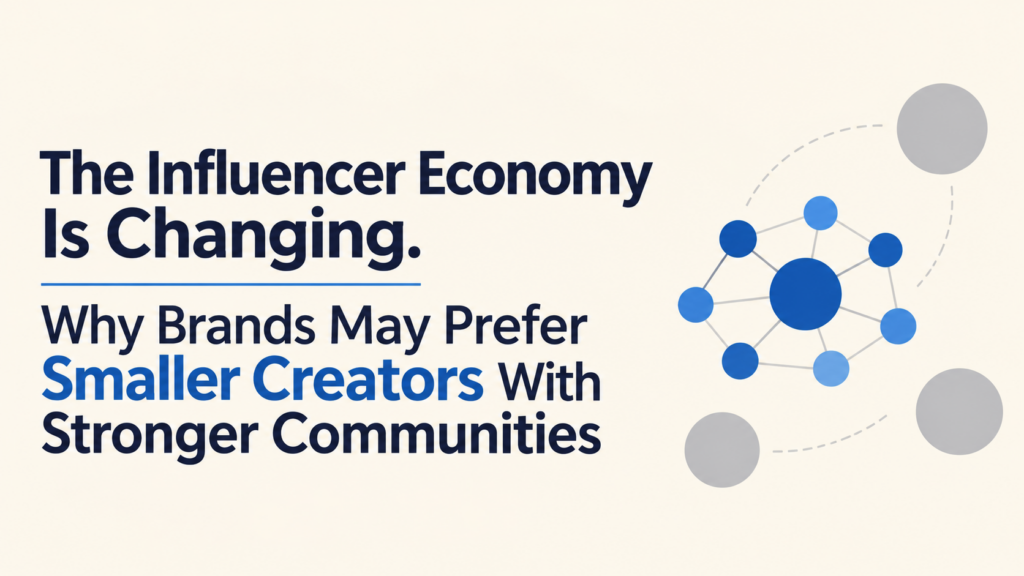
This is one of the more interesting shifts emerging from the global influencer marketing industry. The focus is moving towards smaller, more specialised creators, long-term partnerships and communities built around shared interests. Reach still matters, but it is no longer enough on its own.
For India’s Gen Z, this could have important implications. Young consumers encounter creators across fashion, beauty, technology, gaming, food, fitness, education and personal finance. Their relationship with a creator may be shaped less by celebrity status and more by whether that person understands a category, shares useful experiences or speaks to a community they identify with.
The opportunity for brands is to move beyond buying visibility and start building relevance.
The problem with measuring influence through follower counts
A creator with a million followers can deliver enormous visibility. But visibility and influence are not interchangeable.
A large audience may include people with very different interests, needs and levels of engagement. A creator may be widely recognised but have limited authority in a particular category. Another creator, with a fraction of the following, may have spent years building credibility among people who care deeply about a specific subject.
Consider a technology brand trying to reach engineering students. A mainstream entertainment creator may offer a much larger audience, but a smaller technology creator who regularly explains programming concepts, reviews laptops or discusses career pathways could be more relevant to the intended consumer.
The same logic applies to skincare, gaming, fitness, fashion or financial products. A creator’s ability to influence a decision is often connected to the context in which the recommendation is made.
This does not mean smaller creators are automatically more credible, or that large influencers have lost their value. It means that audience size is an incomplete measure of influence.
The more useful question for marketers is whether the creator has earned a meaningful place in the conversations of the people a brand wants to reach.
AI is making the limitations of reach-based selection more visible
Interestingly, artificial intelligence may accelerate this shift.
AI tools can scan thousands of creator profiles, compare audience demographics, analyse engagement patterns and produce shortlists far more quickly than a human team working manually. These capabilities can make influencer discovery more efficient. But they also expose a limitation in how creator selection has traditionally been approached.
A profile can look impressive in a spreadsheet and still be a poor fit for a campaign.
Kolsquare’s November 2026 report, Beyond the Hype: AI for Influencer Marketing, describes an experiment conducted by influencer marketing agency BeInfluence. The agency compared a group of ten creators selected by AI with ten chosen by its own team.
The AI selected two large accounts to meet the campaign’s reach objective. The agency’s human team selected smaller creators who, according to the report, matched that reach, reached different audiences and generated more engagement.
The finding is worth paying attention to, but it should be interpreted carefully. This was an agency experiment, not a universal comparison proving that smaller creators always outperform larger ones. Its significance lies in the question it raises: if a campaign can achieve its reach objective through a more diverse group of smaller creators, why should follower count dominate the selection process?
The report makes another important observation. Reach and engagement scores cannot tell a brand whether a creator genuinely lives a subject, whether their personality fits the campaign or how strong their relationships are with their community.
These are precisely the qualities that can be difficult to capture through automated selection.
AI can help marketers find creators. It cannot, by itself, determine whether those creators are the right people to represent a brand.
From one-off campaigns to longer relationships
Another development in the Kolsquare report points towards a more sustained approach to influencer marketing.
According to the report’s reference to Kolsquare’s The Future of Influencer Marketing research, 59% of organisations plan to increase spending on long-term creator partnerships. In-person influencer events and ambassador programmes are also identified as areas attracting growing attention.
The underlying shift is significant. Rather than repeatedly paying creators to deliver isolated sponsored posts, brands are increasingly considering relationships that develop over time.
A one-off collaboration can generate awareness. A longer partnership can give an audience multiple opportunities to understand a brand, see a product being used and assess whether the creator’s association feels credible.
Think about a fitness creator working with a sportswear brand. A single post announcing a new collection may create a short burst of visibility. A longer relationship could involve training routines, product demonstrations, conversations about performance and feedback from the creator’s audience.
Similarly, a technology creator working with a laptop brand could produce reviews, comparisons, tutorials and updates based on actual usage. The relationship becomes more useful when the creator has the freedom to explain the product rather than simply repeat a campaign message.
This approach also creates a different expectation from the creator. They are not merely a distribution channel for a brand’s communication. They become a continuing voice through which consumers encounter and understand the brand.
That does not guarantee trust. Long-term partnerships can also become repetitive or overly commercial if the creator’s independence disappears. The relationship needs to remain believable, and audiences should be able to recognise when content is sponsored.
But the strategic logic is clear: a series of relevant interactions may create more value than a single high-reach appearance.
Why communities may matter more than celebrity status
The phrase “community over reach” captures the direction of this change.
In the Kolsquare report, Josefine Gustafson, Director of Operations at Swedish agency We Are Era, describes how brands and agencies are likely to focus more on who they are actually engaging with rather than simply which platforms they are using.
For marketers, this is a useful distinction.
A community is not just a collection of followers. It is an audience connected by a shared interest, identity, problem or aspiration. It may form around a gaming creator, a coding educator, a beauty reviewer, a fitness enthusiast or someone documenting their early career.
The creator’s value comes partly from the context they have built around their content. Their audience returns because it expects a particular perspective, a certain kind of information or a conversation that feels relevant.
For brands, these communities can provide a more focused route into consumer conversations.
A brand targeting young professionals, for instance, may find greater relevance in a creator who regularly discusses workplace skills, first-job experiences and career decisions than in a general lifestyle influencer with a much larger following.
A beauty brand may benefit from a creator whose audience follows detailed product reviews and skincare routines. A gaming brand may find a smaller gaming community more valuable than a broad entertainment audience.
The point is not that niche communities are always commercially superior. It is that they can offer a clearer relationship between the creator, the audience and the product category.
India’s Gen Z creator economy has room for many kinds of influence
This shift deserves particular attention in India, where the creator economy spans multiple languages, regions, interests and income groups.
A young consumer in a metropolitan college and a student in a smaller city may follow some of the same celebrities, but their information needs and purchase considerations can be quite different. A creator explaining affordable technology, local fashion, career options or regional food trends may have a distinct role within a particular audience.
India’s creator ecosystem is also not limited to entertainment personalities. It includes educators, reviewers, gamers, professionals, campus creators, hobbyists and people building audiences around very specific interests.
For brands trying to understand Gen Z, this creates an opportunity to look beyond the familiar roster of high-profile influencers.
A campaign aimed at engineering students, for example, could involve technology educators, student developers and creators who discuss early-career opportunities. A brand targeting young women could explore communities built around fitness, personal finance, beauty, entrepreneurship or career progression rather than assuming that one celebrity endorsement will reach everyone meaningfully.
However, it would be premature to claim that Indian Gen Z universally prefers micro-influencers or trusts smaller creators more. The Kolsquare findings discussed here are drawn from international industry research and agency experience; they do not establish the preferences of Indian young consumers.
That is a question worth examining through India-specific research: whom do young people actually trust, which creator categories influence their decisions, and does the size of a creator’s following affect that trust?
These distinctions matter if brands want to build strategies around evidence rather than assumptions.
The risk: smaller creators can become just another advertising inventory
There is a potential contradiction in the industry’s enthusiasm for micro-influencers.
If brands identify smaller creators only because they offer cheaper access to a narrowly defined audience, they risk reproducing the same transactional model at a different scale.
A creator who is approached by multiple brands for repetitive promotional posts may eventually lose the very quality that made their community valuable. An audience that once came for personal experience, useful advice or a distinctive point of view may begin to see a stream of commercial messages.
Smaller creators are not automatically more authentic. Nor does a niche audience guarantee genuine influence.
Brands need to evaluate the quality of the relationship, not simply the size of the account. Does the creator understand the category? Do followers engage with substance rather than just leave generic reactions? Is there consistency between the creator’s usual content and the product being promoted? Can the creator explain why a product is relevant to their audience?
There is also a responsibility to respect creative independence. If a brand dictates every sentence, every visual and every opinion, it may remove the individuality that attracted the audience in the first place.
A good partnership should give creators a clear brief and genuine room to communicate in their own voice, while maintaining transparency around commercial relationships.
What this means for brands and marketing teams
For marketers, the change does not require abandoning celebrity influencers or large creators. Different campaign objectives call for different kinds of influence.
A large creator may still be effective for a major product launch, mass awareness or a cultural moment. Smaller creators may be better suited to specialist education, product demonstrations, category credibility and sustained engagement with defined communities.
The more useful approach is to build a portfolio rather than rely on a single type of creator.
There are five questions brands should consider when evaluating that portfolio:
- Audience relevance: Does the creator reach the people the brand actually wants to engage, rather than simply offer a large follower count?
- Category credibility: Does the creator have genuine knowledge, experience or a consistent interest in the subject?
- Community quality: Do followers participate in meaningful conversations, ask questions and return for the creator’s perspective?
- Creative fit: Can the creator communicate the product naturally without turning every post into an advertisement?
- Long-term potential: Is there a reason for the brand and creator to work together beyond one campaign?
Measurement also needs to evolve. Reach, impressions and engagement remain useful, but they should be considered alongside audience quality, meaningful interactions, content performance over time, brand consideration and, where measurable, commercial outcomes.
AI can help make this evaluation more systematic. It can identify patterns, flag suspicious activity, organise creator data and help teams build initial shortlists. But final decisions still need human judgement.
The Kolsquare report makes a compelling case for keeping strategy, creative judgement and creator relationships in human hands while using AI for data-heavy groundwork. That distinction is especially important when the objective is to find a creator whose relationship with an audience cannot be reduced to a dashboard score.
The future of influence may be smaller, but it will need to be more meaningful
The influencer marketing industry spent years rewarding scale. The next phase may reward something harder to manufacture: relevance.
As AI makes content production and creator discovery more efficient, the number of possible brand partnerships is likely to grow. But more content does not necessarily mean more attention, and more visibility does not automatically create trust.
For brands, the challenge will be to identify creators who have a genuine connection with the audiences they want to reach, and then build partnerships that preserve that connection.
For creators, it may mean that a smaller but engaged community can become a meaningful professional asset, provided it is built on consistency, credibility and a recognisable point of view.
And for Gen Z, the most influential person may not always be the one with the largest following. It could be the creator whose recommendation feels relevant, whose experience is useful and whose voice has earned a place in a community.
The next big influencer may not necessarily be the one everyone knows. It may be the one a particular audience listens to.
This article draws on Kolsquare’s November 2026 report, Beyond the Hype: AI for Influencer Marketing, including its discussion of creator selection, the BeInfluence agency experiment and the shift towards long-term partnerships. The report’s findings are international industry evidence and should not be read as a measurement of Indian Gen Z preferences.