
From communicating with managers to handling feedback and solving unfamiliar problems, here are the workplace skills Indian students and young professionals need to build beyond their degrees.
A good degree can help you get shortlisted. Technical skills can help you demonstrate what you know. But what happens when you join your first workplace and have to explain an idea to your manager, handle unexpected feedback, work with people you barely know, or deliver a project when the instructions aren’t entirely clear?
These are the moments when academic knowledge alone may not be enough.
For students and recent graduates entering the workforce, the transition from college to a job involves more than learning new tools or understanding a role. It also means learning how to communicate professionally, manage competing priorities, work through disagreements and take responsibility when things don’t go to plan.
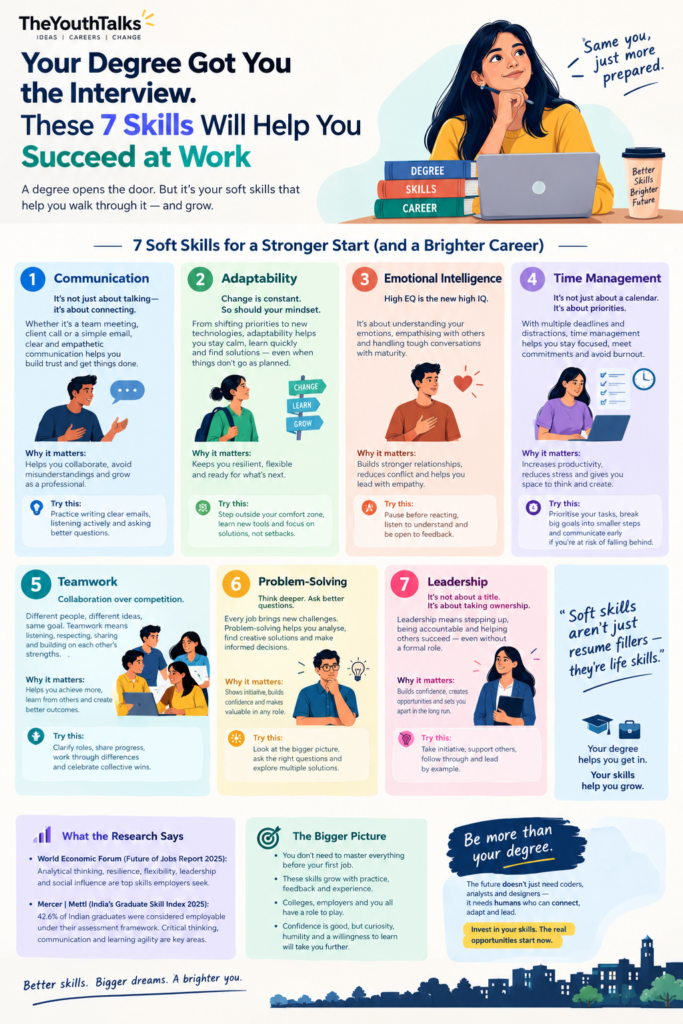
Often grouped under the term soft skills, these abilities are an important part of workplace readiness. The World Economic Forum’s Future of Jobs Report 2025 identifies analytical thinking, resilience, flexibility and agility, and leadership and social influence among the leading core skills employers seek. Creative thinking, self-awareness, empathy and active listening also feature prominently.
The message is clear: employers need people who know their work, but they also need people who can think, learn, collaborate and respond to change. These abilities become particularly important as technology and artificial intelligence reshape how work gets done.
The encouraging part is that these skills aren’t reserved for naturally confident people or born leaders. They can be developed through practice, feedback and experience.
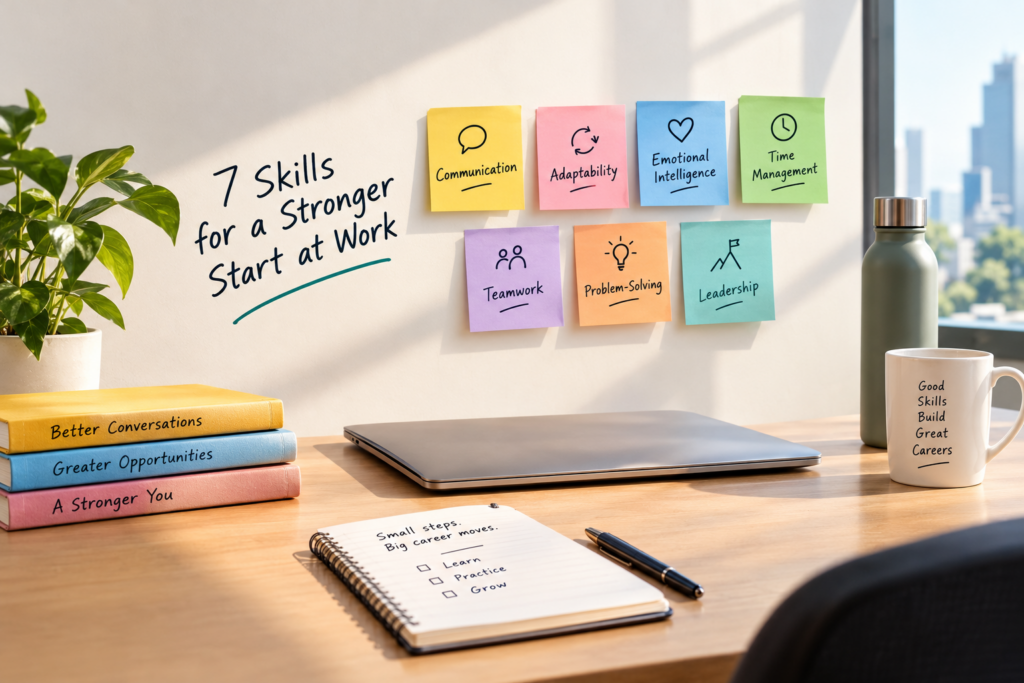
Here are seven workplace skills worth building before—and during—the first few years of your career.
1. Communication: Knowing How to Express Yourself at Work
Being able to speak confidently in a college presentation is useful. Communicating effectively at work, however, involves a different set of challenges.
You might need to explain why a project is running late, ask your manager for clarification, respond to a client’s concerns or disagree with a colleague without making the conversation unnecessarily uncomfortable. Sometimes, the most important communication skill is knowing when to listen rather than speak.
For a first-time employee, this can be a learning curve. In college, students are often evaluated on presentations, written assignments and examinations. At work, communication is also judged by whether other people understand what you mean, know what action to take and can rely on the information you provide.
Consider a simple situation. Your manager asks you to prepare a report by Friday, but you aren’t sure which data should be included. You could spend two days making assumptions and eventually submit something that misses the brief. Or you could ask a few focused questions at the beginning, confirm the expected format and clarify the deadline.
The second approach might seem less impressive in the moment, but it saves time and demonstrates professional judgement.
How to build it: Practise writing concise emails, summarising meetings, asking specific questions and giving clear progress updates. If you’re unsure about an assignment, repeat your understanding of the task before starting. Learn to distinguish between a message that sounds polished and one that actually communicates what is needed.
2. Adaptability: Learning to Work When Things Change
College assignments often come with a defined brief, a submission date and an evaluation framework. Workplaces can be considerably less predictable.
A client may change their requirements halfway through a project. A manager may ask you to prioritise an urgent task. A new tool may alter the way your team works. You might discover that the solution you spent days developing does not address the actual problem.
Adaptability is the ability to respond constructively to these changes without losing sight of the objective.
It does not mean accepting every last-minute request without question or constantly working beyond your capacity. It means understanding what has changed, identifying what matters most and adjusting your approach where necessary.
This ability is becoming increasingly relevant as organisations introduce new technologies and reconsider how different roles operate. The World Economic Forum’s 2025 report places resilience, flexibility and agility among the most important skills employers need, while also identifying technological literacy and curiosity as important to the evolving workforce.
For young professionals, the lesson is not to master every new tool that appears. It is to become comfortable with learning unfamiliar things and recognising when an existing approach no longer works.
How to build it: Volunteer for projects outside your usual area of responsibility, learn unfamiliar software when a task requires it and ask for feedback on how you approach problems. When plans change, focus first on what the new situation requires rather than on what went wrong.
Adaptability also involves knowing when to seek help. Trying to solve everything independently is not a sign of resilience if it prevents you from meeting a deadline.
3. Emotional Intelligence: Understanding Yourself and Others
A colleague disagrees with your idea during a meeting. Your manager points out mistakes in your work. A teammate misses a deadline, leaving you to finish a shared assignment.
These situations can trigger frustration, embarrassment or defensiveness. How you respond can influence not just the immediate outcome, but also the relationships you build at work.
Emotional intelligence involves recognising your own emotions, understanding how they influence your behaviour and responding thoughtfully to the feelings and perspectives of others.
For Gen Z entering the workforce, this does not mean suppressing emotions or accepting inappropriate behaviour in the name of professionalism. It means learning to distinguish between a difficult interaction and a personal attack, while communicating concerns respectfully and maintaining reasonable boundaries.
Imagine receiving critical feedback on a presentation you worked hard on. An instinctive response might be to explain why every decision was justified. A more constructive response would be to understand the criticism, ask which parts need improvement and decide what you can learn from it.
You do not have to agree with every piece of feedback. But being able to consider it without immediately becoming defensive makes it easier to improve.
Emotional intelligence also includes empathy. A colleague may approach a problem differently because of their experience, responsibilities or working style. Understanding that difference can help you collaborate without assuming that everyone should think or behave exactly as you do.
How to build it: Pause before responding when a conversation becomes uncomfortable. Listen to understand rather than simply preparing your reply. Ask for clarification when feedback feels vague, and learn to express disagreement without attacking the person making the argument.
Self-awareness is equally important. Recognising your strengths, limitations and triggers helps you understand where you need support and where you can contribute most effectively.
4. Time Management: Delivering What You Promise
At college, students often manage several assignments, examinations, extracurricular activities and placement preparations simultaneously. Yet the workplace introduces a different kind of challenge: multiple people may depend on your work being completed at a particular time.
A delayed presentation might hold up a client meeting. An unfinished analysis might prevent a teammate from completing their section. Failing to communicate a delay can create a bigger problem than the delay itself.
Time management, therefore, is not simply about maintaining a calendar or downloading a productivity app. It is about setting priorities, estimating how long tasks will take, meeting commitments and communicating early when something is at risk.
One common mistake among new employees is treating every request as equally urgent. Another is agreeing to deadlines without considering existing responsibilities. Both can lead to rushed work and unnecessary stress.
A more effective approach begins with understanding which tasks have the greatest impact, which deadlines are fixed and which activities can be rescheduled. Breaking a large assignment into smaller milestones can also make progress easier to track.
Technology can help. Digital calendars, task managers and focus timers can organise your workload. But no tool can make prioritisation decisions for you.
How to build it: At the beginning of each day, identify your most important tasks. Break complicated assignments into manageable steps and set aside time for focused work. If you realise you cannot meet a commitment, inform the relevant person early and propose a realistic alternative.
Reliability is built through repeated actions. People learn to trust you when your commitments mean something.
5. Teamwork: Learning to Succeed With People Who Think Differently
College projects often reveal an uncomfortable truth: being good at your own part of an assignment does not necessarily make you good at working in a team.
The same is true at work. Projects bring together people with different skills, priorities, communication styles and levels of experience. A designer may approach a problem differently from an analyst. A marketing colleague may prioritise customer response, while a finance colleague focuses on costs and returns.
These differences can improve the quality of a project, but only if the team can work through them.
Teamwork involves more than being friendly or attending meetings. It requires people to share information, respect responsibilities, offer help when appropriate and remain accountable for their own contributions.
For a young professional, one important lesson is that collaboration does not mean agreeing with everyone. A team benefits when people raise concerns, question assumptions and offer alternative ideas. The challenge is to do so constructively, without turning every disagreement into a contest.
It also means giving credit where it is due. Taking responsibility for your contribution is important; taking credit for somebody else’s work undermines trust.
Campus clubs, hackathons, volunteering initiatives and group assignments can all provide opportunities to practise these behaviours before entering a full-time role.
How to build it: Clarify responsibilities at the beginning of a project. Share progress before someone has to chase you for an update. If a teammate is struggling, understand the problem before assigning blame. When disagreements arise, bring the conversation back to the shared objective.
You may not choose every person you work with. Learning to collaborate across differences is part of becoming an effective professional.
6. Problem-Solving: Moving Beyond Identifying What Is Wrong
Every workplace has problems that do not arrive with a neat set of instructions.
A marketing campaign may receive fewer responses than expected. A customer may report an issue nobody on the team has encountered before. A spreadsheet may contain conflicting figures. A process that worked last month may no longer be effective.
In these situations, employers need people who can move beyond identifying a problem and help work towards a solution.
Problem-solving starts with asking the right questions. What exactly is happening? What evidence do we have? Which assumptions are we making? What might be causing the issue? What can we test before committing to a solution?
This is closely connected to analytical thinking, which the World Economic Forum identified as the leading core skill in its 2025 report, with 69% of surveyed employers considering it essential for their workforce.
For young professionals, the practical implication is important: being resourceful matters, but so does knowing how to evaluate information rather than accepting the first plausible answer.
Artificial intelligence can help generate ideas, summarise information and accelerate research. However, the ability to check whether an answer is accurate, relevant and appropriate to the situation remains valuable. A confident-sounding answer is not necessarily a correct one.
Suppose you are asked to investigate why registrations for a campus event are lower than expected. Instead of immediately suggesting more social media posts, you could examine when registrations declined, which channels generated responses, whether the event details were clear and whether the intended audience found the offering relevant.
The quality of the solution depends on how well you understand the problem.
How to build it: Practise analysing real-world situations through college projects, case competitions, internships and personal initiatives. Look for evidence before reaching conclusions. Compare possible solutions, consider their trade-offs and explain why you recommend a particular course of action.
You are not expected to know everything as a fresher. You are expected to demonstrate that you can think through a challenge and make a considered effort to resolve it.
7. Leadership: Taking Ownership Before You Have a Title
Leadership is often associated with managers, team heads and people responsible for making important decisions. But many of the behaviours that make someone a good leader can be demonstrated long before they receive a formal title.
For a young professional, leadership might mean volunteering to coordinate a project, noticing a problem and proposing a solution, helping a new intern understand a process or admitting a mistake instead of hiding it.
At its core, leadership involves taking responsibility for moving something forward.
This does not mean working beyond your role at every opportunity or saying yes to every additional task. Nor does it mean taking control of a team simply because you believe you have a better idea.
Effective leadership requires judgement. It involves recognising when to act independently, when to consult others and when to escalate a problem. It also requires the humility to accept that someone else may have a better solution.
For Gen Z, developing this skill can begin in familiar environments. Organising a college festival, managing a student society, coordinating a group project or leading a volunteering initiative can provide valuable experience in handling responsibilities and working with people.
These experiences become particularly meaningful when you can explain what you actually did: how you handled a disagreement, managed a limited budget, coordinated different contributors or responded when something went wrong.
How to build it: Look for opportunities to take ownership of a specific outcome. Keep people informed, follow through on commitments and acknowledge mistakes when they occur. Help others succeed rather than focusing exclusively on your own performance.
Leadership is not about appearing important. It is about becoming someone others can depend on.
The Bigger Picture: You Don’t Need to Master Everything Before Your First Job
It is easy to read a list of workplace skills and conclude that you need to become an excellent communicator, a confident leader, an analytical thinker and a perfectly organised professional before you are ready to work.
That is an unrealistic expectation.
Most people develop these abilities through experience. Your first internship may teach you how to communicate with a manager. Your first difficult project may reveal gaps in your planning. Your first disagreement with a colleague may help you understand how you respond to criticism.
What matters is whether you learn from these experiences.
The challenge is particularly relevant in India, where a large number of young people are preparing to enter a competitive employment market. Mercer | Mettl’s India’s Graduate Skill Index 2025, which analysed more than one million students across over 2,700 campuses, reported that 42.6% of Indian graduates applying for jobs were considered employable overall under its assessment framework. The report also highlights critical thinking, communication and learning agility as important areas of workforce readiness.
This figure should not be interpreted as proof that the remaining graduates lack ability or potential. Employability assessments measure performance against particular criteria; they do not define an individual’s future. But the findings underline why academic qualifications and job readiness should not be treated as interchangeable.
The responsibility for developing workplace skills also does not rest entirely on students. Colleges can create more opportunities for applied learning, employers can provide better onboarding and mentoring, and organisations can make expectations clearer for early-career employees.
Young professionals, meanwhile, can take a more active role in their own development. Seek feedback instead of waiting for an annual review. Participate in projects where you must work with people outside your usual circle. Practise explaining your ideas clearly. Learn to use technology responsibly. Reflect on what went well and what you would do differently next time.
Most importantly, do not confuse confidence with competence. You do not need to have an immediate answer to every question. Being willing to ask, learn, verify and improve is itself a valuable professional habit.
Your degree remains important. Your technical skills remain important. But the ability to apply what you know, work with others and respond thoughtfully when circumstances change can make a significant difference to how you grow in your career.
The first job is not the point at which you should have everything figured out. It is where a new phase of learning begins.
Your degree may help you get your foot in the door. What you learn, how you work and how you treat the people around you will help shape what happens next.
Sources and further reading
- World Economic Forum, Future of Jobs Report 2025: Skills Outlook
- Mercer | Mettl, India’s Graduate Skill Index 2025