
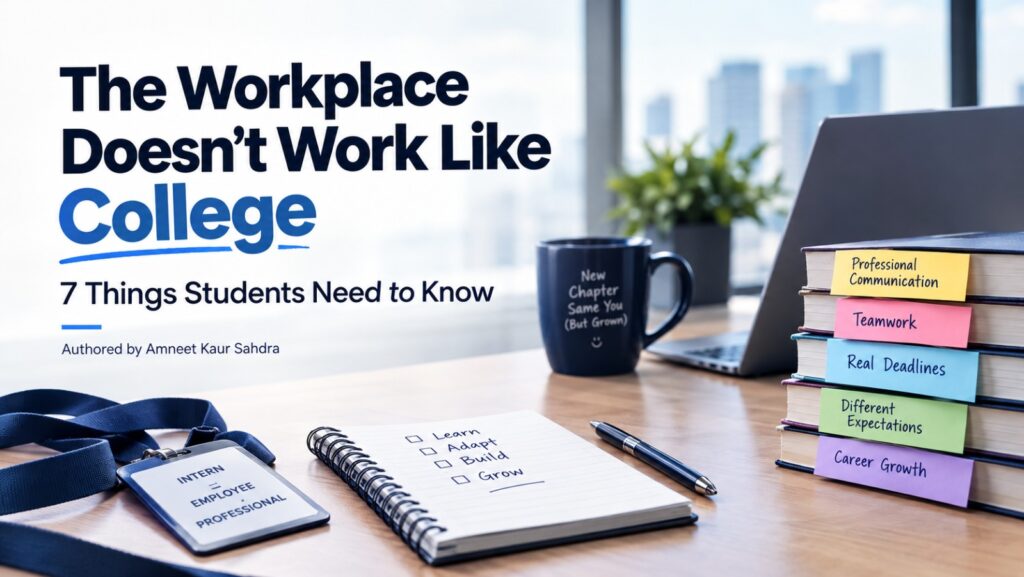
For most students, college is a fairly structured environment. There is a timetable, a syllabus, a set of assignments, an examination calendar and, most importantly, a clear system of evaluation. You generally know what is expected of you and how your performance will be measured.
The workplace is very different.
For many young professionals, the biggest challenge in moving from college to work is not a lack of knowledge. It is the sudden absence of structure. There is no syllabus that tells you what to learn next, no exam that clearly defines success and no professor who is responsible for making sure you understand everything.
This shift can be unsettling, especially for students who have performed well academically. The habits that helped someone succeed in college are certainly useful, but they are not always enough to succeed at work. As explained by Mrs. Amneet Kaur Sahdra, Founder of Catalyze, the workplace demands a different level of judgement, ownership, communication and adaptability.
Understanding this difference early can make the transition from student to professional far smoother.
- Hard work is important, but outcomes matter more
College often rewards effort in visible ways. Students attend classes, complete assignments, study for examinations and receive marks for their performance. The connection between effort and reward is fairly direct.
At work, effort is important, but it is usually not the final measure of performance. Organisations are interested in the outcome that effort creates.
A young employee may spend several hours preparing a presentation, but the real question will be whether the presentation solved the problem it was meant to address. A person may work late into the evening, but the organisation will ultimately look at whether the project moved forward, the client received what was promised or the issue was resolved.
This does not mean that effort has no value. It means that professionals must learn to connect effort with purpose.
A useful question to develop early in a career is: What is this work expected to achieve? That simple question can completely change how a person approaches a task.
The instructions may not always be clear
Students are usually used to defined questions. An assignment may specify the topic, word count, deadline and sometimes even the format in which the answer needs to be presented.
Workplace problems rarely arrive that neatly packaged.
A manager may simply say, “Can you look into this?” or “Can you put something together for tomorrow?” Sometimes the information available will be incomplete. At other times, there may be several possible ways to solve the problem.
This is where professional judgement begins to matter.
Young professionals need to learn how to ask the right questions, clarify the objective, identify missing information and make reasonable assumptions. More importantly, they need to become comfortable with the fact that there may not always be one correct answer.
The ability to move forward despite ambiguity is one of the most valuable capabilities a student can build before entering the workplace.
- Communication is about clarity, not complexity
Many students enter the workplace believing that strong communication means using sophisticated language, speaking confidently or sounding highly knowledgeable.
Professional communication is often far simpler.
A strong communicator is someone who can explain a complicated issue clearly. It is someone who can write an email that helps the reader understand what needs to happen next. It is someone who can listen carefully, ask relevant questions and present an idea without unnecessary complexity.
In the workplace, clarity saves time. Poor communication creates confusion, delays decisions and often leads to avoidable mistakes.
This is why communication should not be seen merely as a “soft skill”. It directly influences how effectively work gets done.
- A manager is not the same as a teacher
One of the most important shifts for a young professional is understanding that a manager plays a very different role from a teacher.
A teacher’s primary responsibility is to educate students. A manager, on the other hand, is responsible for delivering results while managing people, deadlines, clients, budgets and several competing priorities.
A good manager will support learning, but young professionals cannot expect to be taught every step of the way.
They need to take greater responsibility for their own development. This may mean asking for feedback, observing experienced colleagues, doing independent research or attempting to solve a problem before immediately asking someone else for the answer.
The workplace rewards people who are willing to learn, but it values those who also take ownership of that learning.
- Reliability can matter as much as talent
Students are often encouraged to stand out by being intelligent, creative or exceptionally skilled. These qualities certainly matter in professional life. However, early in a career, something much more basic often determines how quickly a person earns trust: reliability.
Can people depend on you?
If you say you will complete something by a certain time, do you deliver it? If a deadline is likely to be missed, do you communicate early? If you make a mistake, do you acknowledge it and correct it? If someone explains something important, do you remember it the next time?
These behaviours may appear simple, but they form the foundation of professional credibility.
Talent may get someone noticed, but consistency and reliability are often what make others trust them with greater responsibility.
- Feedback is not the same as a grade
Students spend years being evaluated through marks and grades. As a result, feedback can sometimes feel personal, especially when it is critical.
Professional feedback needs to be understood differently.
If a manager says that a report needs more structure, it is not necessarily a judgement on the employee’s ability. It is information about how the work can improve. If someone is told that they need to communicate earlier or manage their time better, the feedback is highlighting a behaviour that can be changed.
The most successful professionals tend to develop a healthy relationship with feedback. They do not see every correction as criticism. Instead, they try to understand what they can learn from it.
This mindset is particularly important in the early years of a career, when almost every experience can become a learning opportunity.
- Career growth is no longer automatic
College provides a clear path of progression. Students complete one year, move to the next and eventually graduate.
Careers are far less predictable.
Simply spending time in an organisation does not automatically lead to growth. Professionals need to think consciously about the capabilities they are building, the experiences they are gaining and the value they are creating.
Instead of focusing only on the next title or promotion, young professionals should regularly ask themselves: What am I becoming better at?
Are they learning how to solve more complex problems? Are they becoming stronger communicators? Are they learning how to work with different kinds of people? Are they taking greater ownership of their work?
Career growth is rarely about one dramatic opportunity. More often, it is the result of capabilities being built gradually over time.
Preparing students for the world beyond placement
Career readiness is often discussed only when students reach their final year. The focus then shifts quickly to resumes, interviews, group discussions and placement preparation.
These are important, but they address only one part of the transition. Getting a job and being ready for the workplace are not the same thing.
True career readiness begins much earlier. Students need opportunities to work in teams, solve open-ended problems, communicate ideas, receive feedback, take ownership and operate without being given every answer.
The workplace does not expect a young professional to know everything on the first day. What it does expect is a willingness to learn, adapt and contribute.
Perhaps that is the most important message students need to hear before they graduate. A degree proves that you completed an education.
Your professional life begins when you learn how to use that education in situations where the answers are no longer written in the back of the book.
About Amneet Kaur
Amneet Kaur is an HR and Business Operations Leader with 15+ years of experience across organizations including Future Group, Skechers and Outsized. An ISB alumna, she is the Founder of Catalyze and works at the intersection of career readiness, workplace performance and people development.
About Catalyze
Catalyze is a career and workplace readiness platform focused on bridging the gap between academic potential and professional performance. It works with students, educational institutions and organizations through practical, experiential interventions designed to build confidence, capability and workplace readiness.