





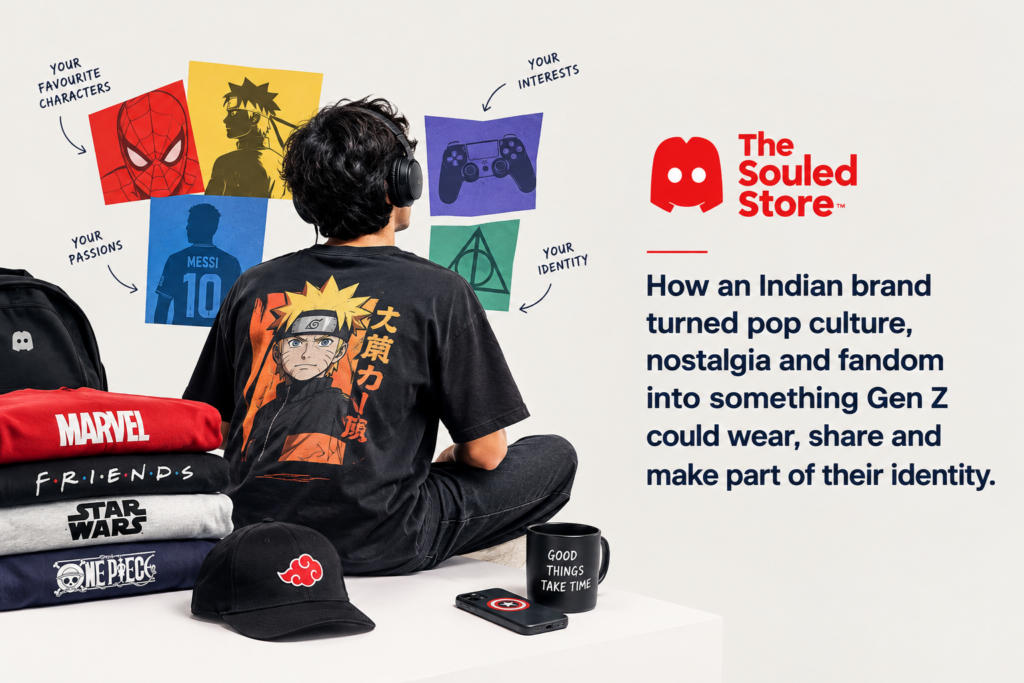
How an Indian brand turned pop culture, nostalgia and fandom into something Gen Z could wear, share and make part of its identity.
There was a time when wearing a superhero on your T-shirt meant you were probably a fan.
Today, it can mean much more.
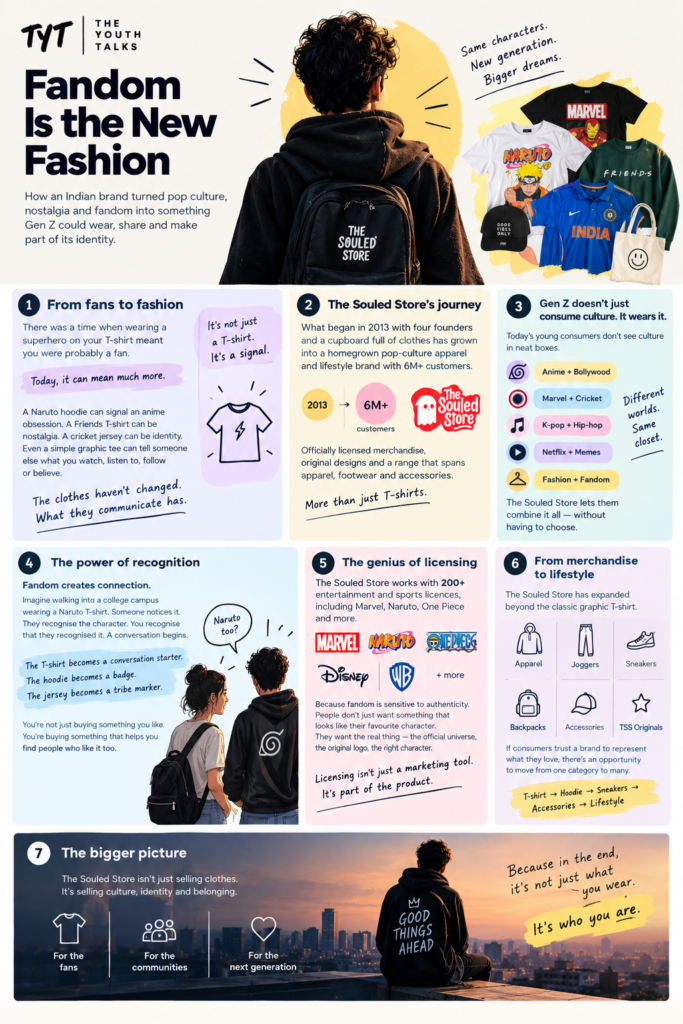
A Naruto hoodie can signal an anime obsession. A Friends T-shirt can be a piece of nostalgia. A Marvel sweatshirt can communicate a childhood connection. A cricket jersey can become an expression of identity. Even a seemingly simple graphic tee can tell someone else what you watch, listen to, follow or believe belongs to your world.
The clothes haven’t fundamentally changed.
What they communicate has.
And somewhere at the intersection of pop culture, fashion and identity sits The Souled Store.
What began in 2013 with four founders and, in the company’s own telling, little more than a cupboard full of clothes, has grown into a homegrown pop-culture apparel and lifestyle brand with more than six million customers. Its proposition spans officially licensed merchandise, original designs and categories ranging from apparel to footwear and accessories.
But the more interesting story isn’t how The Souled Store sells T-shirts.
It is why people want to wear them.
The T-shirt stopped being just a T-shirt
For a long time, branded merchandise was treated as something of a niche category.
A fan bought a poster.
A collector bought a figurine.
A tourist bought a souvenir.
A child wore a superhero T-shirt.
The Souled Store helped move that idea somewhere else.
It made fandom wearable.
Its catalogue brings together entertainment franchises, sports, musicians, comedians and other elements of popular culture, alongside its own original designs. The company describes its purpose around giving consumers products that allow them to express what they love.
That distinction is important.
Because fashion is fundamentally about expression.
And fandom is increasingly about expression too.
Put the two together and the product becomes more than fabric and print.
It becomes a signal.
Gen Z doesn’t just consume culture. It wears it.
This is where The Souled Store becomes particularly interesting from a Gen Z perspective.
Young consumers today don’t experience culture in neat categories.
Anime sits beside Bollywood.
Marvel sits beside cricket.
K-pop sits beside hip-hop.
A Netflix show can become a meme, a meme can become a fashion reference and a fashion reference can become a social identity.
The cultural boundaries are porous.
The Souled Store’s model fits naturally into this environment because it isn’t asking consumers to choose between fashion and fandom.
It allows them to combine the two.
And that creates an interesting psychological shift.
A traditional apparel brand asks:
“What do you want to wear?”
A fandom brand can ask:
“What do you want people to know you love?”
That is a very different proposition.
The power of recognition
There is another reason fandom works so well with younger audiences.
Recognition creates connection.
Imagine walking into a college campus wearing a Naruto T-shirt.
Someone notices it.
They recognise the character.
You recognise that they recognised it.
A conversation begins.
The merchandise has done something advertising cannot easily manufacture.
It has created a shared cultural reference between two strangers.
The same thing can happen with a Marvel character, a football club, a sitcom, a musician or a gaming franchise.
The T-shirt becomes a conversation starter.
The hoodie becomes a badge.
The jersey becomes a tribe marker.
The product becomes social.
And that may be one of the most powerful things about fandom commerce.
You aren’t only buying something you like. You’re buying something that helps you find people who like it too.
The genius of licensing
There is a less visible part of The Souled Store’s business that makes this model work: licensing.
The company says it has more than 200 entertainment and sports licences, with franchises including names such as Marvel, Naruto and One Piece.
That matters because fandom is unusually sensitive to authenticity.
A consumer who loves a character doesn’t necessarily want something that merely resembles that character.
They want the real thing.
The official universe.
The recognisable logo.
The correct character.
The authentic relationship with the franchise.
Licensing therefore isn’t simply a marketing tool.
It becomes part of the product proposition.
And this is one of the interesting differences between a conventional fashion brand and a fandom-led brand.
A fashion label can create its own cultural meaning.
A fandom brand can borrow the emotional meaning that already exists inside a cultural property—and translate it into a product.
That can be incredibly powerful.
But it also creates a responsibility.
The brand has to understand the fandom.
Not just the logo.
From merchandise to lifestyle
The Souled Store has gradually expanded beyond the simple graphic T-shirt.
Its current assortment includes apparel, joggers, sneakers, backpacks and other lifestyle products, alongside its licensed collections and TSS Originals.
That expansion makes strategic sense.
If consumers trust a brand to represent the things they love, there is an opportunity to move from one product category into several.
The journey could look something like this:
T-shirt → hoodie → sneakers → backpack → accessories → lifestyle
The underlying relationship stays the same.
The consumer isn’t necessarily buying a different brand each time.
They are buying different expressions of the same identity.
And that is where The Souled Store starts becoming more than a merchandise company.
It starts becoming a lifestyle platform built around culture.
The offline comeback of a digital-first brand
There is an interesting twist to the story.
The Souled Store began as a digital-first D2C company, but its growth has increasingly moved into physical retail.
The company opened its first offline store in Kamla Nagar, New Delhi, in 2019. By April 2025, it had more than 40 stores across 21 cities, covering metros as well as Tier 1 and Tier 2 locations.
That is important because fandom is inherently experiential.
There is something different about walking into a physical space filled with the characters, stories and worlds you already love.
Online, you search for a product.
In a store, you can discover a fandom you didn’t know you wanted to express.
The physical store therefore doesn’t have to compete with the website.
It can become another form of content.
Another discovery engine.
Another place where fans meet the brand.
And then came Redwolf
In April 2025, The Souled Store acquired Redwolf, another Indian pop-culture merchandise brand. Redwolf’s founders joined The Souled Store as part of the transaction.
The move is revealing.
It suggests that the company isn’t thinking only about selling more products.
It is thinking about owning a larger piece of the fandom ecosystem.
The Souled Store described the acquisition as part of its ambition to become the “Home of Pop-culture” in India.
That phrase is important.
Because the opportunity is much bigger than apparel.
If a company becomes the place where fans go to discover, buy and express their favourite cultural properties, it can potentially sit at the intersection of entertainment, fashion, community and commerce.
That is a much bigger address than “T-shirt company.”
The numbers tell one part of the story
The business has also grown significantly.
The Souled Store reported operating revenue of ₹492 crore in FY25, up from ₹360 crore in FY24, representing approximately 37% growth.
By 2025, reports around the Redwolf acquisition cited more than 8 million registered customers, 200-plus licences and daily order volumes in the range of 15,000–20,000.
These numbers demonstrate scale.
But they don’t fully explain the brand.
Because the more interesting metric may be harder to measure:
How many cultural identities can one brand represent?
A Marvel fan.
A Naruto fan.
A Harry Potter fan.
A football fan.
A Friends fan.
A sneaker enthusiast.
An anime obsessive.
A person who simply likes quirky graphic fashion.
The Souled Store doesn’t need all of these people to love the same thing.
It needs them to believe that the brand understands what they love.
The real currency is belonging
This may be the biggest lesson from The Souled Store.
Young consumers are often described as individualistic.
But individual expression and belonging aren’t opposites.
In fact, they can reinforce each other.
Gen Z may want to stand out.
But it also wants to find its people.
Fandom provides an interesting bridge between the two.
You can express yourself through a specific character, show, sport or aesthetic while simultaneously signalling that you belong to a larger community that understands the reference.
That is why fandom can be such a powerful foundation for a youth brand.
It provides both:
“This is me.”
and
“These are my people.”
The Souled Store sits directly in that space.
The challenge: culture moves faster than merchandise
But fandom isn’t automatically a permanent advantage.
Pop culture moves quickly.
Today’s biggest franchise can become tomorrow’s nostalgia.
A new anime can explode.
A series can become a global phenomenon.
A character can suddenly become a meme.
A sports moment can create an entirely new generation of fans.
The challenge for The Souled Store is therefore not simply acquiring more licences.
It is staying culturally relevant while protecting the authenticity that makes fandom valuable in the first place.
The Redwolf acquisition gives the company additional creative and licensing capabilities, while its growing retail footprint gives it more physical ways to interact with consumers.
The bigger question is how effectively it can turn all of those assets into an evolving cultural ecosystem.
From selling fandom to building fandom
That may ultimately be the next chapter for The Souled Store.
The first phase was:
Find the fandom.
Then:
Put the fandom on products.
Then:
Build a community around those products.
The bigger opportunity is:
Become a destination for the fandom itself.
That could mean deeper experiences around entertainment, anime, sports, gaming, creators and youth culture.
Because the consumer relationship doesn’t have to end when the T-shirt is delivered.
The product can start the relationship.
The community can continue it.
And the culture can keep it alive.
The bigger lesson for brands
For years, brands have tried to create emotional connections with young consumers.
The Souled Store offers a different route.
Don’t always ask people to love the brand.
Sometimes, build a brand around the things they already love.
That is a subtle but powerful distinction.
The Souled Store didn’t invent Marvel fandom.
It didn’t create anime culture.
It didn’t create the emotional attachment people have to Friends, Harry Potter, sports or music.
It created a commercial layer around those passions.
And, importantly, it gave consumers a way to wear their passions in public.
That is why the story of The Souled Store isn’t really a story about merchandise.
It is a story about identity.
About nostalgia.
About belonging.
About the increasingly blurred line between entertainment and fashion.
And about a generation for whom the things they watch, play, listen to and obsess over are increasingly part of how they introduce themselves to the world.
The T-shirt is only the canvas.
The fandom is the message.