
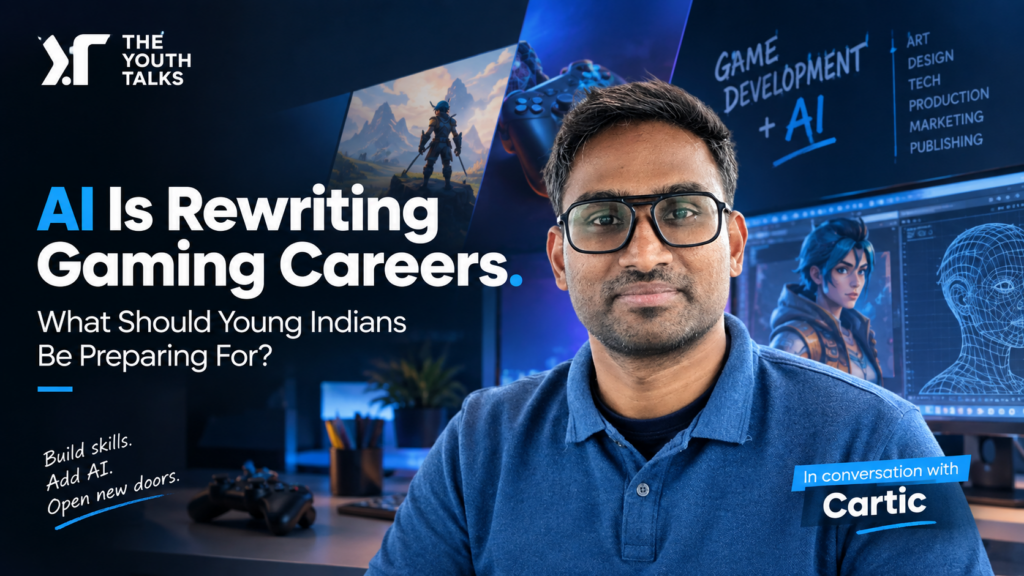
I went into my conversation with Cartic P. with a fairly simple understanding of the gaming industry: there are gamers, developers, designers and perhaps a large ecosystem around them.
I was wrong.
What emerged from our conversation was a far more complex picture — and one that should interest students and young professionals who are thinking about careers in gaming.
Gaming today is not one career. It is an ecosystem.
Beyond programmers and designers, there are environment artists, concept artists, character artists, weapon artists, rigging and effects specialists, producers, QA professionals, marketers, business development teams, store managers, publishing professionals and people working on analytics and monetisation. In larger studios, these roles become increasingly specialised.
Cartic, who has spent more than a decade in the gaming industry and has worked across production, publishing and game development, believes this breadth is still poorly understood in India.
But the bigger disruption is already here: AI is changing the way games are made.
From generating character concepts and 3D assets to accelerating UI design, testing and research, AI is taking over several low-level production tasks. Cartic’s observation is particularly relevant for students: these were often the very tasks through which freshers entered the industry.
That creates a difficult paradox.
AI can make young professionals significantly more productive, but it can also reduce the number of basic tasks available to them.
The answer, according to Cartic, is not to avoid AI. It is to develop a “plus one.”
The idea is simple: build a strong core skill and add AI capability to it.
A UI designer who understands AI tools can potentially do more than a conventional UI designer. An artist who understands how to use AI creatively can move faster. A programmer who understands the fundamentals of algorithms and coding can use AI without becoming dependent on it.
The fundamentals, therefore, still matter.
In fact, Cartic cautions against learning tools without understanding what sits underneath them. Languages, algorithms, coding structures and the principles of game production provide the foundation that allows professionals to adapt when today’s tools inevitably change.
Interestingly, he sees tech art emerging as an important opportunity. Tech artists sit at the intersection of art and technology, taking creative assets into a game engine and understanding how they render and behave. According to Cartic, demand for such roles is already visible.
There is another lesson for young Indians: build, don’t just learn.
For an aspiring artist, a portfolio should demonstrate original work and range. For a 3D artist, showing the journey from high-poly to low-poly modelling, UV mapping and texturing can be more valuable than simply displaying dozens of finished assets. For programmers, actually building a game and making it playable can speak louder than a résumé.
And then there is India’s larger gaming opportunity.
Cartic believes India has considerable strength in mobile and casual gaming, but is yet to establish the kind of global genre dominance seen in countries such as China in shooters or Turkey in puzzle games. India’s gaming industry has historically leaned towards locally relevant themes and a service-oriented production model.
The opportunity ahead may be to move beyond that.
For India’s young workforce, the message is perhaps the simplest one from our conversation: don’t prepare for the gaming industry of yesterday.
Learn the fundamentals. Build something. Understand the tools. And whatever your core skill is, find your “plus one”.
Because the next generation of gaming professionals may not be defined by whether they are artists, programmers or designers.
They may be defined by how well they combine those skills with AI.
Watch the full interaction :-