
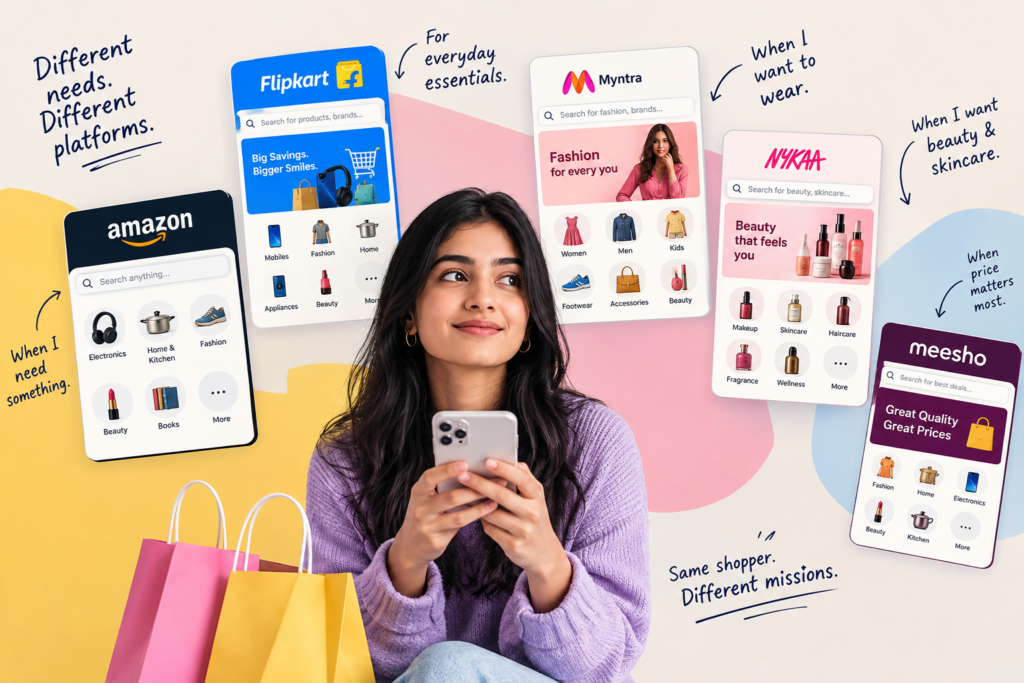
Amazon may be the default, but young Indian women still turn to specialists when the shopping mission gets specific
For years, the e-commerce conversation has been framed as a race.
Which platform has the largest catalogue? Which app has the most users? Which marketplace gets the most transactions? And, ultimately, which one can become the single destination for everything a consumer might want to buy?
But the shopping behaviour of young Indian women suggests that the answer may not be quite that simple.
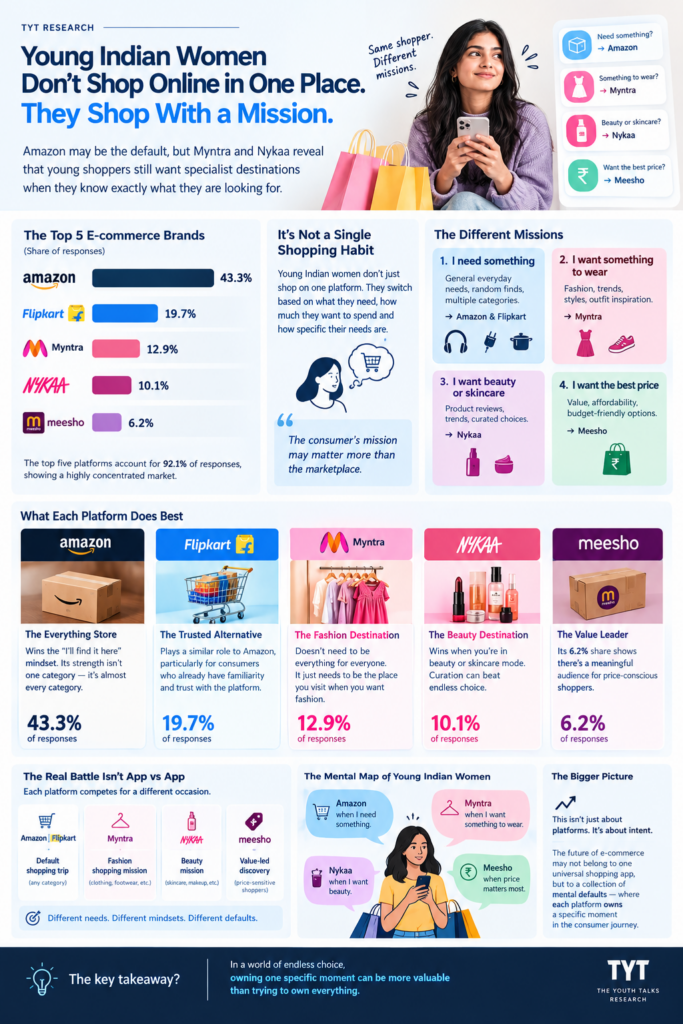
According to TheYouthTalks’ survey on brands loved by young Indian women, Amazon emerges as the clear leader in the e-commerce category, receiving 43.3% of responses. Flipkart follows at 19.7%, while Myntra and Nykaa record 12.9% and 10.1%, respectively. Meesho accounts for another 6.2%.
On the surface, this looks like another ranking of India’s major e-commerce platforms.
Look a little closer, however, and a more interesting pattern emerges.
Young consumers may not be looking for one shopping destination. They may be building a portfolio of destinations, with each platform serving a different purpose.
In other words, the question is increasingly not “Where do young women shop?”
It is “What are they trying to buy right now?”
Amazon owns the “I’ll find it here” mindset
Consider the most ordinary online shopping trip.
You need a phone charger. Then you remember you need stationery. You might also need a kitchen accessory, headphones, a gift for a friend or something for your room.
You don’t necessarily want to think too much about where to shop.
You just want to open an app and find the product.
This is where Amazon’s breadth becomes a formidable advantage.
With 43.3% of responses, Amazon is more than twice as large as the next-ranked Flipkart in this survey. Together, Amazon and Flipkart account for 62.9% of all responses, underlining the continued importance of large, general-purpose marketplaces.
Their proposition is relatively straightforward: whatever the category, there is a strong chance the product is already there.
That creates something more valuable than a catalogue.
It creates a habit.
Amazon can become the first place a consumer thinks of when the shopping mission is still undefined. The platform does not have to persuade the shopper that it is the right destination for one particular category. It simply has to remain the place where the shopper believes they can find almost anything.
Flipkart occupies a similar broad-market position, even as its strength and consumer associations may differ across categories and audiences.
The important point is that generalist platforms are particularly powerful when the consumer begins with a need rather than a product category.
But shopping changes when the mission becomes specific
Now change the scenario.
You are looking for a dress for a friend’s wedding.
Or perhaps a pair of sneakers.
Maybe you want a new lipstick, sunscreen or skincare product.
This time, you already know what you are shopping for.
And that changes the value equation.
An enormous catalogue is useful, but it is no longer enough. You want filters that understand the category. You want recommendations. You want reviews that are relevant. You want trends, inspiration, creators and perhaps even a sense of what other people like you are buying.
Most importantly, you want curation.
This is where specialist platforms become interesting.
Myntra receives 12.9% of responses, placing it third in the category, while Nykaa follows at 10.1%.
Neither figure comes close to Amazon’s share.
Yet comparing them purely on market share misses the strategic role these platforms play.
Myntra has built a strong mental association with fashion. Nykaa has done something similar with beauty.
They do not necessarily have to become the place where a consumer buys everything.
They have to become the place she instinctively considers when she enters a particular shopping mission.
That distinction matters.
When less can feel like more
The internet has given consumers extraordinary choice.
It has also given them an extraordinary number of decisions.
Search for a pair of white sneakers and you can quickly encounter hundreds of options. Search for a serum and you may find dozens of brands, ingredients, price points and competing claims.
Choice is useful—until it becomes exhausting.
This is where specialist platforms have an advantage.
A well-designed category platform can reduce the cognitive load of shopping. It can make products easier to compare, surface trends, provide category-specific information and create a more coherent experience around a particular need.
In a sense, the platform is not simply selling products.
It is helping the consumer make a decision.
That is a powerful distinction in a generation that has grown up with an almost infinite digital shelf.
For young Indian women, the appeal of Myntra or Nykaa may therefore lie not in having more products, but in making the right products easier to discover.
Curation can sometimes beat abundance.
Meesho shows that intent is also about price
Meesho’s 6.2% share adds another dimension to this picture.
Its presence among the leading platforms suggests that shopping missions are not determined only by category. They are also shaped by the consumer’s price sensitivity and expectations around value.
Someone looking for fashion may move between platforms depending on what she wants, what she can spend and how much importance she places on brand, discovery or price.
That means the mental map of e-commerce is more complicated than a simple generalist-versus-specialist divide.
There is also a third question:
What kind of value am I looking for?
Sometimes value means convenience.
Sometimes it means curation.
Sometimes it means a trusted specialist.
And sometimes it simply means getting the best possible price.
Meesho’s position illustrates why platforms can compete successfully even when their propositions are fundamentally different.
The real competition is not app versus app
This may be the most important takeaway from the survey.
The e-commerce market is often discussed as though Amazon, Flipkart, Myntra, Nykaa and Meesho are fighting over exactly the same consumer behaviour.
They aren’t.
Amazon and Flipkart are particularly well placed for the default shopping trip.
Myntra can own the fashion shopping mission.
Nykaa can own the beauty mission.
Meesho can capture value-led discovery and price-conscious shopping.
The consumer can move between all four without necessarily feeling that she is being disloyal to any of them.
That is because the platforms are occupying different positions in her mental decision tree.
The numbers reinforce how concentrated the category has become: the top five platforms together account for 92.1% of responses in the survey.
But concentration does not necessarily mean consumers have one default for every occasion.
It may instead mean that a small number of platforms have successfully established themselves as defaults for different occasions.
Young consumers may have several shopping defaults
Think about the mental shortcuts that can develop over time.
“I need something.” — Amazon.
“I need something to wear.” — Myntra.
“I need beauty or skincare.” — Nykaa.
“I want to see what I can get at a good price.” — Meesho.
These are not rigid rules. Consumers will move between platforms, compare prices and search elsewhere.
But the underlying behaviour is important.
A brand does not always need to own the entire consumer journey to remain strategically relevant. It can own a particular moment in that journey.
And that may become increasingly important as India’s young consumers become more experienced online shoppers.
The first generation of e-commerce was largely about putting products online.
The next phase was about making transactions faster and easier.
The emerging phase may be about understanding intent.
What is the consumer trying to accomplish? How much does she know about the category? Is she browsing or buying? Is she looking for inspiration, convenience, trust or value?
The platforms that understand those distinctions may have a significant advantage.
The specialist still has a place in an everything-store world
Amazon’s lead is undeniable in this survey. But the performance of Myntra and Nykaa carries an equally important lesson.
Consumers do not necessarily reward platforms simply for becoming bigger.
Sometimes they reward platforms for becoming more relevant.
That is particularly interesting for young Indian women, whose shopping behaviour cannot easily be reduced to a single platform preference. Their choices appear to shift with the mission, category and value proposition.
The future of e-commerce, therefore, may not belong to one universal shopping app.
It may belong to a collection of mental defaults.
The largest marketplace can own the broadest destination. The specialist can own the moment when a consumer knows exactly what she wants.
And in a world of endless choice, owning that moment may be more valuable than owning every possible product.
The real question for e-commerce brands is no longer simply, “Can we become the place where consumers shop?”
It is more challenging—and perhaps more useful:
“Can we become the place consumers think of when they have a particular reason to shop?”