There is something fascinating about the smartphone sitting in a young woman’s hand.
It is easy to assume that the device tells us something about her purchasing power. But increasingly, it may tell us something more interesting: what she aspires to become, how she wants to be perceived, and what kind of products she sees as worth wanting.
That tension comes through clearly in TheYouthTalks’ survey of brands preferred by young Indian women.
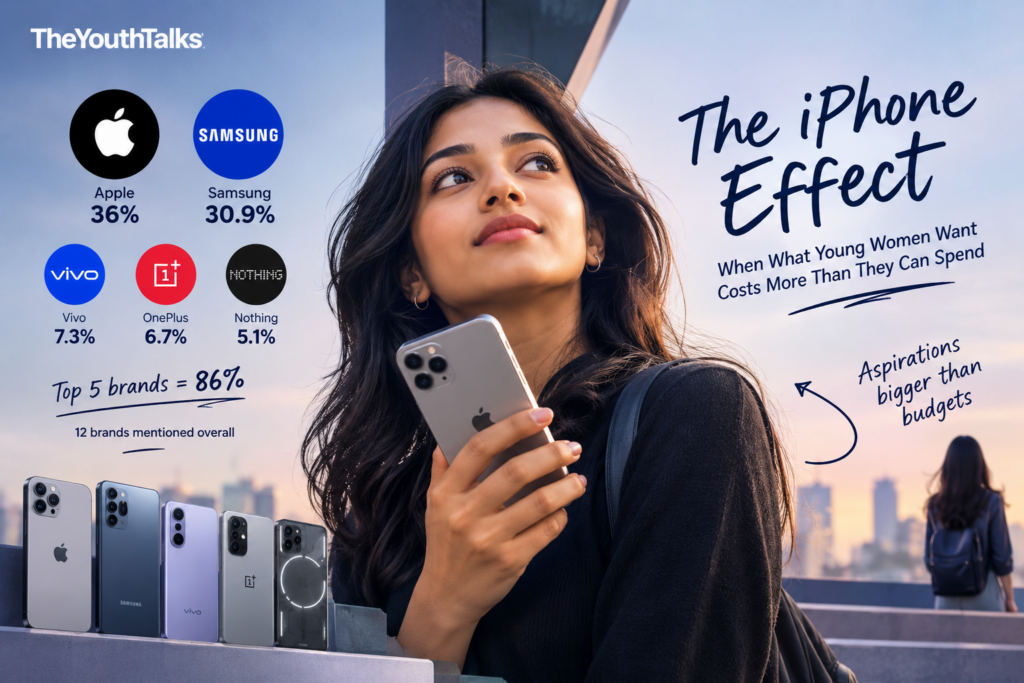
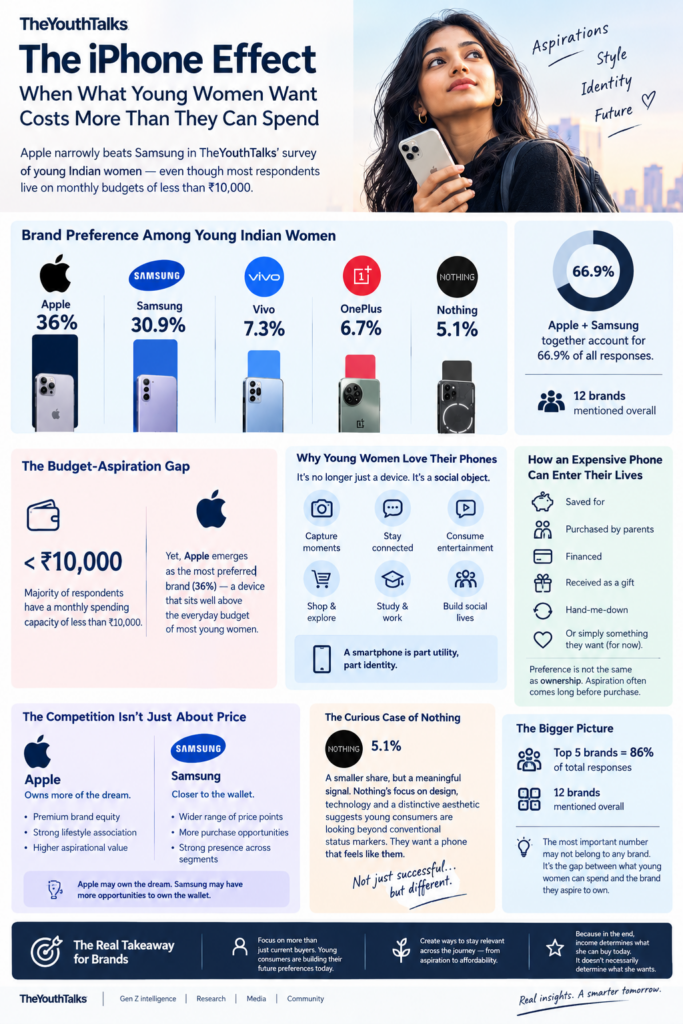
Apple emerged as the most preferred smartphone brand, with 36% of respondents choosing it, narrowly ahead of Samsung at 30.9%. Together, the two brands accounted for 66.9% of all responses. Vivo followed at 7.3%, OnePlus at 6.7% and Nothing at 5.1%.
At first glance, this looks like another familiar Apple-versus-Samsung contest.
But there is a more interesting story underneath the numbers.
The majority of respondents in the survey have a monthly spending capacity of less than ₹10,000.
That creates a striking contradiction.
The brand at the top of the preference chart is also one whose mainstream smartphones sit considerably above the everyday spending capacity of most of the young women surveyed.
And perhaps that contradiction is precisely the point.
The phone young women want isn’t necessarily the phone they can buy
For a long time, smartphones were primarily discussed as technology products.
Better cameras. Faster processors. Bigger displays. Longer battery life. More storage.
Those features still matter, of course. But for young consumers, particularly those who have grown up with smartphones as an integral part of everyday life, the device has acquired another dimension.
It has become a social object.
A smartphone travels everywhere with its owner. It appears in photographs, videos, classrooms, cafes, workplaces and social gatherings. It is used to communicate with friends, consume entertainment, discover products, make purchases, study, work and create content.
Unlike many expensive possessions, it is also constantly visible.
That changes the role it plays.
A phone can communicate technological sophistication. It can signal taste. It can suggest status. It can reflect individuality. And sometimes, it can simply make its owner feel that she belongs to a particular cultural or social world.
In that sense, the smartphone has become part utility and part identity.
This is especially relevant when looking at Apple.
An iPhone is not merely being evaluated against another phone’s specifications. For many consumers, the Apple brand carries associations that extend beyond hardware.
The device can represent aspiration, premium design, creativity, social currency and a particular lifestyle.
That makes the purchase decision more complicated than a comparison of specifications and prices.
Affordability doesn’t necessarily eliminate aspiration
There is an important distinction marketers often overlook: preference is not the same thing as ownership.
A young woman can prefer Apple without currently owning an iPhone.
She may be saving for one. Her parents may eventually buy it for her. She may purchase it through financing. She may receive one as a gift. She could inherit an older model from a family member.
Or she may simply want one.
That last possibility matters more than it initially appears.
Consumers frequently develop emotional relationships with brands long before they have the purchasing power to act on those preferences. Aspirational brands, in particular, benefit from this gap.
A product can become associated with the person’s future self.
The thinking is subtle but powerful:
Not what I have today, but what I would like to have.
That makes aspiration a long-term marketing asset.
A 19-year-old student with a monthly spending capacity below ₹10,000 may not be an immediate premium smartphone customer. But if she already considers Apple her preferred brand, the relationship with that brand has potentially begun years before the eventual purchase.
The brand is entering her consideration set early.
And that matters.
Apple wins, but Samsung is hardly far behind
Apple’s 36% share should not be interpreted as overwhelming dominance.
Samsung is only 5.1 percentage points behind, with 30.9% of respondents choosing the brand.
That is a remarkably close contest.
In fact, the smartphone category is arguably one of the clearest examples of how aspiration and accessibility can coexist in the same market.
Samsung operates across a much wider range of price points. That gives the company considerably more opportunities to convert preference into an actual purchase.
Apple, meanwhile, has built extraordinary aspirational equity.
This creates an intriguing strategic distinction.
Apple may own more of the dream. Samsung may have more opportunities to own the wallet.
The question for both brands is therefore different.
Apple has to find ways of keeping aspirational consumers engaged until they can afford the product they want.
Samsung has an opportunity to capture consumers at multiple stages of their purchasing journey — from affordable devices to premium smartphones.
The competition isn’t simply about who sells more phones today.
It is also about who remains relevant as the consumer’s purchasing power changes.
The curious case of Nothing
Then there is Nothing.
With 5.1% of respondents choosing the brand, Nothing sits well behind Apple and Samsung. Yet its presence is worth examining.
Nothing does not possess the scale or historical legacy of either Apple or Samsung. Its proposition has instead been strongly associated with design, technology and a distinctive visual identity.
That makes its position interesting.
Its appeal suggests that the young consumer isn’t necessarily looking only for conventional premium signals.
She may also be looking for difference.
The question isn’t always, “Which phone makes me look successful?”
Sometimes it is, “Which phone feels like me?”
That is an important distinction for brands trying to understand younger consumers.
Young audiences are often described as wanting authenticity and individuality. In the smartphone category, that desire can manifest itself through design choices, unconventional aesthetics and brands that feel less ubiquitous.
Nothing’s 5.1% may therefore represent something larger than its numerical share.
It is a reminder that even highly concentrated categories can leave room for brands with a sharply defined identity.
What the numbers reveal about young consumers
The smartphone findings become even more interesting when placed alongside the concentration of preferences.
The top five brands — Apple, Samsung, Vivo, OnePlus and Nothing — account for 86% of responses.
Twelve brands were named overall.
That tells us two things simultaneously.
First, young Indian women are not completely locked into a two-brand smartphone market. There is meaningful space for other players.
Second, the vast majority of preference is still concentrated around a small group of familiar brands.
For marketers, this creates a relatively narrow battlefield.
But the more important insight lies elsewhere.
It lies in the relationship between preference and purchasing power.
If most respondents have less than ₹10,000 available to spend each month, yet Apple still emerges as the preferred smartphone brand, then affordability alone clearly does not explain brand preference.
Young consumers are making mental calculations that include other variables.
How does the product make me feel?
What does it represent?
What does owning it say about me?
Will I still want this brand when I can afford it?
Those questions don’t appear in a conventional price-value equation. Yet they can influence behaviour just as strongly.
The smartphone as a marker of the future self
Perhaps this is where the iPhone effect becomes most interesting.
For a young consumer, aspiration doesn’t necessarily mean extravagance.
It can simply mean having a mental picture of the life she would like to lead.
The smartphone becomes one small symbol within that picture.
A student may imagine graduating, getting her first job, becoming financially independent and eventually buying the phone she has wanted for years.
When that happens, the brand has not suddenly acquired a customer.
It has been cultivating one for years.
That is why brand preference among younger consumers deserves attention even when immediate purchasing power is limited.
A brand that wins preference today may have an opportunity to win spending tomorrow.
And conversely, a brand that ignores young consumers because they cannot currently afford its products may be surrendering future customers to competitors.
What this means for marketers
The lesson extends well beyond smartphones.
Young consumers often live with a significant gap between what they can afford and what they desire.
That gap exists across fashion, beauty, travel, technology, automobiles and experiences.
Marketers therefore need to distinguish between three different things:
What a young consumer owns.
What she can realistically buy.
What she wants to own eventually.
They are not necessarily the same.
Traditional consumer research can sometimes overemphasise current ownership and purchase behaviour. But understanding aspiration can provide another layer of insight.
For brands, the opportunity is to build relevance before the consumer reaches peak purchasing power.
That could mean accessible entry-level products, financing, trade-ins, student programmes, communities, content or simply maintaining a strong emotional connection with the audience.
The objective is to remain part of the consumer’s consideration set as her circumstances evolve.
The bigger lesson behind the iPhone
The most revealing statistic in this survey may not actually be Apple’s 36%.
It may be the gap between the spending capacity of young women and the brands they aspire to own.
That gap challenges a simple assumption about young consumers: that limited income necessarily translates into limited ambition.
It doesn’t.
A young woman’s wallet may impose boundaries on her choices today. Her imagination does not have to.
And this is where brands need to pay attention.
Income determines what she can buy today. It doesn’t necessarily determine what she wants.
Apple’s position in TheYouthTalks’ survey illustrates that distinction particularly well. The iPhone may not be the most immediately accessible smartphone for the majority of these respondents. Yet it has already established itself as the brand they would prefer.
That is powerful.
Because the competition for the young consumer isn’t always happening at the point of purchase.
Sometimes, it starts years earlier — in the mind.
And when purchasing power eventually catches up with aspiration, the brands that have already won that mental space may find themselves in the strongest position to win the wallet.
The iPhone, in other words, may not just be competing for today’s purchase. It may already be winning tomorrow’s aspiration.