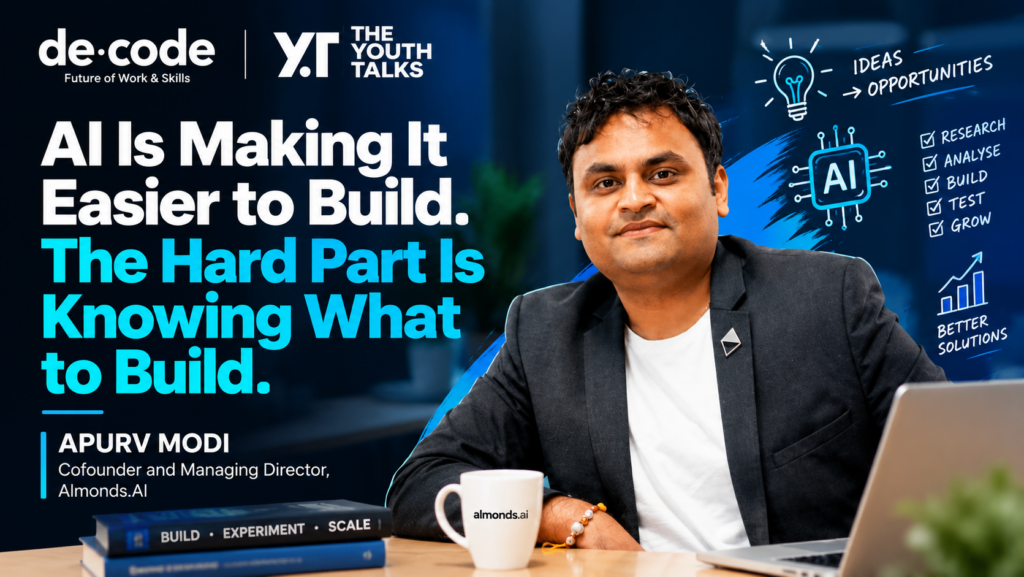
At The AI Jobs Project, entrepreneur Apoorv Modi argued that AI is dramatically lowering the cost of research, experimentation and execution. For young people entering the workforce, the opportunity may lie not just in learning to use AI, but in learning to identify problems worth solving.
AI Is Making It Easier to Build. The Hard Part Is Knowing What to Build.
For years, one of the biggest barriers to entrepreneurship was execution.
You could have a good idea, but turning it into a product required developers, designers, researchers, money and, often, months of work. Even testing whether an idea had potential could be expensive.
Artificial intelligence is changing that equation.
Today, AI can research markets, generate ideas, analyse information, write code, create designs and help build prototypes at a speed that would have been difficult to imagine just a few years ago.
But entrepreneur Apurv Modi, co-founder and managing director of Almonds.ai, believes that this creates a new problem for the generation entering the workforce: when everyone can generate ideas and execute faster, how do you decide which ideas are actually worth pursuing?
Speaking at The AI Jobs Project, Modi’s message to students went beyond the familiar debate about whether AI will take away jobs. Instead, he focused on what young people can do with the technology — particularly if they learn to identify opportunities rather than simply wait for them.
When 15 days of work becomes minutes
One of Modi’s examples involved a task that would traditionally require significant human effort.
Imagine asking an assistant to analyse roughly two lakh emails accumulated over years and produce a meaningful report. The conventional process could involve searching, reading, categorising and reviewing the information before putting it together. Modi described this as potentially taking 15–20 days of work.
With an AI tool such as Copilot, he argued, the same analysis could be produced within minutes.
The significance isn’t simply that AI can complete a task faster.
It is that our expectations of how quickly work should happen are changing.
Once technology makes a particular task dramatically faster, speed itself stops being a differentiator. The question becomes what people do with the time and capability that technology gives them.
And Modi believes that this is where the opportunity begins.
The problem of too many ideas
AI can already produce an extraordinary number of possibilities.
Ask it for business opportunities, potential markets or ideas for a new product, and the response can arrive almost instantly. Modi describes the transformation in deliberately exaggerated terms: earlier, people might have had a handful of ideas and only a few that were practical to execute. With AI, the number of ideas that can be generated and even executed can multiply dramatically.
But the number of good ideas doesn’t necessarily increase at the same rate.
And that creates an interesting paradox.
AI can make execution abundant while making judgement more important.
For a student, that could mean the ability to generate a business plan is no longer particularly impressive. Neither is being able to create a basic prototype with AI assistance.
What becomes more valuable is knowing which problem is worth solving in the first place.
Don’t start with the product. Start with the requirement.
This is perhaps the most practical piece of advice Modi offered students.
Instead of beginning with the question, “What should I build?”, he repeatedly returned to the idea of identifying an existing requirement.
His examples ranged from water and consumer products to adult diapers, cleaning equipment and household appliances. His underlying argument was simple: businesses often emerge where there is an existing need that is poorly served.
For young entrepreneurs, that changes the starting point.
Rather than asking:
“What startup can I create?”
the better question might be:
“What problem do people already have, and can I solve it better?”
AI can then become an accelerator — helping research the market, understand consumers, explore competitors and test possible solutions.
That is a very different way of thinking about AI.
It isn’t simply a tool for getting assignments done faster. It can become a tool for exploring opportunities that previously would have taken far more time and resources to investigate.
From an engineering student to an entrepreneur
Modi’s own career journey reinforced that message.
He recalled struggling to find conventional career opportunities despite eventually scoring well in engineering. He pursued an advanced computing course, later began an MBA and found his way into the incubation ecosystem at IIM Bangalore. While there, he started ventures including DocAndDoc.com and CircuitCity.com, both of which he says were subsequently sold.
His broader journey eventually led to Almonds.ai, alongside several other ventures.
The relevance of the story for today’s students isn’t that everyone needs to become an entrepreneur.
It is that career paths don’t always have to be linear.
And AI may make experimentation with those paths easier.
Modi argues that today’s students can potentially test ideas, build small products and enter markets with much lower initial investment than previous generations. He encourages students to test the market before committing significant capital rather than spending heavily on an unvalidated idea.
That is particularly relevant in an AI-enabled economy where the distance between idea and experiment is shrinking.
AI can design the system. Humans still have to imagine it.
One of Modi’s more interesting examples comes from the jewellery business he described.
AI is being used to identify which designs are gaining traction, generate new designs based on those patterns and feed them into a production process involving CAD and manufacturing.
What matters here isn’t simply that AI can generate jewellery designs.
It is that someone had to imagine the entire workflow.
Someone had to recognise that consumer behaviour could be captured, analysed and converted into new product designs. Someone had to connect those outputs to production.
The AI may perform parts of the process, but the architecture of the process still comes from people.
That distinction could become increasingly important as AI becomes more capable.
The new advantage may be opportunity recognition
There is a temptation to think that an AI-first economy will reward people who know the most AI tools.
Modi’s session points towards a different possibility.
The advantage may increasingly belong to people who can spot a requirement, understand a customer, experiment cheaply and decide what deserves to be built.
That doesn’t make technical skills irrelevant. It makes them part of a larger capability.
A student who knows how to code can build.
A student who knows how to use AI can build faster.
But a student who can identify an important problem, understand the people experiencing it and then use technology to build the right solution may have something considerably more valuable.
And that may be one of the most important shifts AI brings to the world of work.
When everyone can build faster, the real advantage may belong to the person who knows what is worth building.