MakeMyTrip Takes 61.2% of Responses — And Shows How Technology Is Changing the Way Young Indian Women Travel
There is a moment in every travel plan that used to require some effort.
You had to ask someone where to go. Find a travel agent. Check flight schedules. Call a hotel. Compare prices. Work out the route. Keep track of tickets and confirmations. And, somewhere along the way, hope that everything would come together.
For young Indian women today, that moment can be remarkably simple.
Open a phone.
Search.
Compare.
Book.
The journey may still take days, weeks or months to complete, but the decision to travel can happen in minutes.
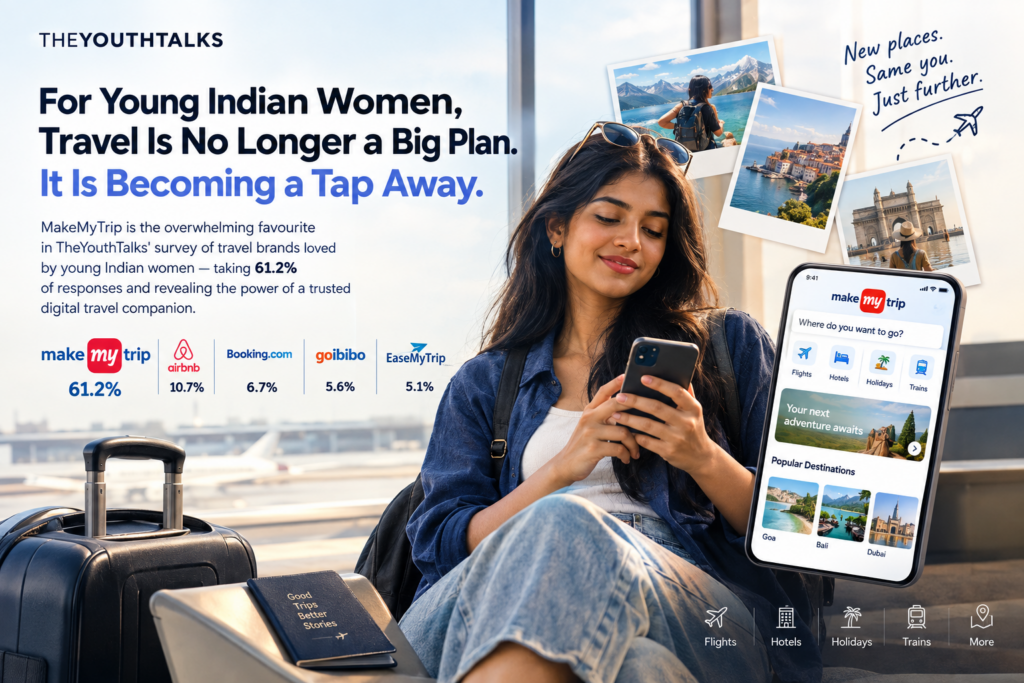
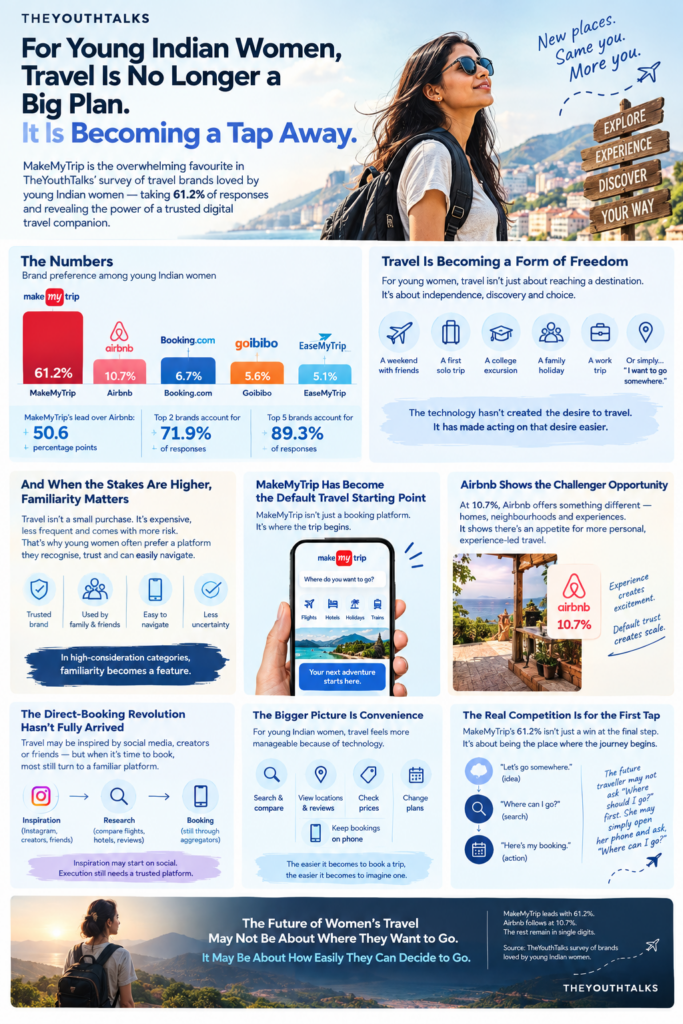
That shift is at the heart of TheYouthTalks’ survey of brands loved by young Indian women. MakeMyTrip was named by 61.2% of respondents, placing it far ahead of every other travel brand included in the survey.
Airbnb followed at 10.7%, while Booking.com received 6.7%, Goibibo 5.6% and EaseMyTrip 5.1%.
The gap between MakeMyTrip and Airbnb is an extraordinary 50.5 percentage points based on the reported survey figures. The top two brands together account for 71.9% of responses, while the top five capture 89.3%.
The numbers point to a striking reality.
For young Indian women, travel may be becoming more spontaneous, more independent and more digitally enabled. But when it comes to actually making the booking, trust and convenience still matter enormously.
Travel Has Become Easier to Imagine
Travel does not always begin with a destination.
Sometimes it begins with a feeling.
“I need a break.”
“Let’s go somewhere this weekend.”
“I’ve never been there.”
“Why don’t we take a trip after exams?”
For an earlier generation, turning that thought into an actual trip could involve considerable planning. Today, technology has shortened the distance between the idea and the action.
A young woman can discover a destination on Instagram, watch a YouTube video about it, search for flights, compare hotels, read reviews and check prices — often without leaving her phone.
That does not mean technology created the desire to travel.
It simply made the desire easier to act upon.
And that distinction is important.
A destination can remain hundreds or thousands of kilometres away. But the number of steps between “I want to go” and “I’ve booked it” has become dramatically smaller.
From Big Holiday to Weekend Decision
Travel is also becoming less confined to the traditional idea of a holiday.
For young Indian women, it can mean a college excursion, a family vacation, a work trip, a weekend with friends or a first solo journey.
Sometimes it can simply mean spending a few days somewhere unfamiliar.
The smartphone has made these different forms of travel easier to organise.
A student can look for affordable accommodation before deciding whether a trip is financially realistic. A young professional can compare flight timings around a weekend. Friends can share booking details instantly. A traveller can keep tickets, hotel confirmations and itineraries in one place.
Each individual feature may seem small.
Together, they change the experience.
Travel starts feeling less like a complicated project and more like something that can be managed independently.
That can be particularly meaningful for young women, for whom the ability to research, compare, plan and make decisions independently can be an important part of the travel experience itself.
MakeMyTrip Has Become More Than a Booking Platform
This is where the 61.2% figure becomes particularly interesting.
MakeMyTrip’s position in the survey is not simply about winning a transaction at the final stage of the travel journey.
It suggests that the platform has become part of the starting point.
Imagine a group of friends deciding that they want to travel.
The destination may not even be fixed.
They may start by looking at flights. Then hotels. Then prices. Then dates. Then perhaps another destination altogether.
The platform becomes part of the conversation.
That is an enviable position for a digital travel company.
The brand does not have to wait until the consumer knows exactly what she wants.
It can be present while she is still figuring it out.
That changes the relationship between the platform and the customer.
It is no longer simply:
“I know where I am going. Help me book it.”
It becomes:
“I want to go somewhere. Help me work out how.”
In Travel, Familiarity Is a Feature
There is another reason the MakeMyTrip number deserves attention.
Travel is not an everyday purchase.
You can experiment with a new food-delivery app without too much consequence. You can try a new fashion brand and decide that the product wasn’t for you.
A holiday is different.
Flights can be expensive. Hotels can be difficult to replace at short notice. Dates may be fixed. And a poor booking decision can affect an entire trip.
That changes consumer behaviour.
When the financial and logistical stakes are higher, familiarity can become valuable.
Consumers may want a platform they have used before. They may prefer something their family recognises. They may feel more comfortable navigating a service whose booking process is already familiar.
In other words, trust itself becomes part of the product.
MakeMyTrip’s 61.2% share should therefore be read not simply as a measure of brand awareness, but as an indication of how powerful the familiar digital starting point can become in a high-consideration category.
Airbnb Shows That Young Travellers Still Want Something Different
Airbnb’s 10.7% provides an important counterpoint.
The platform represents a somewhat different proposition from the conventional hotel-booking experience. Homes, neighbourhoods, longer stays and a more localised sense of travel can appeal to consumers who want their trip to feel less standardised.
Its presence among young Indian women suggests that there is room for experience-led travel.
But the distance from MakeMyTrip is equally revealing.
A distinctive experience can generate interest.
A familiar platform can generate repeated behaviour.
Those are not necessarily competing ideas. A traveller may discover an Airbnb property through social media, research a destination through creators and still use a large travel platform elsewhere in the booking journey.
This distinction matters because inspiration and execution are increasingly separate parts of the travel funnel.
Instagram May Inspire the Trip. The Booking Platform Closes It.
Much of modern travel discovery happens outside traditional travel platforms.
A destination appears on Instagram.
A creator posts a hotel review.
A friend shares photographs from a weekend away.
A YouTube video makes an unfamiliar city look suddenly accessible.
The consumer becomes interested.
But interest is not the same as purchase.
At some point, the traveller has to answer more practical questions:
How much will the flight cost?
Where should I stay?
What are the available dates?
Can I afford it?
What are the cancellation terms?
How do I actually book it?
That is where travel aggregators continue to have enormous relevance.
The inspiration may come from anywhere.
The execution still needs a system.
And MakeMyTrip’s position in the survey suggests that, for a large share of young Indian women, that system remains familiar.
Convenience Is Becoming a Form of Freedom
There is a larger cultural shift underneath all of this.
Technology does not merely make travel faster to book. It can make travel feel more achievable.
Knowing that you can research an unfamiliar destination yourself changes the psychology of planning.
Knowing where you will stay reduces uncertainty.
Being able to compare options gives you more control over the decision.
Having your booking information on your phone makes the trip easier to manage.
None of these things guarantees that travel will be effortless. Airports will still be crowded. Flights will still be delayed. Hotels will sometimes disappoint.
But the planning barrier has fallen.
And when barriers fall, behaviour can change.
A trip that once felt like a major undertaking can start feeling like something that is simply possible.
The Young Traveller Doesn’t Need Everything to Be Perfect
This also changes what travel brands should understand about young consumers.
The modern traveller may not expect every decision to be perfect before she starts.
She can research as she goes.
She can compare alternatives.
She can change plans.
She can read someone else’s experience before making her own choice.
The digital ecosystem allows consumers to navigate uncertainty differently.
That creates a new expectation from travel platforms: don’t just help me book; help me feel confident about the decision I’m making.
Search, reviews, pricing, maps, recommendations, cancellation information and booking management all become part of that confidence.
The interface may look simple.
The value behind it is much bigger.
The Real Competition Is for the First Tap
MakeMyTrip’s 61.2% in TheYouthTalks’ survey is therefore more significant than a conventional brand-preference number.
The real prize in travel may not be the final booking.
It may be the first tap.
The first search.
The first comparison.
The first question about where to go.
Once a platform becomes the place where the consumer begins thinking about the trip, it has already entered the most important part of the decision-making process.
The brand becomes a travel companion before the journey has even begun.
That is a powerful position to occupy.
The Future of Women’s Travel May Be About Decisions, Not Destinations
The most interesting finding in this survey may ultimately have little to do with MakeMyTrip, Airbnb or any individual travel platform.
It is about what technology is doing to the act of travelling.
Young Indian women are growing up in a world where discovering a destination, researching it, comparing options and making a booking can happen within the same digital ecosystem.
Travel does not necessarily need to begin with a detailed plan.
It can begin with curiosity.
And curiosity can become a booking surprisingly quickly.
TheYouthTalks’ survey suggests that MakeMyTrip has become the trusted starting point for a substantial share of that journey, with 61.2% of respondents naming it as a travel brand they love. Airbnb follows at 10.7%, while Booking.com, Goibibo and EaseMyTrip remain in single digits. Source: TheYouthTalks survey of brands loved by young Indian women.
The larger lesson for travel brands, however, goes beyond market position.
The future traveller may not ask, “Where should I go?” first. She may simply open her phone and ask, “Where can I go?”
And increasingly, the technology exists to take her from that question to a real journey with just a few taps.
The distance between wanting to travel and actually travelling has never been smaller.