
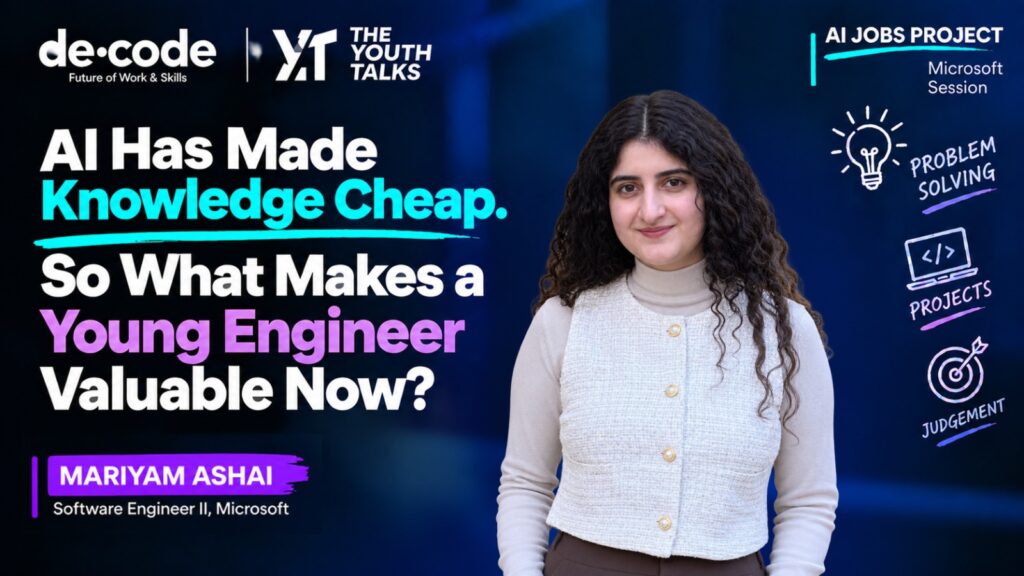
At a recent AI Jobs Project session, Microsoft’s Mariyam Ashai told engineering students that projects, certifications and technical knowledge are no longer enough to stand out. In an AI-first workplace, the ability to identify real-world problems, experiment with solutions and exercise judgement could matter far more.
For years, engineering students have been given a familiar formula for getting their first job: learn the fundamentals, build a few projects, add certifications to the resume and prepare for technical interviews.
But artificial intelligence is changing one important part of that equation.
Almost everyone now has access to knowledge. Almost everyone has access to AI-assisted coding. And almost everyone can build things faster than before.
So what actually makes one student more employable than another?
That was the question at the heart of a recent AI Jobs Project session featuring Microsoft’s Mariyam Ashai, where she challenged engineering students to rethink what it means to stand out in an increasingly AI-driven job market.
Her answer was not another list of certifications to pursue.
It was problem-solving, experimentation and judgement.
When knowledge becomes cheap, differentiation becomes harder
Ashai began by challenging a familiar assumption among engineering students: that their academic branch, courses, certifications or accumulated technical knowledge would automatically differentiate them.
In the AI era, she argued, knowledge has become much more accessible. Students can search for information, use AI assistants and access an almost unlimited pool of ideas and solutions.
That changes the hiring equation.
Even projects, traditionally one of the strongest ways for freshers to demonstrate capability, may no longer be enough.
If 100 students apply for 10 positions and almost all of them have completed projects, the existence of a project itself is no longer the differentiator.
Instead, Ashai suggests students should ask a more fundamental question:
Does what I have built actually align with the role I want?
Companies are hiring for specific requirements, even when the job title might appear broad. And resumes are increasingly filtered through Applicant Tracking Systems, which look for skills and experiences relevant to the particular role.
The lesson is simple: don’t try to become a candidate for every job.
Know what you are targeting, and build evidence that you can do that job.
AI has reset the baseline
Perhaps the most striking part of Ashai’s session was her comparison between the engineering experience of a few years ago and what students are expected to accomplish today.
She recalled a college project she worked on with three other students. It involved a database, backend, APIs and a frontend, and took the team roughly a week to build.
At the time, she was proud of the accomplishment — and understandably so.
Today, she believes a similar basic implementation could potentially be completed by one student in just a few hours with AI assistance.
That doesn’t necessarily mean students are becoming less capable.
It means the baseline has moved.
When AI can help with implementation, technical blockers and basic solutions, employers can reasonably expect candidates to demonstrate something beyond the ability to execute instructions.
The question becomes:
What do you bring to the table that isn’t already available at everyone’s fingertips?
For Ashai, the answer lies in the ability to understand problems and think differently about them.
Don’t build the project everyone else is building
This is where her advice becomes particularly relevant for students preparing their resumes.
Instead of searching online for “Top 10 projects to build,” Ashai encourages students to identify a genuine problem and attempt to solve it.
The difference may sound small, but it represents a major shift.
A student who builds another standard application because a tutorial told them to may demonstrate technical execution.
A student who notices a real problem, investigates it, develops a solution, encounters unexpected challenges and figures out how to overcome them can demonstrate something much more valuable:
initiative and practical thinking.
And AI doesn’t eliminate that process.
In fact, it may make it more important.
AI can provide several possible solutions. But someone still has to decide which problem is worth solving, what constraints matter and which solution makes sense.
The junior engineer’s job is changing too
Ashai also points to a potentially important shift in the expectations placed on junior developers.
Traditionally, junior engineers might receive a design or specification from senior engineers and be expected to implement it.
In an AI-assisted environment, basic implementation is becoming easier.
That means even junior engineers may increasingly be expected to think about how a problem should be solved, rather than simply waiting for someone else to define the solution.
For students entering the workforce, this could represent a fundamental change.
The value of an entry-level engineer may increasingly come not just from “Can you code this?” but from questions such as:
Did you understand the problem?
Did you identify the right approach?
Did you consider what could go wrong?
Can your solution scale?
Can you explain why you chose it?
AI can give you ten answers. You still have to choose one.
Ashai illustrated this idea through an example from the city where the session was taking place: Noida.
She asked students to think about the rush on the Delhi-NCR metro system during peak office hours.
Adding more trains might seem like an obvious solution. But if trains are already arriving frequently, perhaps the real problem lies elsewhere.
Students began suggesting ideas around analysing passenger movement and finding alternative ways to distribute the crowd. Ashai then pushed them to think about how routes and services could potentially be structured differently.
AI could potentially generate many such ideas.
But that is precisely the point.
The AI can generate the options. The judgement remains human.
Ashai argues that if there are ten possible solutions, the important skill is deciding which one actually fits the problem, infrastructure and constraints.
And that judgement doesn’t come simply from reading textbooks.
It develops through implementation.
The next generation of engineers needs to build, not just learn
There is also a deeper technical message in Ashai’s conversation.
As organisations integrate AI and agentic systems into enterprise applications, engineers have to think about issues that go beyond simply connecting an application to an LLM.
AI systems are probabilistic. Their outputs can vary. That creates challenges around reliability, guardrails, security and making AI-powered systems behave predictably enough for real-world use.
For students, that means AI literacy cannot simply mean knowing how to write a prompt.
It means understanding how AI fits into an end-to-end system, experimenting with agents, thinking about scalability and security, and learning how to build solutions for actual problems.
And perhaps that is the biggest takeaway from Ashai’s session.
AI has not made technical fundamentals irrelevant. It has made generic technical competence less distinctive.
When everyone has access to the same tools, the advantage may increasingly belong to the person who can see the problem others haven’t noticed, build something useful around it and make a sound decision when there are multiple possible answers.
For today’s engineering students, being job-ready may therefore require a different mindset.
Don’t just ask what you know.
Ask what you have built, what problem you have solved, what you learned when it didn’t work — and why you chose the solution you did.
Because in an AI-first workplace, knowledge may get you into the conversation. But judgement could be what makes you valuable.