





For generations, Indian footwear was about comfort, durability and value. Young Indian women are increasingly buying something else: identity, lifestyle and belonging.
There was a time when buying footwear in India was a fairly uncomplicated decision.

You needed something comfortable. It had to last. Ideally, it should work with college, office, family occasions and everything in between.
For generations of Indians, there was a good chance the answer was Bata.

But something has changed.
Walk through a college campus today and footwear tells a very different story. Sneakers are no longer reserved for the gym, the running track or Sunday mornings. They appear with jeans, dresses, oversized shirts, trousers and even outfits that would once have been paired with formal shoes.

The shoe has become part of the outfit.
More importantly, it has become part of the identity.
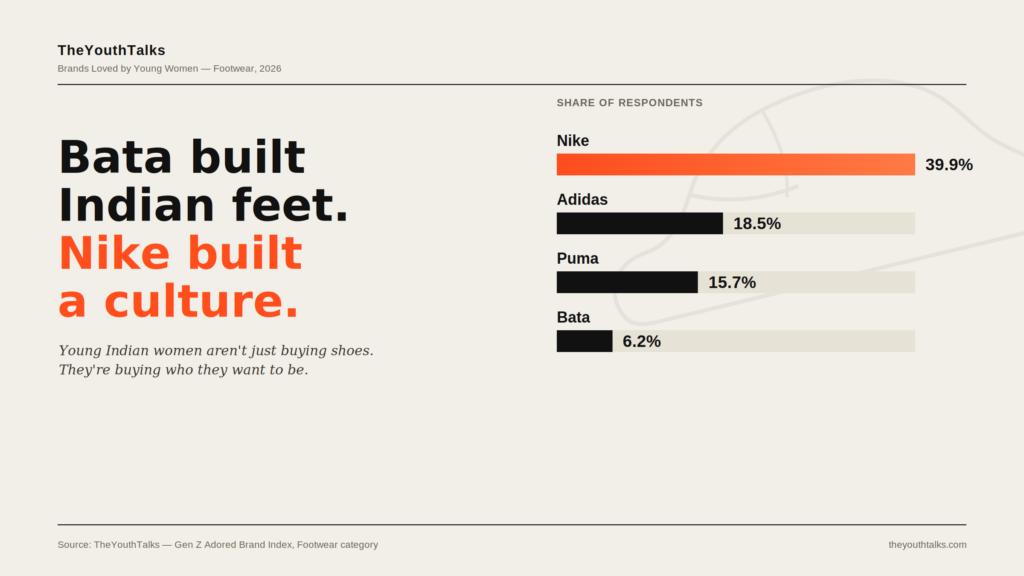
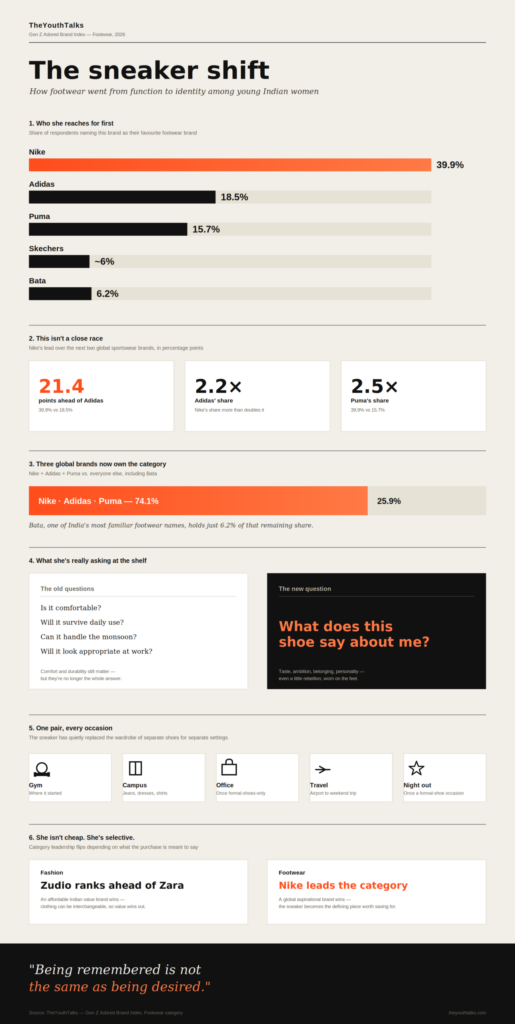
TheYouthTalks’ latest survey of brands loved by young women captures this transition rather sharply. Nike is the runaway leader, named by 39.9% of respondents. Adidas follows at 18.5%, while Puma records 15.7%.
Together, the three global sportswear brands account for 74.1% of responses.
Bata, one of India’s most familiar footwear names, receives just 6.2%, roughly level with Skechers.
That is not simply a story about which shoe brand is popular.
It is a story about what young Indians believe footwear is for.
From something you wear to something you signal
For an earlier generation, a shoe was largely evaluated by function.
Was it comfortable?
Would it survive daily use?
Could it handle the monsoon?
Would it look appropriate at work?
Young consumers haven’t abandoned those considerations. Comfort still matters enormously. But they have added another layer to the decision.
What does this shoe say about me?
That question changes everything.
A pair of Nike sneakers can communicate an interest in sport, streetwear, music, fashion or contemporary youth culture without the wearer saying a word.
A pair of Adidas Originals can carry a different cultural association. Puma can evoke another.
The footwear becomes a visual shorthand.
And this isn’t just an Indian phenomenon. Globally, sneakers have moved steadily from sports equipment into mainstream fashion and culture. In India, that transition is now particularly visible among younger consumers, helped by social media, celebrity influence and the growing acceptance of casual footwear across occasions. Recent Indian reporting has also documented Gen Z’s enthusiasm for retro sneaker styles and the way social platforms have helped turn sneakers into cultural markers rather than merely functional products.
The sneaker isn’t just on the foot anymore.
It is part of the conversation.
Nike isn’t merely selling shoes
This is perhaps the most important reason Nike’s number stands out.
At 39.9%, Nike’s share is more than twice Adidas’ 18.5% and more than two-and-a-half times Puma’s 15.7%.
The gap between Nike and Adidas alone is 21.4 percentage points.
This isn’t a close race.
Nike appears to have built something considerably more powerful than product preference: cultural familiarity.
The Nike swoosh is instantly recognisable. Its athletes, collaborations, silhouettes and campaigns have helped the brand exist simultaneously in sport, fashion and popular culture.
That combination gives Nike an unusual advantage.
It can sell a running shoe to a runner.
But it can also sell the same cultural universe to someone who has never run competitively.
That distinction matters.
A brand becomes enormously powerful when consumers don’t have to be deeply interested in the category to want the product.
Nike’s own collaborations in India illustrate how deliberately the company is extending this cultural positioning. In 2025, Nike collaborated with Indian fashion label NorBlack NorWhite on a collection incorporating the traditional bandhani aesthetic into contemporary sportswear and footwear, explicitly connecting sport, Indian craft and everyday self-expression.
That is not simply footwear marketing.
It is culture marketing.
When sneakers became occasion-agnostic
The rise of athleisure has accelerated this transformation.
The old distinction was straightforward:
Sports shoes were for sport.
Formal shoes were for work.
Casual shoes were for everything else.
That boundary has largely collapsed.
A good sneaker can travel from the gym to a coffee shop, from a college lecture to an airport, from a casual dinner to a weekend trip.
Deloitte’s recent India fashion research describes this broader casualisation of footwear, noting that sneakers have increasingly become “occasion-agnostic” and that Gen Z and young professionals increasingly view footwear as a style statement. The report also points to rising ownership and more frequent rotation of footwear among younger consumers.
That changes the economics of the category.
If one pair can serve multiple situations, consumers have more reasons to invest in it.
And once footwear becomes part of personal style, owning several pairs begins to make sense.
One for everyday wear.
One for sport.
One for going out.
One because it simply looks good.
The wardrobe gets bigger because the meaning of the product gets bigger.
So what happened to Bata?
The 6.2% figure for Bata is perhaps the most emotionally interesting number in the survey.
Bata has not disappeared.
Far from it.
It remains one of the most recognisable footwear brands in India, with decades of distribution, consumer familiarity and brand history behind it. Its corporate filings continue to classify footwear and accessories as its core business.
But familiarity and aspiration are not the same thing.
That is the crucial distinction.
A young woman may know Bata extremely well without necessarily thinking of Bata when she asks herself what shoes she wants to wear.
The brand can remain deeply embedded in a family’s history while becoming less central to a young person’s self-expression.
That is a difficult problem for legacy brands.
Being remembered is not the same as being desired.
For years, footwear marketing could lean heavily on durability, comfort and value.
Those attributes still matter.
But they may no longer be sufficient to make a brand culturally relevant to a generation that discovers fashion through creators, athletes, musicians, celebrities and social feeds.
The globalisation of aspiration
There is another fascinating contrast in TheYouthTalks’ broader research.
In fashion, an Indian value-fashion brand such as Zudio ranks ahead of Zara among young women.
In footwear, global sportswear brands dominate the top of the table.
That tells us something important about the young Indian consumer.
She isn’t simply looking for the cheapest option.
She is selective about where she spends.
A consumer may buy an affordable dress from Zudio and then save for a Nike sneaker.
She may compromise on one category and splurge on another.
Why?
Because the perceived value of the purchase is different.
A dress can be one of several interchangeable items in a wardrobe. A sneaker, particularly a recognisable one, can become a defining element of the outfit.
This is why the young Indian consumer should not be characterised simply as “price-conscious”.
She is better understood as value-conscious.
She will spend when the product feels meaningful enough.
The sneaker has become a form of self-expression
There is something else happening beneath the numbers.
Young consumers increasingly use fashion to construct and communicate identity.
Sneakers fit this behaviour almost perfectly.
They are visible.
They are recognisable.
They can be collected.
They can be swapped according to mood or outfit.
And unlike many clothing items, a particular sneaker silhouette can become a cultural signifier.
This has helped create an ecosystem around footwear that extends far beyond retail.
There are sneaker communities, resale markets, limited releases, collaborations and social-media conversations built around particular models.
India’s sneaker ecosystem is becoming increasingly sophisticated too, with homegrown brands and resale platforms gaining attention alongside the global giants. Business Standard reported in March 2026 that India’s sneaker culture is expanding beyond traditional global brands, driven by Gen Z, streetwear, digital discovery and growing disposable incomes.
That is a remarkable evolution for a category that was once primarily discussed in terms of soles, comfort and durability.
The challenge for Indian footwear brands
The lesson for domestic footwear companies isn’t necessarily that they need to become the “Indian Nike”.
That could be the wrong strategy.
The more interesting question is:
What can an Indian footwear brand own that Nike cannot?
Perhaps it is Indian design.
Perhaps it is climate-specific comfort.
Perhaps it is affordability without sacrificing style.
Perhaps it is customisation.
Perhaps it is sustainability.
Or perhaps it is a completely new cultural identity built specifically around young Indian consumers.
There is room for differentiation.
But competing only on functionality may become increasingly difficult.
The category itself is moving.
A Deloitte analysis suggests India’s footwear market is evolving from a largely functional, replacement-driven category towards a lifestyle-oriented one, with urbanisation, social influence and casualisation encouraging consumers to own multiple pairs and refresh them more frequently.
That means the winning brands of tomorrow may need to sell not merely footwear, but a reason to wear it.
Bata taught India how to buy shoes. Nike taught it why shoes matter.
That may be the simplest way to understand the shift.
Bata’s great achievement was to make footwear accessible, dependable and ubiquitous across generations of Indians.
Nike and its global peers have helped create a different relationship with footwear.
They made the shoe aspirational.
Then social media made it visible.
Celebrity culture made it desirable.
Streetwear made it fashionable.
And Gen Z turned it into a form of self-expression.
TheYouthTalks’ data captures the consequence beautifully.
Nike: 39.9%.
Adidas: 18.5%.
Puma: 15.7%.
Bata: 6.2%.
The numbers aren’t simply ranking brands.
They are reflecting a change in the cultural meaning of the category.
For young Indian women, footwear is no longer just something that completes an outfit.
It can communicate taste, ambition, belonging, personality and even a little bit of rebellion.
And that is perhaps the biggest shift of all.
Bata built generations of Indian feet. Nike helped build a new footwear culture.
The next big Indian footwear brand will have to figure out something even harder:
How do you become part of who a young consumer believes she is?