Coursera narrowly leads LinkedIn Learning and Udemy in TheYouthTalks’ survey, but the bigger story may be what its fragmented results reveal about how young Indian women approach learning and careers.
If education were simply about finding the best place to learn, one platform should eventually dominate.
That isn’t what appears to be happening.
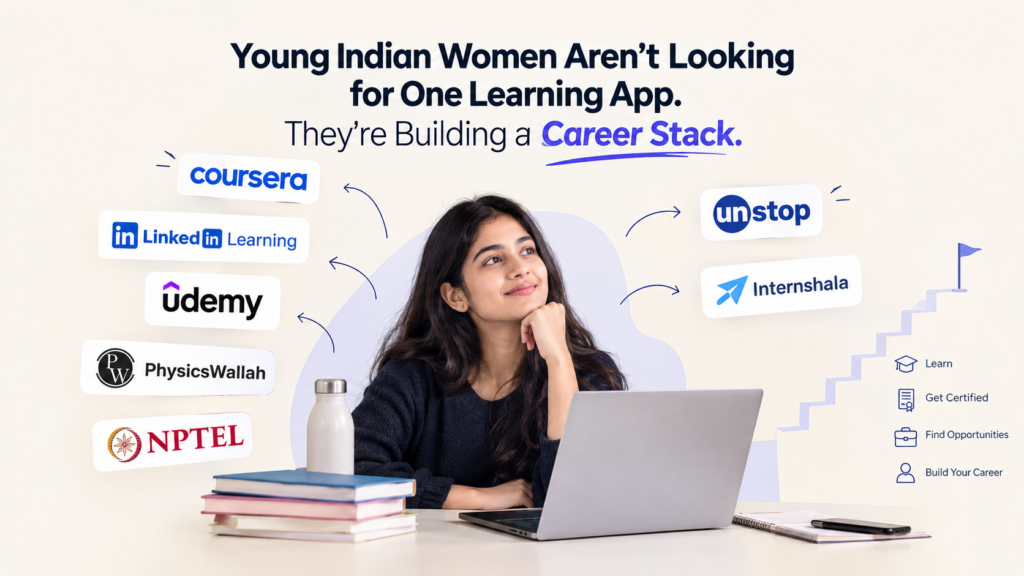
TheYouthTalks’ survey of brands loved by young Indian women points to one of the most fragmented categories in the study. Coursera leads with 24.2% of responses, followed by LinkedIn Learning at 21.9% and Udemy at 15.2%. Physics Wallah accounts for 9%, while NPTEL records 8.4%.
The numbers become more revealing when viewed together. The top two platforms account for only 46.1% of responses, while even the top five reach just 78.7%.
There is a leader, but there is no clear winner.
And that may tell us something important about what young women actually want from digital learning.
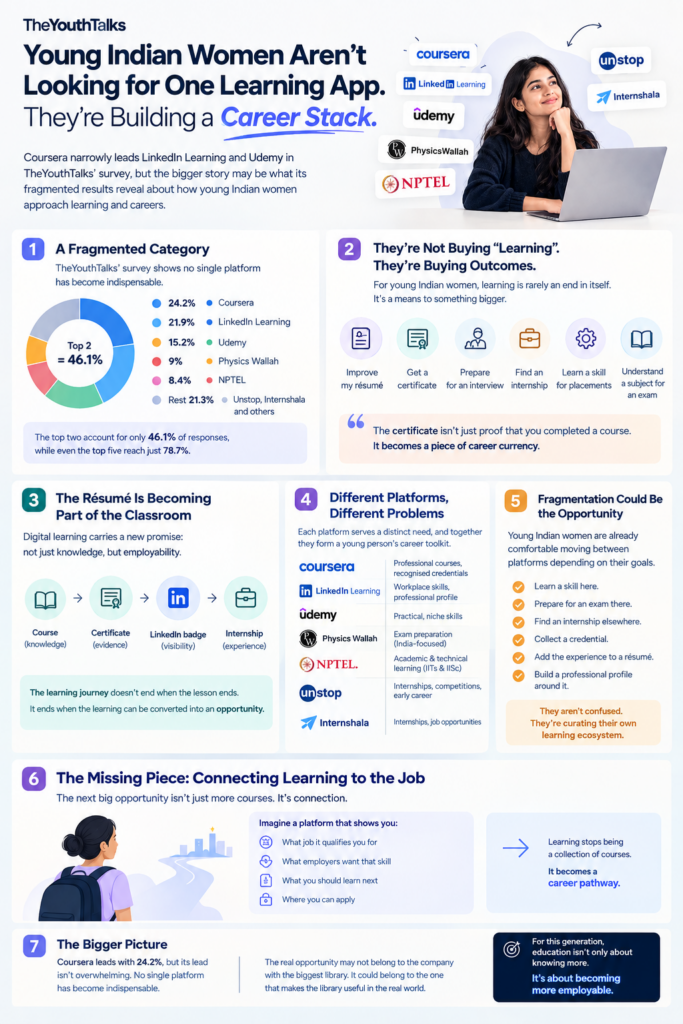
They Aren’t Buying Learning. They’re Buying Outcomes.
A student rarely thinks about learning in isolation.
She might be thinking about improving her résumé before placements. She may need a certificate for a particular role, preparation for an interview, an internship, or a new technical skill. Sometimes the immediate motivation is simply getting through an examination.
The underlying question, however, is often remarkably similar:
Will this help me get somewhere?
That distinction matters.
For young Indian women navigating an increasingly competitive education-to-employment journey, learning appears to be becoming part of a much larger career equation. A course is valuable not merely because it teaches something, but because it can potentially create evidence, credibility or opportunity.
That helps explain the position of platforms such as Coursera and LinkedIn Learning. Both operate strongly in the professional-development space, where courses and credentials can travel beyond the classroom.
The certificate, in this context, becomes more than a certificate.
It becomes career currency.
The Résumé Is Becoming Part of the Classroom
There was a time when the promise of education was relatively straightforward: learn something and know more.
Digital learning has added another layer to that promise: become more employable.
A course provides knowledge. A certificate provides evidence. A LinkedIn credential makes that evidence visible. An internship adds experience that can later become an interview story.
The learning journey, therefore, increasingly extends beyond the lesson itself.
Consider a student who spends a weekend learning data analytics. Her next question may not be about the next course. It may be: What can I actually do with this?
That shift changes the role of learning platforms.
They are no longer competing only on content quality or course libraries. They are increasingly becoming part of a young person’s professional identity.
Different Platforms, Different Jobs
The fragmentation in the survey becomes easier to understand when the platforms are viewed through the problems they solve.
Coursera can appeal to someone seeking structured professional learning and recognised credentials. LinkedIn Learning sits naturally within workplace skills and professional development. Udemy offers an enormous catalogue of practical and highly specific subjects.
Then there are platforms serving very different moments in the journey.
Physics Wallah is deeply embedded in India’s examination-preparation ecosystem. NPTEL connects learners with academic and technical content from leading Indian institutions. Unstop and Internshala operate closer to internships, competitions and early-career opportunities.
These aren’t necessarily interchangeable products.
They are becoming pieces of a career stack.
A student may learn on one platform, prepare on another, find an internship through a third and showcase the resulting experience somewhere else.
She isn’t necessarily struggling to choose.
She is choosing differently for different needs.
Fragmentation Could Be the Opportunity
A fragmented category can look immature. It can also indicate that consumers haven’t yet found a product capable of bringing everything together.
Young Indian women already appear comfortable stitching together their own ecosystem.
Learn a skill here. Prepare for an examination there. Find an internship somewhere else. Collect a credential. Add the experience to a résumé. Build a professional profile around it.
The missing piece is not necessarily another course catalogue.
It may be connection.
Today, the learner often has to connect the dots herself.
What Happens When Learning Meets Opportunity?
Imagine a platform that doesn’t stop at telling a student what she has learned.
Instead, it tells her which roles that skill is relevant to, what employers are asking for, which gaps remain in her profile, what she should learn next and where she can find opportunities to apply those skills.
That changes the proposition completely.
Learning stops being a collection of courses and becomes a career pathway.
And this may be the larger lesson hidden inside TheYouthTalks’ survey.
Coursera leads the category, but with just 24.2%, its lead is hardly overwhelming. No single platform has become indispensable to young Indian women.
The opportunity, therefore, may not belong to the company that builds the biggest library.
It could belong to the one that makes the library useful in the real world.
Because for a generation navigating education, employability and an increasingly uncertain job market, the most important question may no longer be “What can I learn?”
It may be:
“Where can this learning take me?”