Rapido is winning young riders with low fares and short-distance convenience. But safety concerns, particularly among women, show why India’s Gen Z isn’t choosing mobility apps on price alone.
There is a tiny ritual happening across India’s cities every day.
You need to get somewhere. College. The metro station. Work. A friend’s house. Maybe you’re already late.
You reach for your phone and, almost without thinking, open a ride-hailing app.
For years, that reflex belonged largely to Uber and Ola. But for India’s youngest riders, another name has become increasingly difficult to ignore: Rapido.
The reason is not particularly complicated.
It is cheap. It is quick. And for short distances, a bike can often make more sense than a car stuck in traffic.
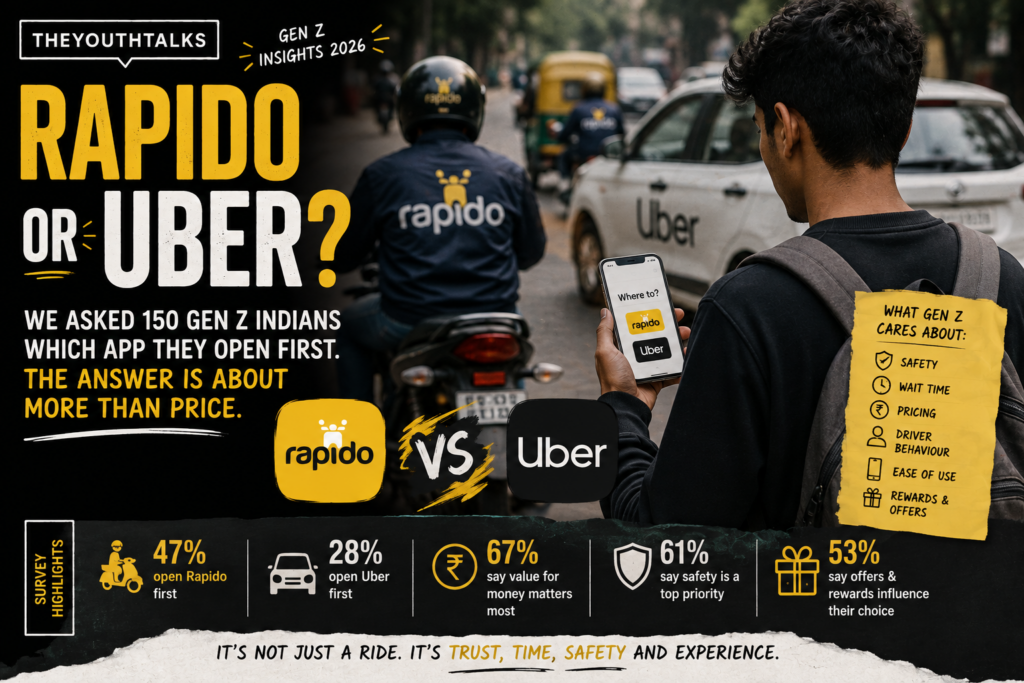
But numbers and market share only tell part of the story. To understand what is really happening, we asked 150 Indian Gen Z respondents, primarily college students and early-career professionals across metro and tier-2 cities, one simple question:
When you need a ride, which app do you open first — Rapido or Uber — and why?
The answers reveal something bigger than a contest between two mobility platforms.
They reveal how a generation thinks about money, convenience, safety and brand loyalty.
Rapido Is Becoming the First Tap
The strongest pattern from our conversations was the rise of the Rapido-first habit.
For many respondents, particularly those making short daily journeys, Rapido has become the first app they check.
College to PG.
PG to metro station.
Metro station to office.
A quick ride across a congested neighbourhood.
These aren’t journeys where a customer necessarily wants a luxurious car. They want to get there without spending too much.
Hardik, a young respondent from Delhi, summed up the appeal rather simply:
“Rapido works the best for me because of its low prices.”
There is something almost mundane about that answer.
And that’s precisely why it matters.
Gen Z isn’t necessarily looking for a revolutionary mobility experience. It wants everyday things to be affordable.
For a student or young professional managing rent, food, subscriptions and other expenses, the difference between a ₹70 bike ride and a ₹180 cab ride isn’t trivial.
It can determine whether the ride gets booked at all.
The Ride-Hailing App Has Become a Price Checker
Several respondents described another distinctly Gen Z habit: opening Rapido just to check the fare.
They don’t necessarily book immediately.
They compare.
If the price looks reasonable, they go ahead. If it doesn’t, they might check Uber, look for an auto, take the metro or simply walk.
That behaviour is important because it shows how little platform loyalty can mean to this generation.
The app isn’t necessarily a “brand” in the traditional sense.
It is a tool.
And the tool that gives them the best combination of price, time and convenience wins that particular transaction.
Today it could be Rapido.
Tomorrow it could be Uber.
Uber Still Owns the “Important Ride”
But Uber remains firmly embedded in the lives of young Indians.
Its role, however, appears somewhat different.
Among our respondents, Uber was more likely to be associated with airport journeys, late-night travel, longer distances, luggage or situations where comfort and reliability mattered more than saving a few rupees.
In other words, Uber isn’t necessarily the everyday choice.
It is the choice for the ride that feels important.
There was also an interesting family dynamic.
Some respondents said their parents were more comfortable with Uber, particularly when they were travelling late at night. In some families, Uber had become the established option for sharing trip details or tracking a young person’s journey.
That creates an unusual kind of brand loyalty.
The young consumer isn’t always choosing Uber because they love Uber.
Sometimes their parents chose it for them first.
Then There Are the Switchers
A third group doesn’t have a default at all.
They open both apps.
Check the fare.
Check the estimated arrival time.
Look at surge pricing.
Then decide.
This may actually be the most representative behaviour of Gen Z consumers.
They compare everything.
Food delivery. Flights. Hotels. Shopping. Streaming subscriptions.
Why should mobility be any different?
The idea of choosing one platform permanently feels almost unnecessary when the alternative is two taps away.
For ride-hailing companies, that creates a difficult reality.
The customer isn’t necessarily loyal to you. They are loyal to value.
Why Price Matters So Much to Gen Z
The price sensitivity we saw isn’t surprising.
Young Indians are often making independent spending decisions for the first time, but their purchasing power is still developing.
A ₹50 saving may seem insignificant to someone with a large monthly income.
For a student making several trips every week, it can become meaningful.
That is where Rapido’s bike-first proposition becomes powerful.
The bike solves two problems simultaneously.
It can cost less, and it can move through traffic more easily.
For short-distance travel, those advantages compound.
A young commuter doesn’t necessarily need the comfort of a sedan when the journey is 3 km and the roads are gridlocked.
They need to arrive.
Quickly.
And cheaply.
But Then Safety Changes the Calculation
There was one major caveat in our conversations.
Safety.
And this is where the gender divide became particularly interesting.
Female respondents were more likely to express reservations about bike taxis, particularly at night.
The concern wasn’t necessarily about Rapido alone. It was about the nature of the ride itself.
A woman travelling alone after dark may feel more comfortable inside a car than sitting behind an unfamiliar rider on a motorcycle.
Weather is another factor.
So is traffic.
And there is a psychological difference between being inside an enclosed vehicle and being exposed on a two-wheeler.
One female respondent’s perspective, captures this tension:
“During the day I don’t mind taking a Rapido because it is cheaper and faster. But at night, especially if I’m travelling alone, I would rather pay more for an Uber because I feel safer in a car.”
That distinction is important.
Gen Z may be price-conscious.
But price does not always beat perceived safety.
A Safety Concern Rapido Should Take Seriously
There is another issue that came up around bike and auto bookings: vehicle-number mismatches.
Some users report that the registration number displayed in the app does not always match the vehicle that arrives.
This is not simply a minor inconvenience.
A recent report in The Tribune documented a Delhi user’s experience in which a bike taxi arrived with a different registration number from the one displayed in the app. The report also noted that police advised passengers not to board when vehicle details do not match and to report the discrepancy through the platform.
There are also user reports specifically raising concerns about mismatched vehicle numbers on Rapido.
The reasons for such mismatches may vary. Drivers can operate multiple platforms, vehicles can be shared within families, and there can be legitimate replacement or operational circumstances.
But from the customer’s perspective, the problem is simpler.
The bike shown on the screen should be the bike standing in front of them.
If the app says one registration number and a completely different motorcycle arrives, the passenger should not be expected to guess whether the explanation is legitimate.
This is an area where Rapido could potentially strengthen trust by making vehicle verification stricter and more visible.
For a platform whose biggest advantage is convenience, trust cannot become the price of convenience.
The Rapido Experience Needs to Match the Promise
This matters even more because Rapido’s appeal is increasingly tied to young consumers.
Recent app-store reviews show users praising the platform’s convenience while also raising concerns about driver accountability, navigation, pricing and customer support.
The lesson for Rapido is straightforward.
Low prices can get the first booking.
They don’t necessarily guarantee the second.
If a passenger repeatedly experiences mismatched vehicles, poor support or uncomfortable rides, the economic advantage can quickly become irrelevant.
The stronger long-term proposition is not simply:
“We’re cheaper.”
It is:
“We’re cheaper, faster and just as trustworthy.”
That is a much harder promise to deliver.
And a much more valuable one.
Gen Z Isn’t Really Choosing Between Rapido and Uber
Perhaps the biggest takeaway from our 150 conversations is that the question itself may be slightly wrong.
Gen Z isn’t necessarily asking:
“Am I a Rapido person or an Uber person?”
It is asking:
“What makes sense for this journey?”
Rapido wins when price and speed dominate.
Uber wins when comfort, perceived safety or reliability matter more.
And both can lose when the metro, bus, auto or walking is a better option.
That is a very different kind of consumer.
There is little nostalgia.
Very little brand loyalty.
And almost no patience for paying more simply because a company is familiar.
The Bigger Battle Is for the First Tap
For mobility companies, the most valuable moment may not be the booking itself.
It is the moment before the booking.
When a young Indian needs to go somewhere and reaches for their phone, which app does their thumb find first?
That is where the real competition happens.
Rapido appears to have built a powerful advantage among young riders by understanding something fundamental about India’s Gen Z: they are willing to trade some comfort for affordability, particularly when the journey is short.
But there is a limit.
Safety remains non-negotiable.
Trust remains essential.
And convenience only works when the experience behind the app matches what the screen promises.
For now, the battle between Rapido and Uber isn’t simply about who has more riders.
It is about who understands the mindset of India’s youngest consumers better.
Because Gen Z isn’t asking for the fanciest ride.
It isn’t necessarily looking for the cheapest one either.
It wants the smartest ride for right now.
And increasingly, the company that earns that first tap may be the one that wins.