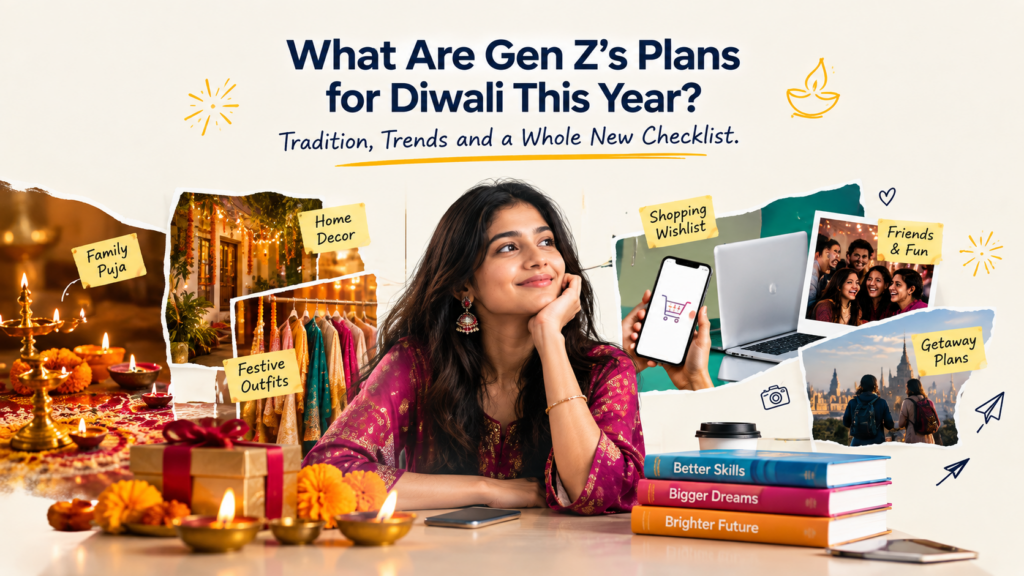
Diwali is still weeks away, but for Gen Z, the planning has already begun.
Outfits are being discussed. Homes need to be cleaned and decorated. Friends are making plans. Family gatherings are on the calendar. Card parties are returning. Diwali melas are finding their way into weekend plans. Some are even thinking about getting out of the city for a few days.
And then there is the shopping list.
A new phone. Perhaps a better laptop. A bike. Maybe even a family car. Gifts for parents, partners and loved ones. And, in many cases, something nice for themselves.
In conversations with 100+ Gen Z / youngsters who recently attended a TheYouthTalks event, one thing became clear: Diwali hasn’t become less relevant to young Indians. If anything, they appear to be finding more ways to make the festival their own.
That makes this year’s Diwali particularly interesting for brands.
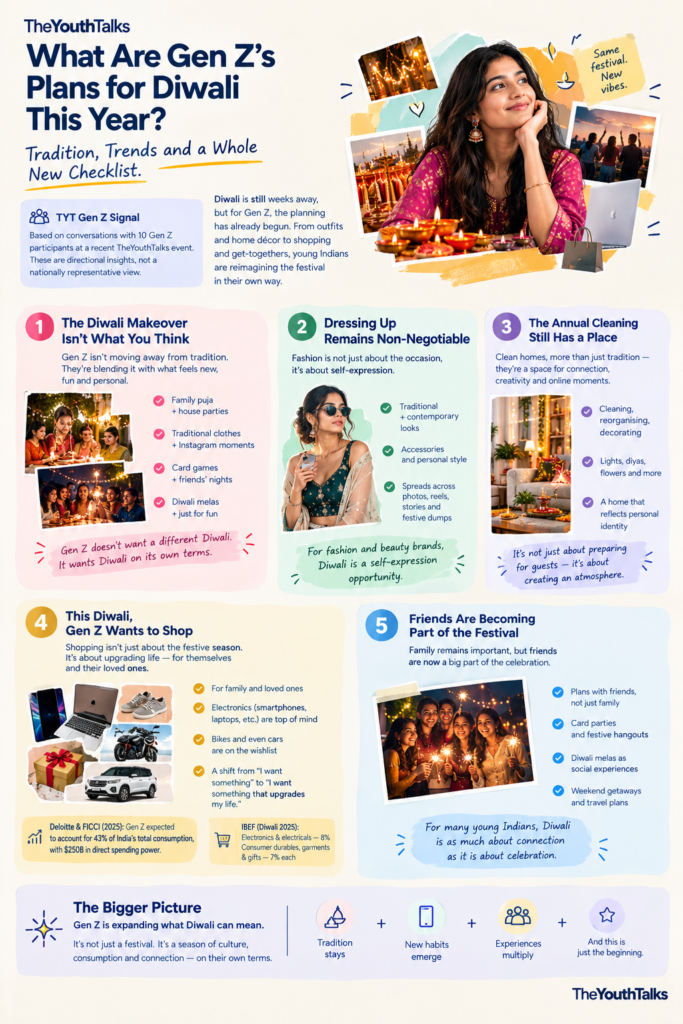
The Diwali Makeover Isn’t What You Think
There is an easy assumption that younger Indians are moving away from traditional festivals.
Our conversations suggested something more nuanced.
Gen Z still wants the familiar Diwali markers: a clean home, lights and decorations, dressing up, family time, festive food and celebrations with friends. What is changing is the context around them.
The traditional and the contemporary are sitting comfortably next to each other.
A family puja can coexist with a house party. Traditional clothes can become an Instagram moment. A card game can become a friends’ night out. A Diwali mela can be less about tradition and more about simply having fun.
Gen Z doesn’t necessarily want a different Diwali. It wants Diwali on its own terms.
That distinction matters for brands.
Dressing Up Remains Non-Negotiable
Fashion continues to be one of the most visible parts of the festive experience.
For young Indians, Diwali provides another reason to dress up, experiment and, inevitably, document the moment.
But festive dressing is no longer confined to a prescribed idea of what ethnic wear should look like. Young consumers are mixing traditional silhouettes with contemporary fashion, accessories and their own individual aesthetic.
And the outfit doesn’t end when the celebration does.
It becomes a photograph, a reel, a story, a profile picture or part of a festive photo dump.
For fashion and beauty brands, therefore, Diwali isn’t simply a seasonal sales opportunity. It is a self-expression opportunity.
The Annual Cleaning Still Has a Place
There is perhaps no ritual more universally associated with the run-up to Diwali than cleaning the house.
And Gen Z hasn’t exactly cancelled it.
Homes are being cleaned, reorganised and decorated. Lights, diyas, flowers and other festive elements come out.
But there is an interesting contemporary layer to this.
The home is increasingly a social space, a backdrop and an extension of personal identity. For a generation that has grown up sharing parts of its life online, decorating a home isn’t only about preparing for guests or following tradition.
It is also about creating an atmosphere.
That opens up a much larger opportunity for home décor, consumer durables, quick commerce, food, lifestyle and even technology brands around the festive season.
This Diwali, Gen Z Wants to Shop
Perhaps the strongest consumption signal from our conversations was remarkably simple:
Everyone wanted to shop.
The motivation, however, wasn’t the same for everyone.
Some wanted to buy for their parents or family. Some had a loved one in mind. Others were looking at Diwali as the perfect excuse to upgrade something for themselves.
Among the students we spoke to, electronics featured particularly strongly.
A new smartphone is on some wish lists. A better laptop is another aspiration—particularly because, for students, a laptop isn’t merely a consumer gadget. It can be a study tool, a creative platform, a gaming device, a project machine and, increasingly, a gateway to future work.
Then the aspiration gets bigger.
Some spoke about buying a bike. Others mentioned a family car.
This mirrors a broader shift in India’s consumer economy. Deloitte and FICCI reported in 2025 that Gen Z was expected to account for 43% of India’s total consumption, with estimated direct spending power of $250 billion. The report also identified Gen Z as a driver of premiumisation across categories including fashion and electronics.
And festive shopping itself remains a significant consumption moment. IBEF reported that electronics and electricals accounted for 8% of estimated Diwali 2025 goods sales, while consumer durables, garments and gifts each accounted for 7%.
For brands, the takeaway isn’t simply that Gen Z likes shopping.
It is that the young festive consumer can move surprisingly quickly from “I want something” to “I want something that upgrades my life.”
Friends Are Becoming Part of the Festival
Family remains important. But Gen Z’s Diwali isn’t confined to the family home.
Friends feature prominently in the plans.
Card parties, dinners, house gatherings and simply finding reasons to get a group together are all part of the festive experience.
This is an important distinction for brands trying to reach young consumers.
The social occasion itself becomes part of the product proposition.
A food brand isn’t merely selling snacks. A beverage isn’t merely a beverage. A fashion brand isn’t merely selling clothes.
They are potentially participating in the moment in which friends come together.
And that is a much more powerful emotional territory.
Green Crackers: Tradition Gets Reconsidered
One of the more unexpected observations from our conversations was the interest in green crackers.
The respondents we spoke to weren’t necessarily looking to abandon the tradition of fireworks. Instead, some were talking about whether it was possible to participate in the ritual in a more environmentally conscious way.
That is a fascinating Gen Z contradiction.
The generation often associated with questioning inherited behaviours isn’t necessarily rejecting the tradition. It appears, at least among some of those we spoke to, to be asking:
Can we keep the tradition and change the way we practise it?
This is not enough evidence to declare a broad Gen Z trend. But it is an interesting signal.
And it fits into the wider environmental conversation around Diwali. The Central Pollution Control Board itself has promoted an “Eco-Green Deepavali” approach and notes that conventional fireworks can release particulate and gaseous pollutants.
For brands, this is a useful reminder: sustainability messaging doesn’t always have to mean removing the tradition. Sometimes it can mean helping consumers participate differently.
And Then There Is the Great Diwali Escape
Perhaps the most intriguing contradiction is that while Gen Z wants to celebrate Diwali, some also want to leave town.
Pollution is one reason.
For those who can afford to travel, spending three or four days somewhere cleaner offers a different kind of festive experience: a break from the city, some time with friends or family and the chance to turn the festival into a short holiday.
This isn’t necessarily an escape from Diwali.
It is an attempt to experience the holiday differently.
That distinction is important for travel and hospitality brands looking at the festive opportunity. Diwali travel doesn’t have to compete with the festival. It can become another way of celebrating it.
Diwali Mela Is Back on the Agenda
Then there are the Diwali melas.
For some of the Gen Z respondents, the appeal is straightforward: go with friends, eat, shop, walk around, experience the lights and have fun.
There is something interesting here.
In an age dominated by digital experiences, young consumers are still attracted to physical spaces that feel crowded, spontaneous and social.
The mela isn’t necessarily being consumed as a cultural obligation.
It is being consumed as an experience.
And experiences are becoming increasingly important in how younger consumers spend their time and money. Deloitte’s research on Indian consumers has also pointed to growing interest in experiential spending, including leisure travel.
Before Diwali, There Is Durga Puja
There is also another important part of the festive calendar that Gen Z is eagerly anticipating: Durga Puja.
It isn’t Diwali, of course. But for many young Indians, particularly in cities with strong Bengali communities, Durga Puja forms part of the broader festive season leading into Diwali.
Pandal hopping, food, dressing up, meeting friends and spending evenings outdoors make it a social experience as much as a cultural one.
And perhaps that is another way Gen Z is changing the festive calendar.
They don’t necessarily experience festivals as separate occasions. They experience them as one extended season of culture, consumption and connection.
So, What Does Gen Z Want From Diwali?
After speaking to these 10 young Indians, the answer wasn’t a rejection of tradition.
It was almost the opposite.
They want to clean their homes.
They want to decorate.
They want to dress up.
They want to spend time with family.
They want to meet friends.
They want cards, melas and celebrations.
They want to shop—for their parents, their loved ones and themselves.
They want phones and laptops, and some are already thinking about bigger purchases like bikes and cars.
Some want crackers, but perhaps in a more conscious form.
And some want to travel somewhere cleaner for a few days.
The bigger story for brands is therefore not that Gen Z is changing Diwali.
It is that Gen Z is expanding what Diwali can mean.
It can be tradition and self-expression. Family and friends. Shopping and gifting. Celebration and travel. Physical experiences and digital storytelling.
The opportunity for brands lies in understanding those intersections.
Because this Diwali, the young Indian consumer may not be asking brands to choose between tradition and modernity.
They want both.
And they want to experience both their way.