
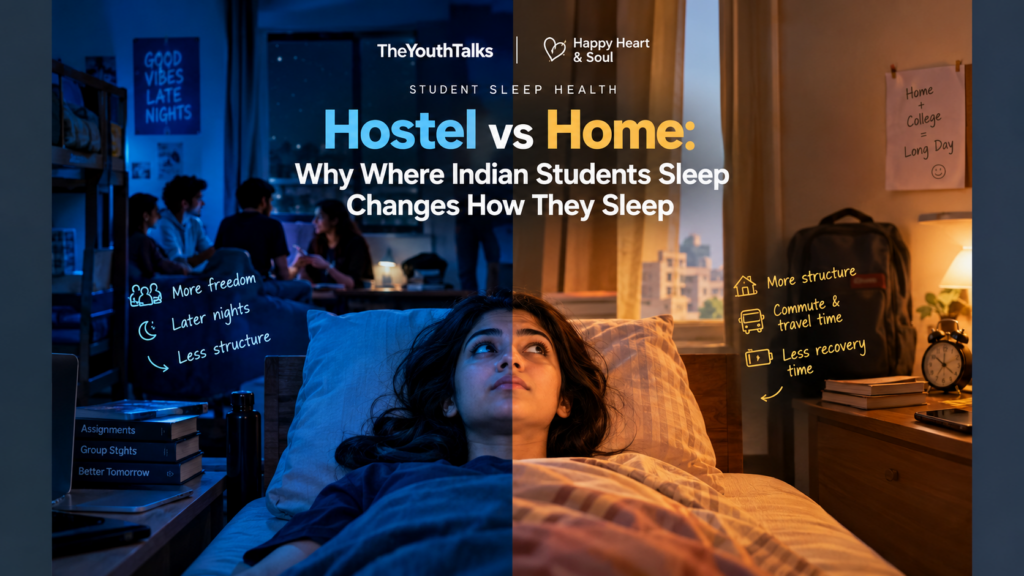
For a college student, where you sleep can change more than the address on your college ID.
A hostel room comes with freedom: no parents asking when you will sleep, no household bedtime, and often a social environment that continues long after midnight.
Living at home comes with a different reality. There may be more structure around bedtime, but there can also be commuting, household routines and the daily journey between campus and home.
New research by TheYouthTalks and Happy Heart & Soul suggests that these living arrangements are reflected in how Indian students sleep.
The difference is not simply hostel versus home.
It is about the constraints that come with each.
Hostellers are going to bed later
Among the 472 students for whom living-arrangement data was available, 62.4% of hostellers were in bed after midnight, compared with 52.3% of day scholars.
The difference becomes visible at the extremes too.
20.8% of hostellers reported getting into bed after 2 AM, compared with 16.3% of day scholars.
At the other end of the spectrum, 6.5% of hostellers were in bed before 10 PM, compared with 5.2% of day scholars.
The overall pattern suggests that hostel life is associated with a later night.
And that later night appears to carry a cost.
The hours add up
Across the survey, hostellers were more likely to report sleeping for fewer than six hours: 39.0% compared with 29.1% among day scholars.
Hostellers also reported a higher average memory-and-retention difficulty score, at 6.60 versus 5.98 for day scholars.
But the story becomes more interesting when we look at how refreshed students feel.
Day scholars reported a higher average burnout score — 6.32 compared with 6.16 among hostellers — and 15.0% of day scholars said they were rarely or never refreshed, compared with 9.1% of hostellers.
So this is not a simple story in which one group is “sleeping better.”
The two groups appear to be dealing with different pressures.
The hostel gives freedom. It also removes the household clock.
For many students, moving into a hostel is one of the first major experiences of living without the routines of home.
There is no parent asking them to switch off the light.
Friends may still be awake.
A study session can become a late-night conversation. A late assignment can become a 1 AM assignment. And when tomorrow’s first obligation does not feel immediately connected to tonight’s bedtime, the boundary between the day and the night can become easier to push.
The research describes this as a freedom effect: hostellers lose hours to the flexibility of hostel life.
That interpretation should not be mistaken for proof that hostel freedom causes shorter sleep. The survey is cross-sectional and cannot establish causation.
But the living-arrangement difference is large enough to raise a practical question for colleges: can the same sleep intervention work for a student living in a hostel and one travelling home every evening?
The data suggests the answer may not be straightforward.
Home has its own sleep tax
Day scholars are not necessarily protected simply because they sleep at home.
Their constraint may be recovery time.
The report characterises this as a commute tax — the time and energy consumed getting between home and campus.
A student can have a relatively structured household bedtime and still arrive at night with little time left for decompression, family interaction, studying and personal life.
That may help explain why day scholars in this sample reported higher burnout despite somewhat earlier bedtimes and fewer reports of very short sleep.
Again, this is an interpretation of the observed pattern, not a causal finding.
The important point is that sleep opportunity and recovery are not exactly the same thing.
One sleep programme may not fit both
This is where the hostel-versus-home finding becomes useful beyond the numbers.
A programme designed for hostellers might need to focus on late-night routines, peer culture, social boundaries and the absence of a household clock.
For day scholars, the intervention may need to account for commuting, decompression time and the transition between campus and home.
The survey also found that demand for structured support was broadly similar across the two living arrangements.
That creates an interesting opportunity for colleges.
Students in both environments are asking for help. Their constraints, however, are different.
And that means the answer may not be to tell every student the same thing:
“Go to bed earlier.”
For one student, the challenge may be knowing when hostel life should end for the night.
For another, it may be finding enough recovery time between leaving campus and starting the next day.
The Indian student sleep problem, this research suggests, does not happen in one universal bedroom.
It happens inside different environments — and those environments shape the habits, pressures and boundaries that students carry to bed.
Where a student sleeps may not determine how well they sleep. But it clearly changes the conditions under which sleep has to happen.