
A TheYouthTalks survey of 500 young Indians reveals how AI is quietly becoming the first confidant for questions that are too awkward, intimate or embarrassing to ask another human.
There is a particular kind of question that people tend to ask quietly.
Not necessarily because it is complicated. Not because the answer is unavailable. Sometimes, it is simply because saying it aloud feels uncomfortable.
“Is this normal?”
“Could I be pregnant?”
“Why does it hurt after sex?”
“Why am I suddenly losing so much hair?”
“Is my body supposed to look like this?”
“Can I ask you something embarrassing?”
For years, a young Indian with such a question might have searched Google late at night, scrolled through Reddit, watched a YouTube video, or summoned enough courage to ask a friend.
Today, there is another option.
AI.
And it doesn’t look at you.
It doesn’t laugh. It doesn’t interrupt. It doesn’t ask why you didn’t know this already.
Most importantly, it allows the question to remain private.
That seemingly simple shift could be changing the way India’s Gen Z seeks health information.
A new TheYouthTalks survey of 500 Gen Z Indians suggests that AI is moving beyond its familiar role as a study assistant, coding partner or productivity tool. It is becoming a private conversational space for questions about the body, sexual health, relationships, mental wellbeing and other deeply personal concerns.
The numbers are revealing.
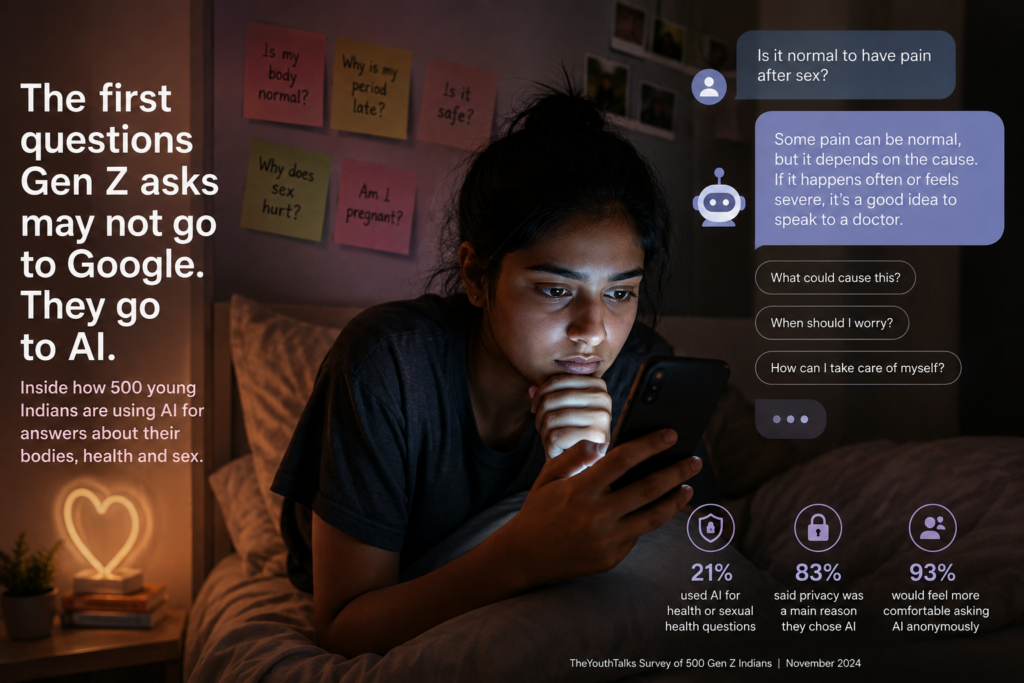
21% of respondents said they had used an AI chatbot to ask about a health, body, sexual-health or personal-wellbeing question.
Among those who had done so, 83% identified privacy as one of the main reasons they chose AI.
And perhaps the most striking finding: 93% said they would feel more comfortable asking AI anonymously than another person about at least one sensitive health question.
The story, therefore, may not really be about whether Gen Z thinks AI is smarter than a doctor.
It may be about something much more human.
AI is easier to talk to.
AI Is Becoming the First Stop, Not Necessarily the Final Answer
For a long time, the health-information journey was relatively predictable.
You asked your mother.
Or your father.
Maybe an older sibling.
Then came Google.
Then YouTube.
And, if the problem seemed serious enough, a doctor.
AI is quietly inserting itself much earlier in that sequence.
Instead of opening several search results and trying to work out which source is credible, a young person can type a question directly into a chatbot and continue the conversation.
“My period is 10 days late. Should I be worried?”
Or:
“Is it normal to have pain after sex?”
Or:
“Why am I suddenly getting so much acne?”
Or perhaps the most revealing version:
“I don’t know how to ask this, but is this normal?”
The attraction is obvious.
There is no appointment. No waiting room. No awkward eye contact. No fear of being judged.
And the question does not have to be spoken.
TheYouthTalks’ survey found that 21% of respondents had already used AI for a health, body, sexual-health or personal-wellbeing question.
That is significant in itself. But the reason behind the behaviour is even more interesting.
Among those users, 83% cited privacy as one of the reasons they chose AI.
The implication is important.
AI’s competitive advantage in this context may not be superior medical intelligence.
It may be psychological accessibility.
The Question Isn’t “Can AI Answer?” It Is “Can I Ask?”
There is a subtle difference between wanting information and wanting a conversation.
Google has been answering health questions for years. Search engines can tell you what PCOS is, what symptoms accompany an STI, what causes acne or what might happen if you miss a period.
But search requires the user to formulate a query, sift through results and decide which information to trust.
A conversational AI changes the experience.
You can ask one question.
Then ask another.
Then admit that you didn’t understand.
Then reveal another detail.
Then ask, perhaps nervously:
“Are you sure?”
That conversational quality is particularly powerful when the subject involves shame or uncertainty.
And there is evidence that this isn’t simply an American or Silicon Valley phenomenon.
India has already seen substantial demand for digital conversations around sexual and reproductive health.
SnehAI, an AI chatbot developed for young people in India, exchanged 8.2 million messages over a five-month period. Almost half of incoming messages were free-text questions involving personal concerns about sexual and reproductive health and related subjects. Researchers described the platform as providing a safe space for users to discuss sensitive topics, seek information and access local services.
That is a remarkable signal.
People didn’t merely want a database of health information.
They wanted to talk.
Sex Is Where the Privacy Advantage Becomes Most Obvious
There are some questions that are simply harder to ask another person.
Sexual health sits near the top of that list.
Questions about contraception, pregnancy, masturbation, sexually transmitted infections, sexual performance, virginity and pain during sex can be deeply personal. Cultural expectations and social stigma can make them even harder to discuss openly.
AI introduces a peculiar new possibility:
Ask without being seen.
TheYouthTalks survey found that 93% of respondents said they would feel more comfortable asking AI anonymously than another person about at least one sensitive health question.
That doesn’t necessarily mean young Indians don’t trust doctors.
It may mean they aren’t ready to speak to one yet.
There is a difference.
A young person may not be prepared to walk into a clinic and say, “I think something is wrong with my sexual health.”
But they may be perfectly willing to type the same sentence into a chatbot at 1:30 in the morning.
That first conversation can lower the psychological barrier to seeking help.
And sometimes, that first conversation may be precisely what is needed to eventually reach a human professional.
India Already Has a Real-World Example
The idea of using conversational technology to address these questions is not theoretical.
UNFPA India, in partnership with the National Health Mission and government stakeholders, developed Just Ask/Khulke Poochho, an AI-enabled chatbot for adolescents and young adults.
It covers subjects including puberty, bodily changes, menstruation, reproductive health, pregnancy, family planning, gender identity, sexual orientation and other sexual and reproductive health topics. The platform is designed to be safe, personalised, multilingual and empathetic, and it can connect users with health facilities and helplines.
The scale is notable.
According to UNFPA India, by June 2025 JustAsk had provided services to more than 140,000 young people, answered more than 2.2 million user queries, and was being accessed across more than 20 states and union territories.
And the evidence is moving beyond engagement.
A 2026 UNFPA evaluation of its My Rights, My Choices programme found that the combination of digital innovation, including the JustAsk chatbot, and community-based interventions was associated with a 7.2 percentage-point net increase in modern contraceptive prevalence in intervention districts.
That changes the conversation.
AI isn’t simply being tested as a novelty.
It is increasingly being explored as part of a real health-information and service-delivery ecosystem.
But Gen Z Doesn’t Necessarily Trust AI Completely
Here is where the story gets more interesting.
Young people may be willing to ask AI.
That doesn’t mean they are willing to believe AI blindly.
TheYouthTalks found that 67% of respondents said they would verify an AI-generated health answer elsewhere before acting on it.
That creates an important distinction:
AI may be the first conversation without becoming the final authority.
And that distinction could define the future of health AI.
There is evidence of a similar pattern globally.
Pew Research Center reported in 2026 that 22% of U.S. adults get health information from AI chatbots at least sometimes. Among adults aged 18 to 29, the figure rises to 32%. Yet users are more likely to describe AI-generated health information as convenient than accurate.
Convenience is winning the first interaction.
Trust still has to be earned.
The Mental Health Parallel Is Even More Striking
The phenomenon extends beyond physical and sexual health.
A nationally representative U.S. study published in JAMA Pediatrics in 2026 found that 19.2% of adolescents and young adults aged 12 to 21 had used an AI chatbot for mental-health advice.
Among those users, 42.8% used AI at least monthly, and 91.7% considered the advice somewhat or very helpful.
But there was another striking finding.
The majority of young users who had used AI for mental-health advice had not disclosed that use to anyone else.
That is perhaps the clearest indication yet that AI is becoming more than an information source.
It can become a confidant.
A private first conversation.
A place to articulate a thought before deciding whether it deserves to be shared with another person.
For health systems, that is both promising and unsettling.
India’s Language Advantage Could Be a Major Differentiator
There is another factor that makes the Indian market particularly interesting.
Health questions don’t always arrive in polished English.
They might arrive as:
“Periods late hai, pregnancy ho sakti hai?”
Or:
“Bhai ye normal hai kya?”
Or:
“Mujhe ye problem kisi ko batane mein awkward lag raha hai.”
India’s young population routinely moves between English, Hindi and regional languages, sometimes within the same sentence.
That makes localisation more than a translation exercise.
It is about understanding how people actually communicate.
SnehAI was built around a conversational, Hinglish-oriented experience. UNFPA’s JustAsk platform similarly emphasises multilingual and empathetic engagement.
The opportunity for Indian health AI therefore may not simply be:
AI + medical knowledge.
It could be:
AI + medical knowledge + local language + cultural context + privacy + trusted escalation.
That combination is far harder to replicate than simply placing a chatbot on top of a language model.
The Biggest Problem: AI Can Be Confidently Wrong
There is, however, a serious problem hiding beneath all this enthusiasm.
AI can produce an answer that sounds authoritative even when it is incorrect.
In most categories, that is frustrating.
In healthcare, it can be dangerous.
A young person asking whether a symptom is normal isn’t necessarily looking for an essay. They may be deciding whether to wait, buy something, take medication, speak to someone or see a doctor.
That makes accuracy, source quality and escalation critical.
Research into AI chatbots for youth sexual-health information has highlighted precisely these concerns, including limitations around safety, inclusivity and the breadth of information available.
And this is why the next generation of health AI may not be built around a simple proposition of:
“Ask AI anything.”
The better proposition may be:
“Ask AI anything — and know where the answer came from.”
This Is Where RAG Could Become More Than a Technical Buzzword
The business opportunity becomes particularly interesting here.
A generic chatbot can answer:
“Could this be PCOS?”
But imagine an India-specific health platform that retrieves information from a carefully curated medical knowledge base before generating its response.
It could:
- identify the user’s question;
- retrieve relevant medical evidence;
- explain the information in plain language;
- cite the underlying sources;
- distinguish symptoms from diagnosis;
- identify potential red flags;
- ask appropriate follow-up questions;
- and recommend when professional medical care may be necessary.
That is the promise of a retrieval-augmented generation, or RAG, health platform.
The basic technology is not necessarily the difficult part.
The difficult part is building the trust layer.
Who selected the sources?
Who reviewed them?
How frequently are they updated?
How does the system deal with uncertainty?
What happens when a user describes an emergency?
What personal data is retained?
Can the user remain anonymous?
And, perhaps most importantly:
When should the AI stop talking and tell the user to speak to a human?
Those are product questions.
They are also ethical questions.
The Opportunity May Be Much Bigger Than Sexual Health
Sexual health may be the entry point.
But the behaviour is broader.
TheYouthTalks respondents reported using or considering AI for questions around menstruation, skin and acne, weight and body image, hair loss, fitness and nutrition, sleep, mental wellbeing, relationships, sexual health, pregnancy, contraception and general symptoms.
And there is a common thread running through all of them.
It isn’t a particular medical speciality.
It is a question:
“Is this normal?”
That may be the most important finding of all.
Gen Z isn’t necessarily asking AI to diagnose them.
They are asking AI to help them understand what is happening to them.
What Are Young Indians Actually Asking?
The Indian SnehAI experience gives us an extraordinary glimpse into the kinds of questions young people are willing to put into a private digital interface.
An analysis of 99,936 typed messages related to sexual and reproductive health found that the largest category — 57.2% — concerned safe sex, consent, sexual practices and pregnancy.
Another 15.2% concerned adolescent sexual health topics including masturbation, pornography, sexual stamina, erectile dysfunction and STIs.
Menstruation, virginity and premarital sex accounted for 14%.
Family planning, contraception, abortion and fertility accounted for 6.3%.
Look at what that tells us.
People aren’t necessarily looking for a diagnosis.
They are trying to make sense of their lives.
They want to know what is normal.
What is safe.
What isn’t.
What they should worry about.
What they should do next.
And sometimes, simply whether they should be embarrassed at all.
AI Could Become the “Pre-Doctor”
Perhaps the most useful way to think about this emerging relationship is not AI versus doctors.
It is:
AI before the doctor.
A young person might first ask:
“What could this mean?”
Then:
“How serious could it be?”
Then:
“Should I see someone?”
Then:
“What kind of doctor should I see?”
And finally:
“What should I ask them?”
AI becomes a navigation layer between uncertainty and healthcare.
The ideal journey might look like:
AI → Explain → Educate → Assess risk → Recommend next step → Human care
Not:
AI → Diagnose → Treat
That distinction is crucial.
A responsible health AI should know the limits of its role.
The Real Competition May Be for Trust
There is a temptation to view this as another AI adoption story.
It isn’t.
The deeper story is about trust.
A young person may trust AI enough to reveal something they would not tell a friend.
They may trust it enough to ask a question they would never ask a parent.
They may trust it enough to search for reassurance at two in the morning.
But trust is not the same as accuracy.
And comfort is not the same as competence.
That is why the next wave of health AI products could be defined less by how impressive their models are and more by how responsibly they manage the relationship between information and action.
The winner may not be the company with the most sophisticated chatbot.
It may be the company that can credibly answer:
“Why should I trust this answer?”
The Question Young Indians Are Asking Has Changed
Young Indians have always had questions about their bodies.
What has changed is who they can ask.
A teenager who once searched Google at 2 a.m. can now have a conversation.
A young woman who may not want to tell her family about a sexual-health concern can ask privately.
A young man embarrassed to discuss sexual performance can type a question instead.
Someone worried about their body can simply write:
“Is this normal?”
And something will answer.
The question facing us now isn’t whether young people will use AI for these conversations.
They already are.
The more important question is whether the AI they turn to is trustworthy enough to deserve that intimacy.
Because when a young person asks an AI about their body, their health, their sex life or their mental wellbeing, they aren’t simply searching for information.
They are handing over something personal.
And perhaps that is the real frontier of AI in healthcare.
Not diagnosis. Not automation. Not even intelligence.
Trust.
And the companies, institutions and healthcare systems that understand that may end up building the most important health-AI products of the next decade.