





TheYouthTalks Beauty Research | Young Women & Brand Behaviour
Young women are often described as the ultimate experimental beauty consumer.

They discover a serum on Instagram, save a creator’s “five-step routine”, compare ingredients on Reddit, and may happily replace a product they have been using for months because something newer, cleaner or more exciting has appeared.
But there is an interesting contradiction hiding inside the modern beauty cabinet.

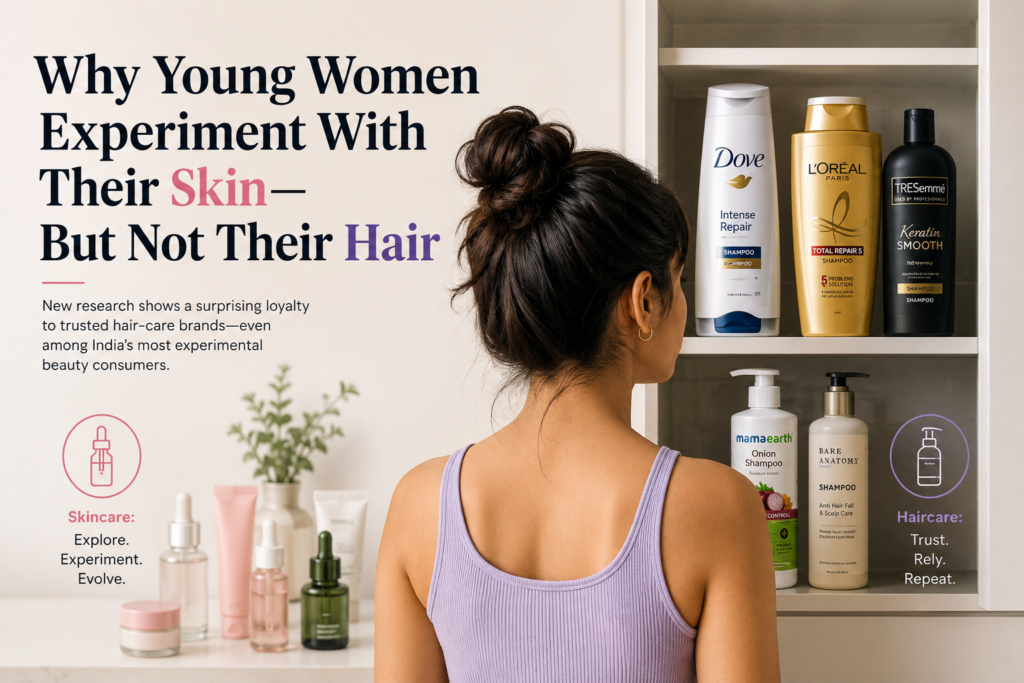
Young women may be experimental with their skin, but when it comes to their hair, they are surprisingly loyal.
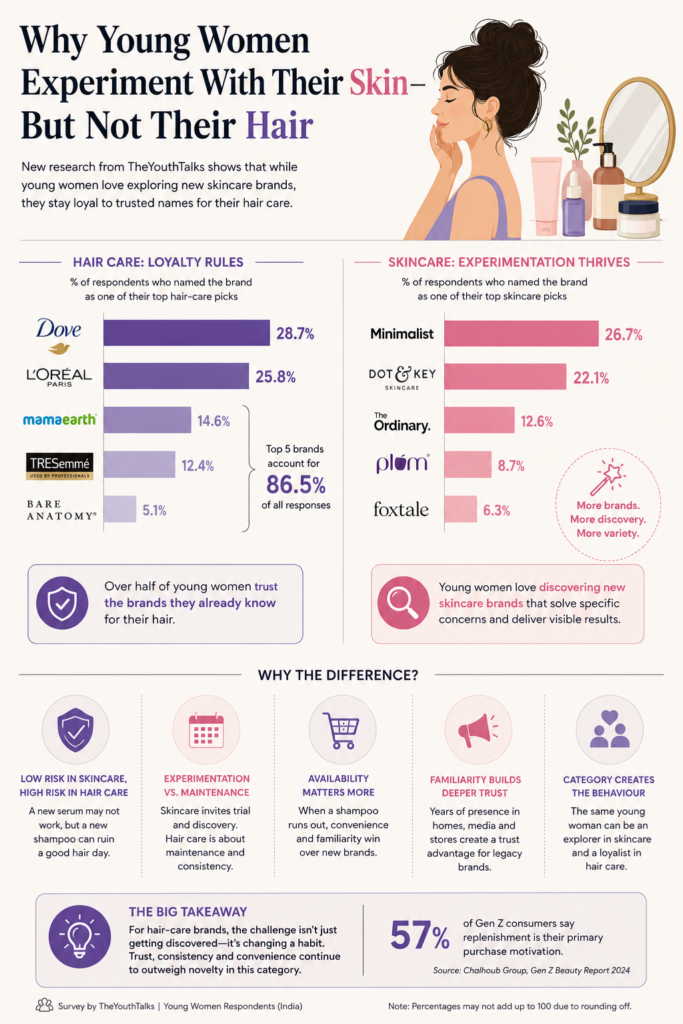
TheYouthTalks’ survey of brands loved by young women offers a revealing glimpse into this behaviour. Dove leads the hair-care category with 28.7% of responses, followed by L’Oréal Paris at 25.8%. Together, the two brands account for 54.5% of all responses.

That concentration is striking when compared with skincare, where newer-age names such as Minimalist and Dot & Key have become prominent choices among young consumers.
The implication is bigger than a ranking of shampoo brands.
It suggests that Gen Z does not have one universal relationship with brands. Their behaviour changes dramatically depending on the category.
And hair care may be one of the clearest examples.
The bathroom cabinet is more conservative than the Instagram feed
Look further down TheYouthTalks’ hair-care ranking and the pattern becomes even more apparent.
Mamaearth occupies third place with 14.6%, followed by Tresemmé at 12.4%. Bare Anatomy, a newer specialist player, records 5.1%.
Together, the top five brands account for 86.5% of responses.
That is a remarkably concentrated market.
The leading names are also brands many young women would have encountered long before they started following beauty creators. Dove and L’Oréal Paris have existed in Indian consumers’ lives through television advertising, supermarkets, family bathrooms and neighbourhood stores.
That familiarity matters.
In fact, it may matter more in hair care than it does in skincare.
Recent research supports the broader idea that young beauty consumers are not simply abandoning established brands. A 2024 beauty report from Chalhoub Group found that Gen Z combines loyalty to trusted favourites with a willingness to explore products that become culturally relevant, while 57% of Gen Z consumers cited replenishment as their primary purchase motivation.
In other words, experimentation and loyalty can coexist.
The question is: where does each behaviour show up?
Skin is a playground. Hair is a routine.
Think about the typical skincare conversation.
Acne. Pigmentation. Barrier repair. Hydration. Retinol. Niacinamide. Vitamin C.
There is always another concern to solve, another ingredient to understand and another product promising to transform the routine.
Skincare almost invites experimentation.
Hair care, by comparison, is often far more functional.
Shampoo. Conditioner. Maybe a hair mask. Perhaps a serum or oil.
Then repeat.
If a particular shampoo works reasonably well, smells good, doesn’t leave the hair feeling dry and is available when the bottle runs out, there may be very little incentive to switch.
There is also an element of risk.
A bad skincare experiment might mean a few days of irritation. A bad hair-care experiment can leave someone with frizz, dryness, limp hair or an unwanted result before an important event.
Nobody wants to discover that their new shampoo doesn’t agree with their hair on the morning of a college presentation, first date or wedding.
In hair care, “new” has to be substantially better than “known” before consumers feel compelled to switch.
The D2C beauty playbook has a harder job to do
This creates an interesting challenge for India’s new generation of beauty brands.
The digital-first playbook has worked exceptionally well in skincare.
Ingredient education. Creator recommendations. Before-and-after content. Problem-specific products. Attractive packaging. Personalised routines.
The model is powerful because it turns a consumer problem into a discovery journey.
Recent Indian beauty research from Mintel similarly highlights Gen Z’s interest in beauty experimentation, self-expression and skincare routines, with social media playing an important role in shaping perceptions of appearance.
But hair care doesn’t necessarily respond to the same formula.
A consumer might happily add a new serum to an existing skincare routine without replacing everything else. Convincing her to replace a shampoo she has used for three years is a different proposition.
That is why specialist brands face a particularly difficult challenge.
They are not merely competing for attention.
They are competing against habit.
Mamaearth shows that the wall can be breached
The exception is perhaps Mamaearth.
Its 14.6% share in TheYouthTalks’ survey places it comfortably ahead of newer specialist brands. Its positioning around natural and plant-based products helped create a bridge between the trust associated with traditional personal-care brands and the discovery culture of digital-first beauty.
That positioning matters because consumers do not necessarily wake up one morning wanting a “new brand”.
They want a solution.
If a brand can provide that solution while reducing the perceived risk of switching, it has a chance.
But even Mamaearth remains well behind Dove and L’Oréal Paris in the survey.
That gap tells its own story.
Distribution may matter more than discovery
There is another powerful advantage that established hair-care brands possess: availability.
Hair care is fundamentally a replenishment category.
Eventually, the bottle is empty.
At that point, the consumer may not want to conduct research, watch five reviews and compare ingredient lists. She may simply want the same product again.
That is where distribution becomes a competitive weapon.
A familiar Dove bottle sitting on a supermarket shelf, in a neighbourhood store or on a quick-commerce app can win without having to create a fresh discovery moment.
The brand does not have to ask, “How do I get her to try me?”
It only needs to make sure she can find it.
L’Oréal’s own Indian distribution footprint illustrates the scale of this advantage: the company says L’Oréal India operates across mass-market channels, salons, selective distribution and pharmacy/chemist channels, with 26 brands in its portfolio.
For a challenger, therefore, the battle is not simply marketing versus marketing.
It is distribution versus habit, familiarity versus novelty and reassurance versus experimentation.
But don’t mistake loyalty for a lack of curiosity
There is an important nuance here.
Young women are not necessarily uninterested in experimenting with hair.
They are experimenting with different parts of the category.
Hair colour, styling, curls, heatless hairstyles and niche treatments can provide a much more expressive outlet. Nykaa’s 2024 Beauty Trends Report, for instance, identified “playfulness with hair” as an emerging behaviour, with niches such as hair styling, colour and curly-hair care gaining momentum.
That distinction is important.
The consumer may not want to change her shampoo every month.
But she may absolutely want to try a new hair colour, styling tool or treatment.
So the opportunity for challengers may not be to attack the entire hair-care routine.
It may be to enter through a specific behaviour, problem or aspiration and gradually build trust.
The bigger lesson: Gen Z is not one consumer
Perhaps the most useful conclusion from this data has little to do with shampoo.
It is about how marketers understand young consumers.
We often speak about “Gen Z” as if it were a single behavioural group.
It isn’t.
The same 20-year-old can be experimental with skincare, loyal to shampoo, price-conscious about makeup, adventurous with fragrance and extremely brand-conscious when buying sneakers.
The category creates the behaviour.
That is a crucial distinction.
Recent market research continues to point towards both fragmentation and digital-first growth in Indian beauty, while also highlighting the importance of personalisation, efficacy and convenience among younger consumers.
For Dove and L’Oréal Paris, the lesson is encouraging: decades of familiarity can still translate into remarkable relevance among young consumers.
For emerging brands, the lesson is more uncomfortable.
A better Instagram strategy may win attention.
A more sophisticated formula may win consideration.
But in hair care, winning the consumer may require something much harder: changing a habit.
And that may be the real opportunity hiding inside India’s next beauty boom.
The question for every challenger is no longer simply “How do we get young women to notice us?”
It is:
What would make them trust us enough to stop using what already works?
That is where the next generation of hair-care brands will either break through—or remain the interesting product sitting one shelf below the brands consumers already know.
Source: TheYouthTalks, Gen Z Women Brand Index. The survey captures the preferences of young women in the study sample and should be read as a focused consumer snapshot rather than a representation of all Indian women.
Read the full report: TheYouthTalks Gen Z Women Brand Index