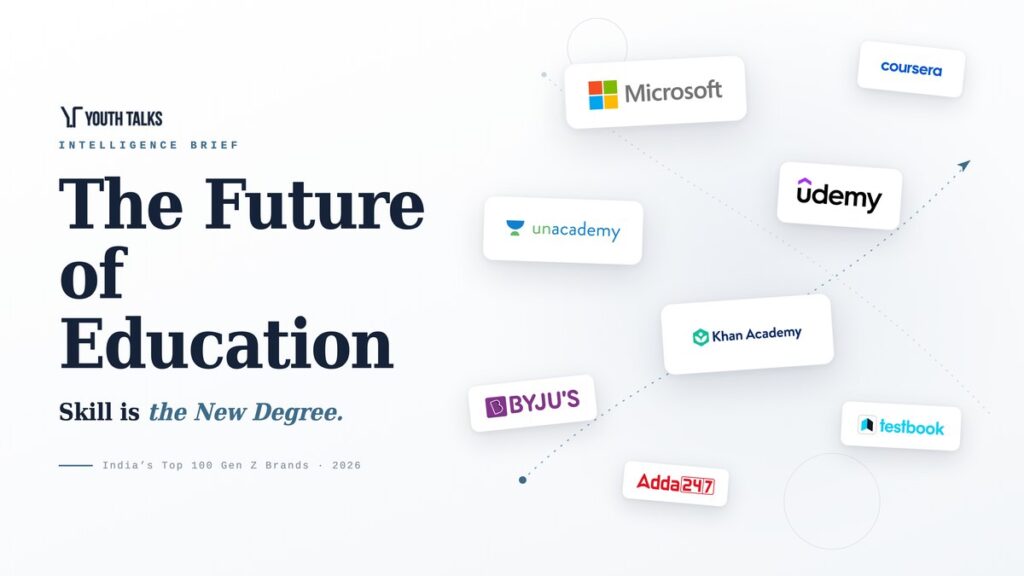
A TheYouthTalks Intelligence Brief | India’s Top 100 Gen Z Brands 2026
For more than a decade, India’s education technology industry has competed on a familiar promise: more courses, more teachers, more content and greater accessibility.
The assumption has been simple. If learning becomes more affordable and more widely available, students will naturally gravitate towards the platforms that offer the greatest reach.
Our latest research suggests Gen Z is beginning to ask a different question.
Does this platform actually improve my future?
That shift may redefine the next decade of education.
TheYouthTalks surveyed more than 5,000 Indian college students to understand which education and skilling brands they use, trust and recommend. The findings reveal a growing disconnect between popularity and emotional preference, suggesting that the next generation of winners will not necessarily be the platforms with the largest audiences—but those delivering the greatest sense of progress.
In education, distribution may attract learners.
Outcomes create advocates.
The Big Finding: Students Remember Impact, Not Scale
PhysicsWallah has become one of India’s most widely used learning platforms, reaching more than four in ten students in our study.
Its scale is undeniable.
Yet when students were asked—without prompts—to name the education brand they admire most, a different picture emerged.
Khan Academy generated significantly stronger spontaneous preference despite serving a smaller share of learners, while platforms such as Microsoft Learn, Coursera and Udemy demonstrated stronger emotional conversion between usage and affection.
This distinction matters because education is fundamentally different from most consumer categories.
Students rarely become loyal to platforms because they are popular.
They become loyal because those platforms change what they are capable of achieving.
Learning is one of the few purchases where success is measured months—or even years—after the transaction.
Education Has Entered the Outcome Economy
The strongest signal in this year’s research is not which platform students use.
It is why they choose one in the first place.
An overwhelming majority identified quality of teachers and learning content as the single most important factor influencing their decision, far ahead of certification value and affordability.
This is a powerful reminder for education providers.
Students are not searching for the largest content library.
They are searching for confidence.
Confidence that they will understand complex concepts.
Confidence that the skills they acquire will remain relevant.
Confidence that their investment of time and money will improve their future.
For Gen Z, learning has become less about consuming information and more about creating opportunity.
Trust Is Earned Through Transformation
Education is unlike any other industry represented in this report.
When students recommend a learning platform, they are not simply recommending software.
They are endorsing something that influenced their own career journey.
That makes recommendation extraordinarily powerful—and extraordinarily difficult to earn.
More than four out of five respondents reported influencing the education choices of friends and peers.
But recommendation follows transformation.
Students recommend platforms that helped them clear an examination, secure an internship, master a difficult concept or gain confidence in a new skill.
Brands such as Microsoft Learn, Coursera and Udemy appear to benefit from this dynamic, converting educational experiences into long-term advocacy.
Their strongest marketing asset is not advertising.
It is student success.
The Next Competitive Advantage Is Career Relevance
The first generation of EdTech companies succeeded by making education more accessible.
The next generation will succeed by making education more meaningful.
As artificial intelligence reshapes jobs and industries evolve at unprecedented speed, students increasingly evaluate education platforms through a different lens.
Not “What course can I take?”
But “What future can this platform help me build?”
This places new expectations on education providers.
Courses must remain current.
Credentials must retain credibility.
Learning experiences must connect more directly to real-world outcomes.
The brands that consistently bridge the gap between education and employability are likely to earn the deepest loyalty among Gen Z.
Three Strategic Lessons for Education Leaders
1. Content Attracts Learners. Outcomes Build Trust.
Students increasingly judge platforms by the opportunities they create, not the number of courses they host.
2. Credentials Matter. Confidence Matters More.
Certificates may strengthen a résumé, but genuine understanding strengthens careers.
The platforms that build capability—not just credentials—will enjoy greater long-term loyalty.
3. Student Success Is the Most Powerful Marketing Strategy.
Advertising creates awareness.
Success stories create advocacy.
Every learner who achieves a meaningful outcome becomes a stronger ambassador than any campaign.
Monday Morning Memo for Education Leaders
If you’re leading an education or skilling platform today, ask three questions before launching your next programme.
- Are we optimising for course completions—or career outcomes?
- Would students recommend us because of our marketing—or because of their experience?
- Are we helping learners consume content, or helping them build capability?
The answers will define the next generation of educational brands.
TheYouthTalks Verdict
India’s education ecosystem is entering an outcome-first era.
For years, the industry’s competitive advantage came from expanding access to learning.
That challenge has largely been solved.
The next challenge is helping learners translate knowledge into opportunity.
Gen Z is increasingly choosing platforms that do more than teach.
They want platforms that prepare them for an uncertain future, strengthen their confidence and improve their employability.
The brands that consistently deliver measurable transformation—not simply measurable enrolments—will define the future of learning in India.
Download the Complete Gen Z Adored Brands Report
This article highlights just one chapter of a much larger story. The full TheYouthTalks Gen Z Adored Brands Reportanalyses how more than 5,000 young Indians perceive and emotionally connect with brands across multiple industries—from automobiles and smartphones to fashion, food, finance, entertainment and beyond. If you’re a marketer, founder, researcher or business leader looking to understand what truly drives the next generation of consumers, download the complete report and explore the insights shaping the future of brand building in India. Access your complimentary copy at TheYouthTalks Gen Z Adored Brands: https://theyouthtalks.com/genz-adored-brands/