For Young Indian Women, the Best Ride Isn’t Always the Most Comfortable One. It’s the One That Gets Them There.
Uber Leads. Rapido Is Surprisingly Close. Ola Has Lost the Plot.
If you wanted to understand how quickly consumer preferences can change, you could do worse than look at something as ordinary as the way young Indian women travel across their cities.
A college student heading to class. A young professional rushing to work. Someone trying to make the last metro connection. Friends meeting across town on a weekday evening.
For all of them, mobility is rarely an abstract brand decision. It is a practical calculation.
How quickly can I get there?
How much will it cost?
Will I find a ride when I need one?
And, depending on the journey, how much comfort am I willing to trade for convenience?
TheYouthTalks’ survey of brands loved by young Indian women offers an interesting answer.
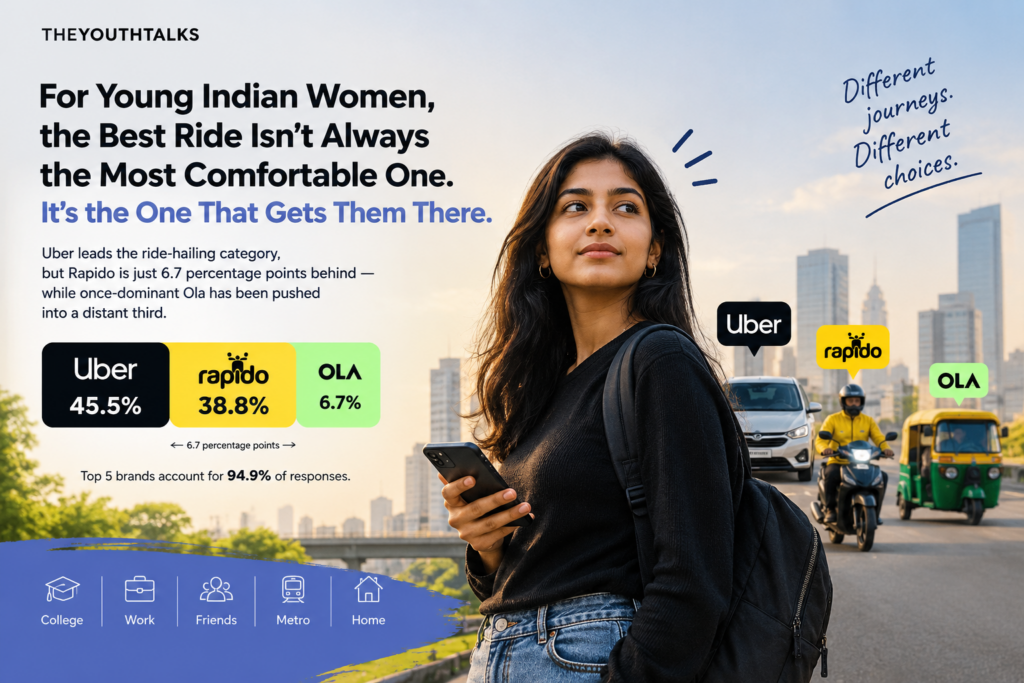
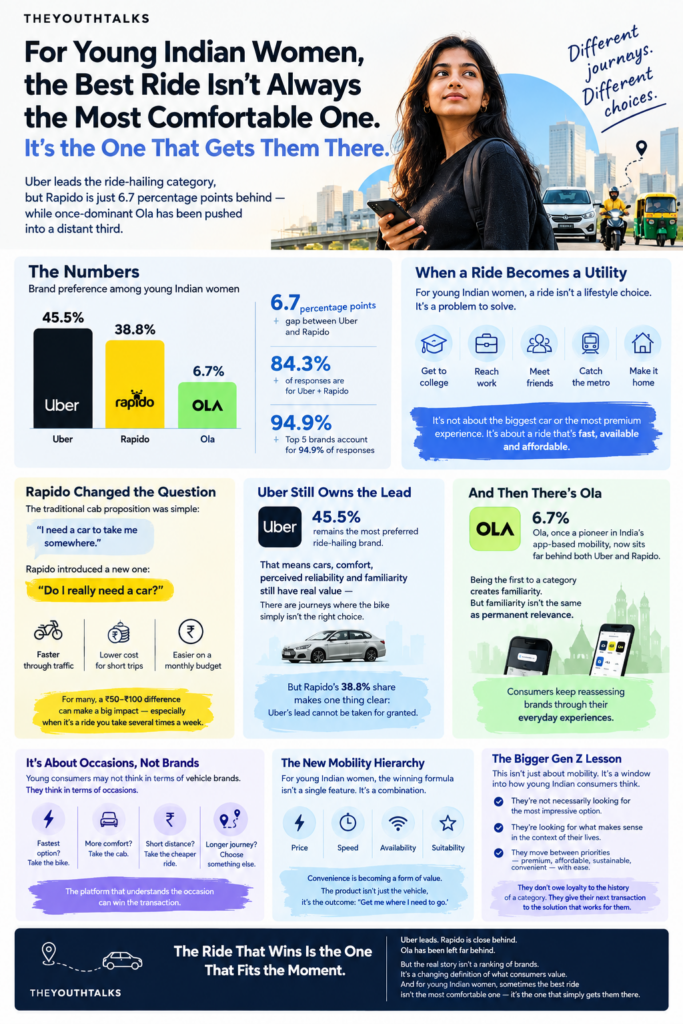
Uber leads the ride-hailing category with 45.5% of responses. Rapido follows at 38.8%.
That is a gap of just 6.7 percentage points.
Together, the two brands account for 84.3% of responses, leaving relatively little space for the rest of the category.
And then comes the more striking number.
Ola receives just 6.7%.
For a company that was once almost synonymous with app-based cab booking in India, that distance from the leaders is difficult to ignore.
The story, therefore, is not simply that Uber remains number one.
It is that Rapido has come remarkably close to the category leader — while Ola has fallen far behind both.
When Mobility Stops Being a Lifestyle Choice
There was a time when booking a cab could feel like a small upgrade.
You were not taking public transport. You were not negotiating with an auto driver. You could sit back, open your phone and expect a relatively predictable journey.
But urban mobility has become much more functional.
For many young women, particularly students and early-career professionals, a ride is simply one part of getting through the day.
Go to college.
Reach the office.
Get to the metro station.
Meet friends.
Return home.
Make the next appointment.
The objective isn’t necessarily to have the most luxurious journey possible. It is to complete the journey with the least friction.
That changes the meaning of value.
A comfortable sedan is valuable in some situations. But if a two-wheeler can navigate traffic faster and cost substantially less for a short trip, comfort may not be enough to justify the additional expense.
This is where Rapido’s proposition becomes particularly relevant.
Rapido Changed the Question
The traditional cab-booking proposition was relatively simple:
“I need a car to take me somewhere.”
Rapido introduced another question:
“Do I actually need a car?”
For short urban journeys, the answer may be no.
A bike can be quicker through congested roads. An auto can be practical for certain distances. And a lower fare can make repeated journeys easier to accommodate within a student’s or young professional’s monthly budget.
That distinction matters.
A single ₹50 or ₹70 difference may not seem significant. But multiply that across several journeys every week, and the economics begin to look very different.
The challenger, therefore, doesn’t necessarily need consumers to develop an emotional attachment to the brand.
It needs to give them a reason to choose it today.
That is a powerful proposition in a category where purchase decisions can happen several times a week.
Uber Still Owns the Lead
None of this takes away from Uber’s position.
At 45.5%, Uber remains the most preferred ride-hailing brand among the young women surveyed by TheYouthTalks.
That lead also tells us something important.
The market has not abandoned cars.
There are journeys where comfort matters more. There are longer trips where a car makes more sense. There are occasions when travelling with friends, carrying luggage or simply wanting a more comfortable experience changes the calculation.
Uber’s strength, therefore, is not merely about being an established name. Its proposition continues to fit a significant range of occasions.
But the Rapido number makes the competitive picture more interesting.
A 38.8% share means the challenger isn’t sitting on the margins of the category. It is participating in a substantial part of the same consumer decision.
The question for Uber is consequently not whether consumers like cars.
It is whether the car remains the default answer for enough everyday journeys.
The More Revealing Number May Be Ola’s 6.7%
If Uber’s 45.5% represents category leadership and Rapido’s 38.8% represents disruption, Ola’s 6.7% represents something else entirely: how quickly familiarity can lose its competitive advantage.
Ola was one of the pioneers of India’s app-based mobility market. For years, the consumer conversation could almost be reduced to a simple question:
Ola or Uber?
That framing no longer describes what the data shows among the young women surveyed.
Rapido has entered the conversation with a fundamentally different mobility proposition, while Ola now sits considerably behind both brands.
There is a broader lesson for consumer businesses here.
Being early to a category can create enormous familiarity. But familiarity is not the same thing as permanent relevance.
Consumers continue to reassess brands through their everyday experiences.
If another company makes a common task faster, easier or more affordable, historical leadership may not be enough to retain the transaction.
Young Consumers May Be Loyal to Occasions, Not Brands
Perhaps the most interesting insight lies beyond the individual numbers.
Young consumers may not necessarily approach mobility through rigid brand loyalty.
They may think in terms of occasions.
Short distance? A bike might make sense.
Heavy traffic? The fastest available option may win.
Longer journey? A cab could become more attractive.
Need greater comfort? The calculation changes again.
Travelling on a tighter budget? Price becomes more important.
This is an important shift in consumer behaviour because it changes what competition means.
A mobility platform is no longer competing only against another platform offering the same type of vehicle.
It may be competing against a different solution altogether.
That makes the battle less about cars versus bikes and more about which service understands the journey better.
Convenience Is Becoming a Form of Value
Young consumers are often described as price-conscious, but price alone does not explain the mobility data.
What consumers appear to be evaluating is a combination of price, speed, availability and suitability.
That is a more sophisticated definition of value.
A cheaper ride that takes much longer may not feel cheaper.
A comfortable ride that takes too long to arrive may not feel convenient.
And the lowest-priced option may still lose if it doesn’t fit the occasion.
For mobility companies, this means the product is not simply the vehicle.
The product is the outcome:
“Get me where I need to go.”
Everything else supports that promise.
The Mobility Hierarchy Is Changing
The top five brands in the survey account for 94.9% of responses, indicating a highly concentrated category.
But concentration should not be confused with permanence.
Rapido’s 38.8% demonstrates how quickly a challenger can become a major part of the consumer conversation when its proposition addresses an everyday need.
Ola’s 6.7%, meanwhile, illustrates the other side of the equation: established brands can lose relevance when consumer expectations and habits evolve.
And that may be the most useful lesson for marketers.
Young consumers do not necessarily reward brands simply because they are established, premium or familiar.
They reward relevance.
Sometimes relevance looks like comfort.
Sometimes it looks like affordability.
Sometimes it is speed.
And sometimes it is simply getting from point A to point B without making the journey more complicated than it needs to be.
The Bigger Gen Z Consumer Lesson
The mobility data offers a window into a broader characteristic of young Indian consumers.
They are not necessarily looking for the most impressive option.
They are often looking for the option that makes sense in the context of their lives.
That distinction is important.
For brands trying to understand Gen Z, the temptation is to search for a single winning proposition: premium, affordable, sustainable, convenient, experiential or aspirational.
But young consumers can move between these priorities remarkably quickly.
The same person who chooses the cheaper bike on a weekday morning may happily choose a cab for a late-night journey or a longer trip.
There is no contradiction.
The occasion has changed.
And the brand choice changes with it.
The Ride That Wins Is the One That Fits the Moment
Uber continues to lead among young Indian women in TheYouthTalks’ survey, with Rapido only 6.7 percentage points behind.
Ola, at 6.7%, sits considerably further back.
But the real story is not a simple ranking of three brands.
It is a changing definition of what consumers value from mobility.
The most comfortable ride will not always win.
The cheapest ride will not always win either.
Increasingly, the winning proposition may be the one that understands what the consumer is trying to accomplish — and removes the most friction from getting there.
For brands, that is a useful warning.
Consumers don’t owe loyalty to the history of a category. They give their next transaction to the solution that works for them.
And for young Indian women navigating increasingly busy cities, sometimes the best ride isn’t the one that makes the journey feel luxurious.
It’s the one that simply gets them there.