






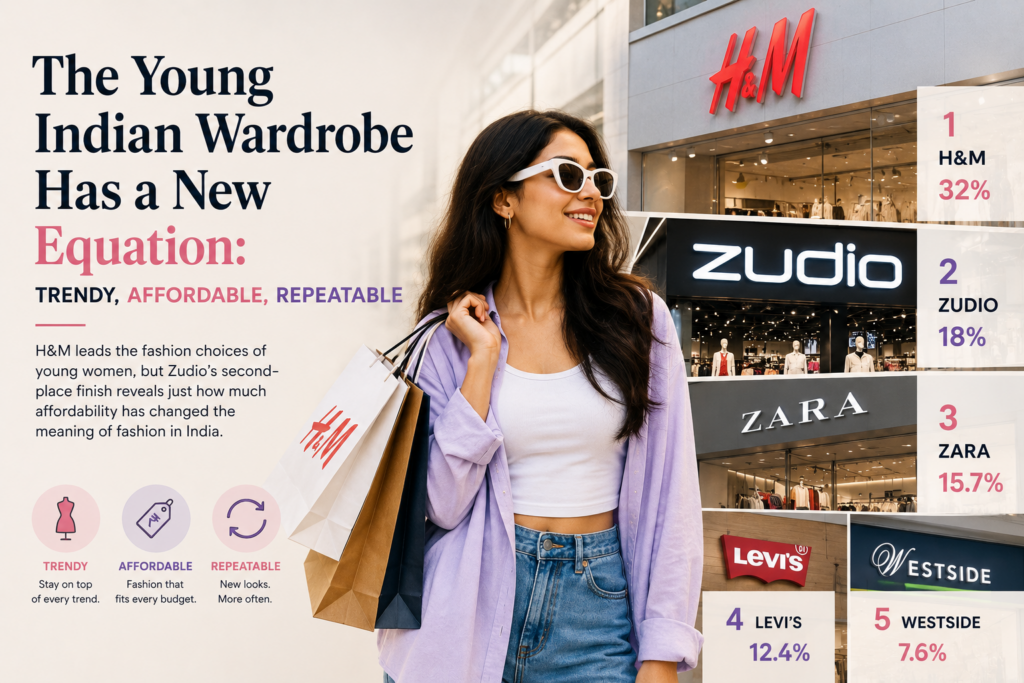
H&M leads the fashion choices of young women, but Zudio’s second-place finish reveals a bigger shift: affordability is no longer the opposite of aspiration. It is increasingly what makes aspiration possible.
What does a young Indian woman actually want from fashion?

For a long time, the obvious answer might have been a recognisable brand, a premium label or the latest international trend. But the answer appears to be changing.
Increasingly, it may be something much simpler:

Something fashionable. Something affordable. And something she can buy again.
TheYouthTalks’ latest survey of brands loved by young women offers an interesting window into this shift. H&M emerges as the clear leader, with 32% of respondents naming it, followed by Zudio at 18% and Zara at 15.7%. Levi’s and Westside complete the top five.

Together, the five brands account for 85.4% of responses.
At first glance, this looks like a straightforward victory for H&M.
Look a little closer, though, and Zudio’s second-place position may actually be the more important story.
Because here is an Indian value-fashion retailer sitting ahead of Zara, one of the world’s most recognisable names in high-street fashion.
That tells us something about what young India increasingly expects from its wardrobe.
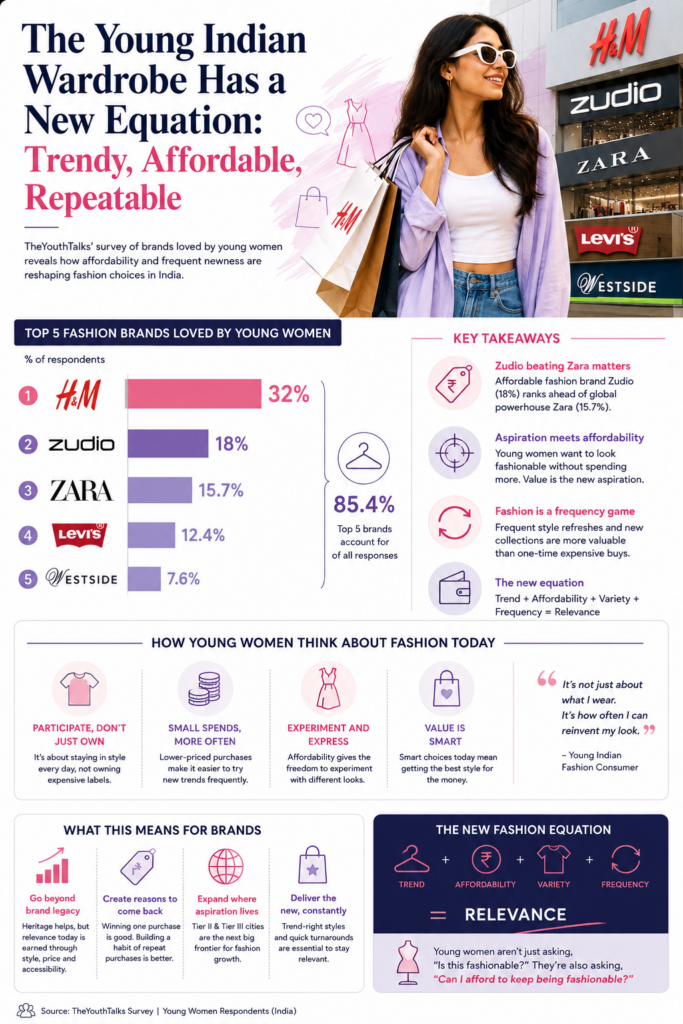
Zudio beating Zara is about more than price
There is a temptation to interpret Zudio’s rise simply as a price story.
That would be too easy.
Yes, affordability is clearly important. But Zudio’s appeal comes from combining affordability with fashionability and frequent product refreshes. Trent, which owns Zudio, describes the brand as a value-fashion concept built around accessibility, with in-house offerings at sharp price points.
That combination is particularly relevant to younger consumers.
Imagine a college student walking into a store with ₹2,000 in her pocket.
She could spend most of it on one statement piece. Or she could walk out with several things that allow her to experiment with different looks.
The second option creates something that a single expensive purchase cannot:
frequency.
And frequency matters when trends move as quickly as they do today.
Social media has effectively compressed the fashion cycle. A look can move from an international runway to Instagram, from Instagram to a creator’s wardrobe and from there to college campuses within weeks.
The consumer doesn’t necessarily want to own fashion.
She wants to participate in it.
That changes the economics of aspiration.
The new aspiration: looking expensive without spending like it
Young consumers have not necessarily become less aspirational.
They may simply have become more value-conscious about how they express that aspiration.
Research from Deloitte’s 2026 India fashion report describes the country’s fashion market as undergoing a structural shift, with rising consumer expectations, wider access to products and stronger value-seeking behaviour reshaping the industry. The report also highlights the growing influence of a digitally native generation.
That distinction is important.
A consumer does not have to choose between “I want to look fashionable” and “I don’t want to spend too much.”
She can want both.
In fact, she may increasingly expect brands to deliver both.
This is where Zudio’s positioning becomes particularly interesting. Its success suggests that affordability itself can become aspirational when it allows consumers to experiment more often.
The aspiration is no longer necessarily:
“I own an expensive fashion brand.”
It can be:
“I always have something new to wear.”
That is a very different definition of fashion success.
H&M may have found the sweet spot
If Zudio represents affordability and Zara represents global fashion aspiration, H&M occupies an interesting middle ground.
Its 32% share in TheYouthTalks’ survey places it significantly ahead of both.
That position is powerful because H&M does not force the consumer into a binary choice.
It offers international fashion credibility, recognisable styling and a relatively accessible price point.
For a young shopper, that creates a compelling proposition:
“I can afford this, and I still feel fashionable wearing it.”
That may be the sweet spot.
The brand doesn’t need to be the cheapest option in the market. It simply needs to make the consumer feel that she is getting enough fashion value for what she is spending.
And that perception of value is becoming increasingly sophisticated.
Young shoppers are not evaluating fashion purely through the lens of price. They are also assessing design, relevance, quality, variety and how frequently they can realistically afford to return.
A 2026 JLL analysis of India’s retail market similarly identifies affordability and trend relevance as key characteristics shaping Gen Z fashion consumption, noting the rapid expansion of mass-fashion brands into both major cities and Tier II markets.
Fashion is becoming a frequency game
This may be one of the most consequential changes in the young Indian wardrobe.
Fashion used to be relatively episodic.
A new outfit for Diwali. A shopping trip before college. A special purchase before a wedding. Perhaps a seasonal wardrobe refresh.
Now, fashion can be continuous.
There is always another trend, another creator, another aesthetic and another occasion to dress for.
That doesn’t necessarily mean young consumers are spending enormous amounts every time.
It means they can make smaller purchases more frequently.
And this is where affordable fashion becomes structurally powerful.
A ₹900 purchase feels very different from a ₹4,000 purchase when the consumer is already thinking about what she might want next month.
The more affordable the individual purchase, the lower the psychological barrier to experimentation.
A young woman may not buy an entire new wardrobe.
She might buy the top.
Then the jeans.
Then the accessories.
Then something she saw on a creator.
Little purchases can keep the fashion relationship alive.
The real competition isn’t between H&M, Zudio and Zara
Perhaps the most useful way to interpret the ranking is to stop thinking of these brands as simply competing against one another.
They are answering different versions of the same question:
How fashionable can I feel for the money I am willing to spend?
Zara answers that question through aspiration, design and global fashion credibility.
Zudio answers it through accessibility and value.
H&M sits somewhere between the two.
And all three appearing in the top three is revealing.
It suggests that young women’s fashion choices are being shaped by a three-way tension between trend, aspiration and affordability.
The winner is not necessarily the brand that maximises one of these.
It may be the brand that combines all three convincingly enough.
Zudio isn’t killing aspiration. It is democratising it.
This is where the Zudio story becomes more interesting than a simple “value fashion is winning” narrative.
Young Indian women have not suddenly stopped aspiring to global fashion.
Zara is still in the top three.
H&M leads the ranking.
Instagram continues to expose consumers to international styles and aesthetics.
What has changed is the ability to translate that aspiration into everyday consumption.
A young woman does not necessarily need to buy the exact product she saw online.
She needs access to something that allows her to recreate the feeling.
That is a subtle but powerful shift.
The fashion industry is moving from selling individual products to selling participation in trends.
And participation has to be affordable if it is going to happen repeatedly.
The rise of value fashion is also a retail story
There is another reason the Zudio phenomenon deserves attention: physical accessibility.
Zudio has expanded aggressively across India’s retail landscape, including beyond the largest metropolitan markets. JLL notes that Gen Z-focused mass-fashion brands are increasingly important retail tenants and that brands such as Zudio are expanding into Tier II cities, where rising exposure to trends is creating new aspirational demand.
This matters because India’s fashion opportunity isn’t restricted to Mumbai, Delhi or Bengaluru.
A digitally connected consumer in Jaipur, Chandigarh or Indore can see the same trend as someone in a major metro.
But her shopping environment, disposable income and access to international brands may be very different.
Affordable fashion closes some of that gap.
It effectively says:
You don’t have to live in a global fashion capital to participate in global fashion.
That is a significant change in the Indian consumer landscape.
The wardrobe is becoming more fluid
There is also a cultural dimension to all this.
Young consumers are increasingly using fashion for self-expression rather than simply social conformity. An Under25 study reported in 2025 found that 61% of Gen Z respondents said they primarily buy clothing for personal satisfaction, rather than to impress others.
That makes affordability even more important.
If fashion is a form of self-expression, consumers need room to experiment.
Different moods.
Different aesthetics.
Different versions of themselves.
A wardrobe that costs too much to change becomes restrictive.
A wardrobe that allows affordable experimentation becomes expressive.
That is perhaps the deeper reason value fashion resonates with young consumers.
It isn’t just cheaper.
It gives them more freedom to change.
What this means for fashion brands
For fashion marketers, the lesson is becoming increasingly clear.
Young consumers are not simply asking:
“Is this fashionable?”
They are asking:
“Is this fashionable enough for what it costs?”
And increasingly, there is a second question:
“Can I afford to come back?”
That last question could prove particularly important.
A brand that wins one ₹5,000 purchase may generate revenue.
A brand that creates a reason for a consumer to return every few weeks can create a relationship.
This is why H&M’s position is so interesting, and why Zudio’s second-place ranking deserves attention.
The future may not belong exclusively to premium fashion or ultra-cheap fashion.
It may belong to brands that understand the economics of repeatable aspiration.
The young Indian wardrobe has changed
The old fashion equation was relatively straightforward:
Brand + aspiration = desire.
The new equation looks different:
Trend + affordability + variety + frequency = relevance.
That doesn’t mean brand names no longer matter. They clearly do.
It means that brand equity alone may not be enough.
Young consumers want to feel fashionable, but they also want to remain flexible. They want to experiment without feeling financially reckless. They want access to trends without committing their entire monthly budget to them.
And that is why the most revealing number in TheYouthTalks’ survey may not actually be H&M’s 32%.
It may be Zudio’s 18%—ahead of Zara.
Because it captures something larger happening across India’s young consumer economy.
Affordability is no longer the opposite of aspiration.
For a generation that wants to keep changing, it may be what makes aspiration sustainable.
And perhaps that is the new Indian fashion equation:
Don’t just give young consumers something they want to wear. Give them a reason—and the ability—to come back and wear something new again.
Source: TheYouthTalks, Gen Z Women Brand Index. The survey captures the preferences of young women in the study sample and should be read as a focused consumer snapshot rather than a representation of all Indian women.
Read the full report: TheYouthTalks Gen Z Women Brand Index