
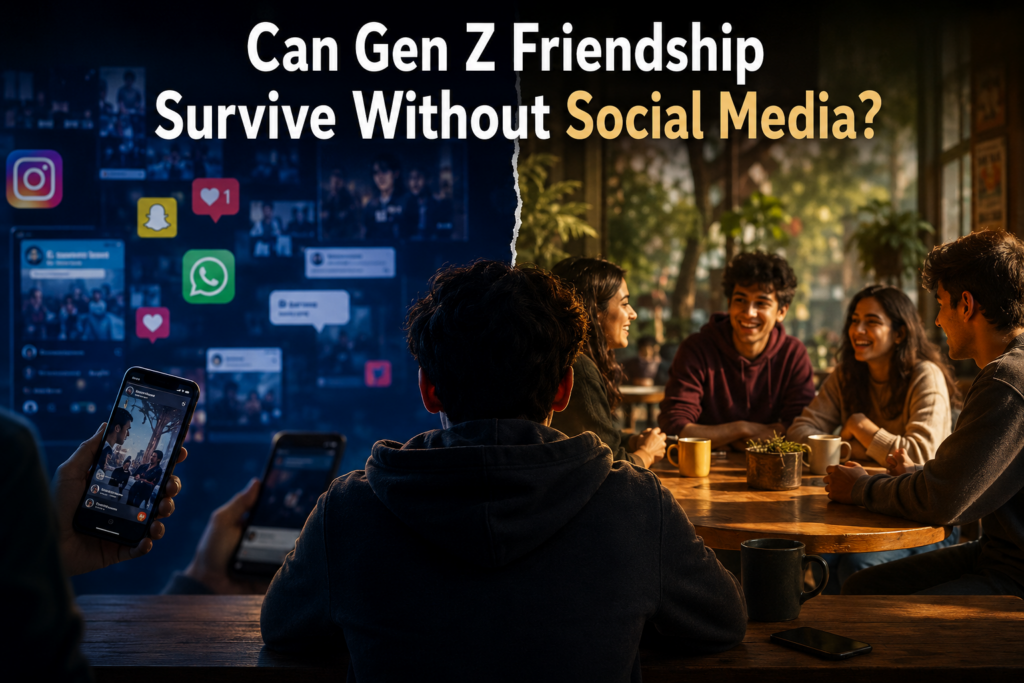
If Instagram, Snapchat and WhatsApp disappeared tomorrow, how many of your friendships would actually survive?
Imagine waking up tomorrow and discovering that Instagram, Snapchat, WhatsApp and every other social platform had simply disappeared.
No stories to watch. No reels to send your best friend. No likes. No birthday reminders. No group chats buzzing late into the night. No way of quietly keeping up with someone you have not spoken to in months.
Who would you still call?
It sounds like a dramatic thought experiment. Yet for Gen Z, it raises a surprisingly relevant question because friendship has never been entirely offline for this generation.
Social media is no longer just a place to share photographs or watch entertaining videos. It has become part of the infrastructure of modern friendship — a space where relationships begin, conversations continue, inside jokes evolve and connections survive geographical distance.
But has social media actually made Gen Z better at friendship?
Or has it simply made Gen Z better at staying in touch?
What Gen Z Told TheYouthTalks
Recently, TheYouthTalks had an unexpected opportunity to explore this question directly.
At a student event, around 100 students had gathered for a session. When the speaker finished earlier than expected, we found ourselves with roughly 30 minutes before the day ended.
Rather than allowing those 30 minutes to disappear, we turned them into a small, conversational research exercise.
We asked students about friendship, social media and what might happen to their relationships if social platforms suddenly disappeared.
The responses were surprisingly balanced.
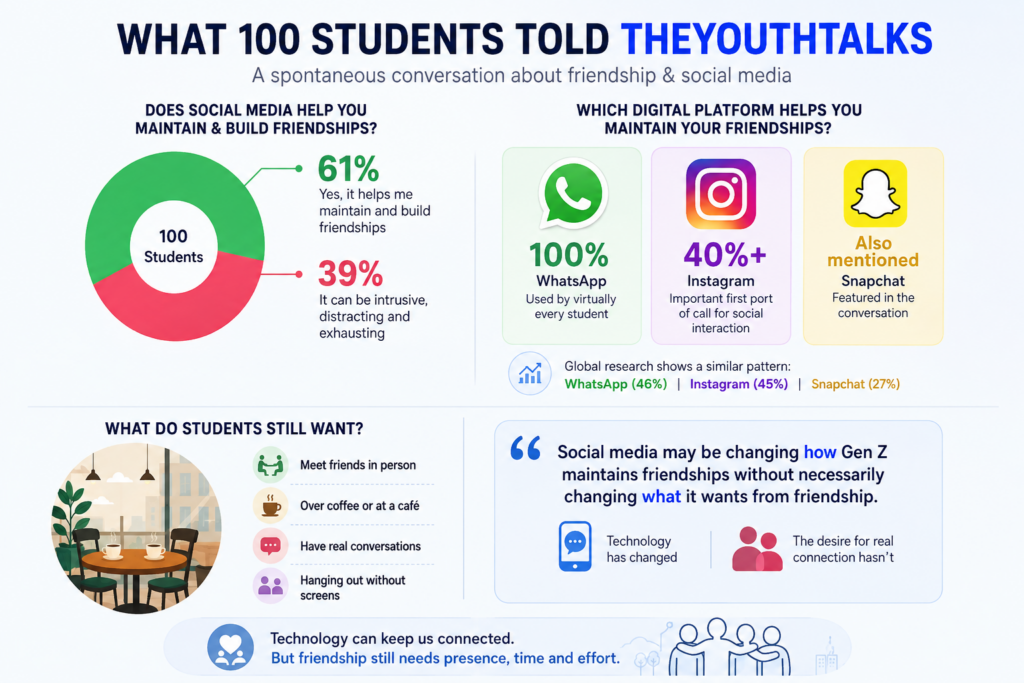
Around 61% of the students said social media helps them maintain and build friendships. For this group, social media is not necessarily replacing friendship. It is helping friendship survive.
Think about a student whose closest friend moves from Delhi to Bengaluru. Or someone who leaves India for university in Canada. Staying connected no longer requires an elaborate plan. A message, voice note, photograph or shared reel can keep that person present in everyday life.
But another group raised a different concern.
They felt that social media can be intrusive, distracting and, at times, exhausting. They talked about wanting to actually meet their friends, sit across a table, have coffee, talk without constantly checking a phone and spend time together without feeling the need to photograph or document everything.
Perhaps the most interesting finding was not the 61%.
It was the fact that both groups understood the value of real-world friendship.
The debate was not really “online versus offline”.
It was about how much of each is enough.
This was a small, conversational exercise rather than a representative survey of Gen Z, so the findings should be viewed as a snapshot of student attitudes rather than a statistical representation of the entire generation.
What 100 Students Told TheYouthTalks About Platforms
We also asked a more practical question: Which digital platform actually helps you maintain your friendships?
The response was striking.
WhatsApp emerged as the platform used by virtually all participants for maintaining friendships. Instagram was identified by more than 40% of attendees as an important first port of call for social interaction, while Snapchat also featured in the discussion.
Interestingly, this broadly aligns with wider research into Gen Z communication. One global study found WhatsApp and Instagram among the most prominent platforms for Gen Z communication, with WhatsApp at 46%, Instagram at 45% and Snapchat at 27%.
The figures are not directly comparable with our student exercise because the samples and questions were different. Still, the broader pattern is revealing: WhatsApp tends to facilitate communication, while Instagram often plays a stronger role in social discovery and interaction.
And then came the more interesting part.
Students repeatedly spoke about wanting to meet their friends in person.
Over coffee.
At a café.
On campus.
At someone’s home.
Or simply by hanging out without having anywhere particular to go.
That may be the real story here.
Social media may be changing how Gen Z maintains friendships without necessarily changing what it wants from friendship.
The technology has changed.
The desire to sit across a table from someone you care about has not.
Friendship Has Become Easier
There was a time when maintaining a friendship required considerably more effort.
You called someone.
You met them.
You visited their home.
You wrote a letter.
You made plans.
Today, friendship can sometimes be maintained by something as simple as sending a reel.
A meme can quietly say, “This reminded me of you.”
A story reaction can mean, “I saw this.”
A DM can restart a conversation that has been dormant for months.
It is tempting to dismiss these interactions as superficial. But that would be too simplistic.
Sometimes these tiny interactions are precisely what keep a relationship alive.
Social media has made friendship remarkably resilient to geography.
Your closest friend can move from Delhi to Mumbai, Bengaluru to London, or India to Canada and still remain part of your everyday life. You can see what they are doing, celebrate their achievements and occasionally drop into their lives without needing to schedule a formal conversation.
Research from the Pew Research Center has similarly found that young people view social media as an important tool for staying connected with friends and keeping up with what is happening in their lives.
In other words, technology has reduced one of friendship’s oldest enemies: distance.
But it may have introduced another.
Convenience.
Is Staying Connected the Same as Being Close?
This is where the conversation becomes complicated.
You might know where your friend went on holiday.
You might know what they had for dinner.
You might know that they recently started going to the gym.
You might know they attended a concert last weekend.
You might even know that they have been having a difficult week.
But have you actually spoken to them?
Social media gives us an extraordinary amount of information about other people’s lives.
Information, however, is not necessarily intimacy.
And this may be one of the biggest contradictions of digital friendship:
We may know more about each other’s lives without necessarily knowing each other better.
A story view is not a conversation.
A like is not emotional support.
A streak is not necessarily intimacy.
A group chat is not automatically a community.
Yet it would also be unfair to dismiss these digital interactions as meaningless.
For many young people, these small signals are how affection, humour and belonging are expressed. Sending someone a ridiculous reel may be the modern equivalent of saying, “I know you well enough to know you’ll find this funny.”
The medium is different.
The emotion can still be real.
The Convenience Problem
Perhaps the greatest strength of social-media friendship is also its greatest weakness:
It is incredibly convenient.
You do not necessarily have to make plans to stay connected.
You do not have to find an hour to call someone.
You do not even have to say anything.
You can simply send a reel.
But meaningful friendships have traditionally required something technology cannot completely automate: effort.
Real friendship often means showing up when it is inconvenient.
It means sitting with someone when they are having a terrible day. Having an uncomfortable conversation. Making time when both people are busy. Travelling across town for coffee.
Sometimes it means doing absolutely nothing together.
And this is where the students we spoke to offered an interesting counterpoint.
Even those who strongly valued social media still talked about wanting to meet friends in person.
They wanted coffee.
They wanted conversations.
They wanted shared experiences.
They wanted time together without the constant mediation of a screen.
Perhaps Gen Z is not choosing between online and offline friendship after all.
Perhaps it wants both.
Social Media Can Create Friendships Too
There is another side to this debate that often gets overlooked.
Social media does not only maintain existing friendships.
It can create entirely new ones.
A student interested in gaming, music, fashion, coding, anime, fitness or an obscure fandom can potentially find thousands of people online who share that interest.
That can be liberating.
Your physical environment no longer has to determine the entirety of your social circle.
For someone studying in a small college or living in a community where their interests are unusual, the internet can help them find “their people”.
Research into online social interaction has repeatedly shown that young people can form meaningful relationships through digital spaces.
And there is an important distinction here.
Online friendship is not automatically fake friendship.
Sometimes it is simply friendship that started somewhere different.
The person you meet through a gaming community may eventually become the person you call when something important happens in your life.
The internet can open the door.
What happens after that depends on the people behind the screens.
But the Algorithm Has Entered the Friendship
There is one more uncomfortable question worth asking.
How many friendships survive partly because technology keeps reminding us about them?
Instagram shows us someone’s story.
Facebook reminds us about their birthday.
A platform puts their latest post in our feed.
A memory appears from three years ago.
The algorithm keeps people psychologically present.
But what happens when it stops?
If someone disappears from your feed for six months, do you eventually stop thinking about them?
If the answer is yes, social media is doing more than helping us maintain friendships.
It may also be influencing which friendships remain visible to us.
That is a much bigger question.
Our social lives increasingly depend not only on whom we know, but also on whom platforms choose to place in front of us.
Maybe Friendship Needs Friction
The answer, therefore, is probably not that Gen Z should abandon social media.
That would neither be realistic nor necessarily desirable.
The better question is whether we have allowed convenience to become a substitute for effort.
Social media can maintain a friendship.
It can help you discover people.
It can make distance less painful.
It can keep weak ties alive.
But deeper friendships are usually built through shared experiences, vulnerability, trust and showing up.
A reel can start a conversation.
It probably cannot replace one.
A DM can maintain a friendship.
It may not be enough to build a lifetime of memories.
A story can tell you what your friend is doing.
A coffee may tell you how they are actually doing.
That distinction matters.
So, Can Gen Z Friendship Survive Without Social Media?
Probably.
But perhaps that is not the most interesting question.
The more revealing question is:
If social media disappeared tomorrow, which friendships would we make the effort to save?
The answer might tell us something fundamental about what friendship really means to Gen Z.
Because perhaps the strongest friendships are not the ones that survive because we constantly see each other on a screen.
They are the ones where, even when the screen goes dark, someone still picks up the phone and says, “Coffee?”
And maybe that is the challenge for Gen Z — not to choose between digital friendship and real-world friendship, but to make sure that one does not quietly replace the other.
Social media can keep us connected.
But connection is only the beginning.
Friendship still needs presence. It still needs time. And sometimes, it simply needs two people sitting across a table with nowhere else to be.