





Young Indian women may still name Lakmé more than any other makeup brand. But the numbers reveal a category where loyalty is surprisingly difficult to win.
There is a winner in young women’s makeup.
But there isn’t really a dominant brand.
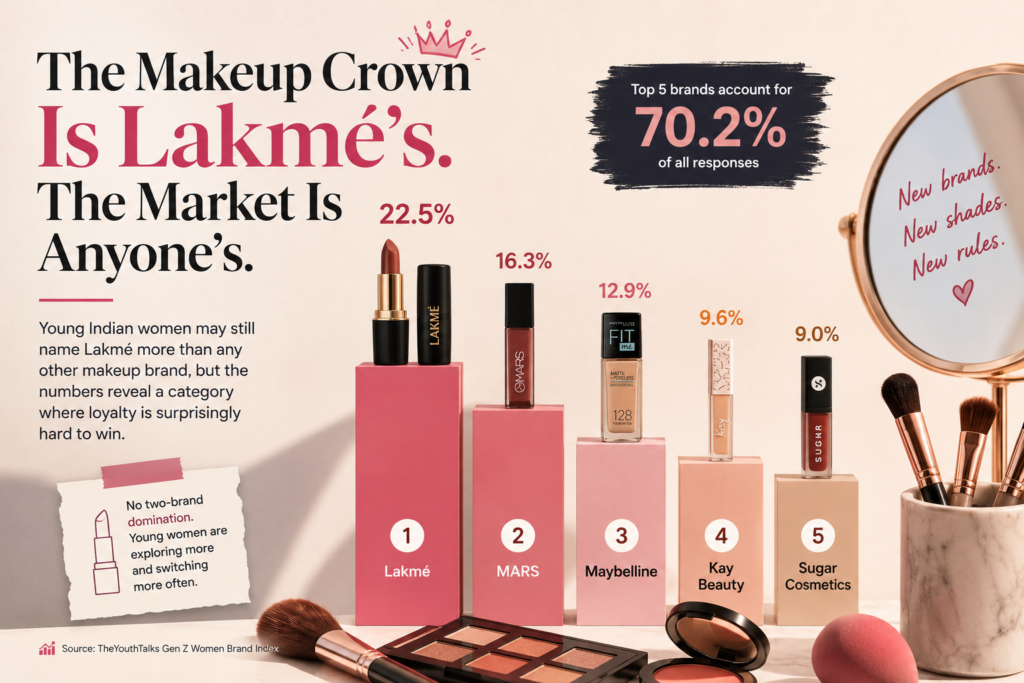
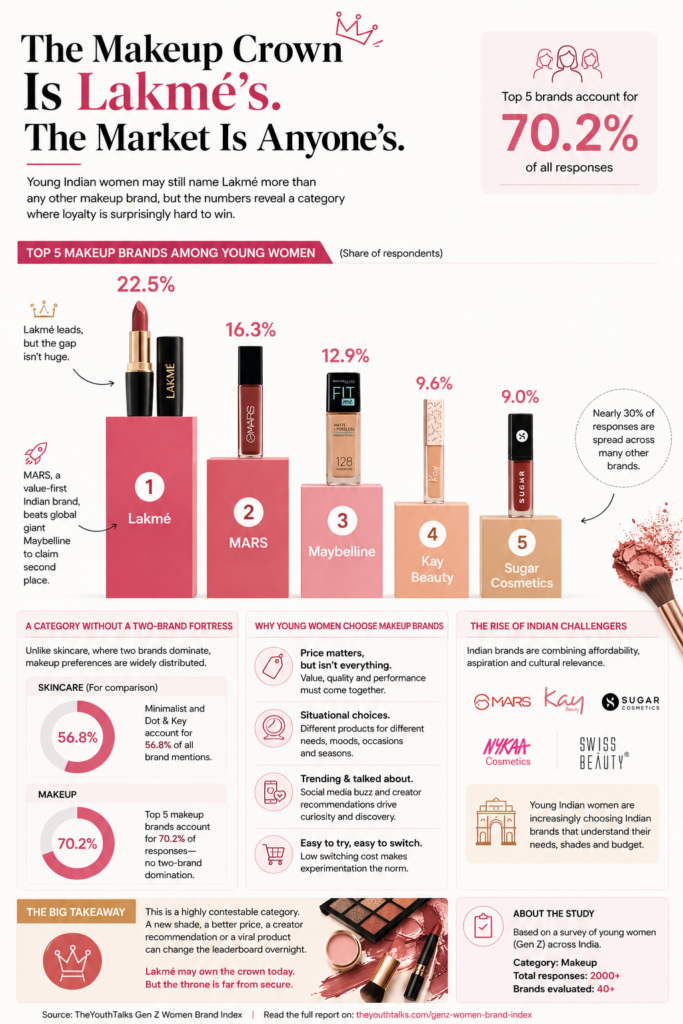
Lakmé occupies the No. 1 position in TheYouthTalks’ latest survey, with 22.5% of respondents naming it as a makeup brand they love. It is a respectable lead, particularly for a brand with decades of history in the Indian market.
But look beyond the top spot and the picture changes quickly.
MARS follows at 16.3%, just 6.2 percentage points behind Lakmé. Maybelline comes next at 12.9%, followed by Kay Beauty at 9.6% and Sugar Cosmetics at 9.0%.
Together, the top five brands account for 70.2% of all responses.
That leaves almost 30% spread across a much wider collection of brands.
And this is perhaps the most interesting finding in the data.
Unlike skincare, where Minimalist and Dot & Key together accounted for more than half of all brand mentions, makeup has no equivalent two-brand stronghold.
Young women aren’t putting all their makeup eggs in one basket.
Lakmé Leads. But It Doesn’t Own the Consumer.
Lakmé’s position at the top is significant.
Few beauty brands in India have the combination of familiarity, distribution and cultural recognition that Lakmé possesses. It has been part of Indian women’s beauty routines for generations, and its name remains almost synonymous with makeup for a large section of the market.
Yet the 22.5% figure also tells us something else.
Nearly four out of five respondents did not name Lakmé.
That is an important distinction between being the market leader and being the default choice.
A brand can be the most popular name in a category without becoming indispensable to its consumers. And among young women, that distinction may matter even more because makeup is a category built around experimentation.
The next lipstick doesn’t have to replace the previous one.
The next blush doesn’t have to come from the same company.
There is room for several brands on the same dressing table.
MARS Is Perhaps the More Interesting Story
If Lakmé represents established leadership, MARS represents the disruption happening underneath it.
At 16.3%, the Indian value-focused makeup brand has moved ahead of Maybelline, one of the world’s most recognisable cosmetics names.
That is not a trivial development.
For years, beauty aspiration in India was strongly associated with international brands. Global names carried a certain cultural cachet. They were aspirational, recognisable and often perceived as benchmarks for quality.
But the young Indian consumer has a much broader set of choices today.
A brand does not necessarily need decades of history—or a global parent company—to appear credible.
It needs the right product, the right price and, increasingly, the right cultural conversation.
MARS appears to be benefiting from precisely that environment.
Its position suggests that value and aspiration are no longer opposites. A young consumer can want makeup that looks premium while still being intensely conscious of what she is paying for it.
That calculation is becoming increasingly sophisticated.
Is the shade right?
Will the product actually perform?
Is it being talked about?
Does a creator recommend it?
Can I find reviews?
And ultimately, is it worth the money?
The brand that answers those questions convincingly has a chance.
Makeup Is Becoming a Portfolio, Not a Loyalty Programme
This is where makeup begins to look fundamentally different from skincare.
Imagine a consumer finding a moisturiser that works exceptionally well for her skin. There is a strong incentive to buy it again. Switching can involve uncertainty, experimentation and sometimes even risk.
Makeup has fewer such barriers.
A consumer can use one brand’s foundation, another brand’s lipstick and a third brand’s blush without feeling that she has violated some notion of brand loyalty.
In fact, experimentation is part of the appeal.
A new shade can be exciting. A viral product can create curiosity. A creator can introduce a previously unknown brand to millions of potential customers. A discount can make a product worth trying.
The result is a category where the next purchase is always up for grabs.
That makes makeup highly contestable.
And it means today’s No. 1 brand cannot afford to assume that today’s consumer will automatically make the same choice tomorrow.
The Price of Aspiration Is Changing
The ranking also reveals something broader about India’s young consumers.
The top five include Lakmé, MARS, Maybelline, Kay Beauty and Sugar Cosmetics—a mix of legacy, international, celebrity-backed and new-age Indian brands.
There is no single definition of what an aspirational beauty brand looks like anymore.
Kay Beauty brings celebrity association and premium positioning. Sugar has built a strong identity around contemporary Indian consumers. Maybelline carries global recognition. MARS brings affordability and accessibility. Lakmé combines heritage with enormous familiarity.
They are very different propositions.
Yet they are competing for the attention of the same consumer.
This is important because the old equation—international equals aspirational, local equals affordable—is becoming increasingly outdated.
Indian beauty brands are demonstrating that they can combine price, design, product relevance and cultural fluency.
A young woman can discover an Indian makeup brand on Instagram, watch someone use it, compare it with an international competitor, read reviews and order it within minutes.
The logo’s age becomes almost irrelevant.
Social Discovery Has Changed the Makeup Game
Makeup is also uniquely suited to the creator economy.
It is visual. Demonstrable. Transformative.
A skincare product can require weeks before its benefits become visible. Makeup can deliver its demonstration in seconds.
A creator can apply a lipstick, show the shade, compare it with another product and offer an opinion—all within a short video.
That creates an extraordinary discovery mechanism.
For brands, however, it also creates volatility.
The same system that can propel an unknown product into the spotlight can make yesterday’s favourite feel old surprisingly quickly.
This is why cultural relevance increasingly matters alongside product quality.
Being seen is not enough.
A brand has to participate in the conversations consumers are already having.
The Indian Challenger Has Entered the Room
Perhaps the larger story emerging from the rankings is the growing confidence of Indian beauty brands.
MARS, Kay Beauty and Sugar are already competing near the top, while names such as Nykaa Cosmetics and Swiss Beauty appear in the wider competitive landscape.
This does not mean young Indian women have stopped wanting global brands.
It means they have more choices—and increasingly, they see Indian brands as capable of delivering the same combination of aspiration and performance.
That is a significant shift.
The competitive advantage once created by heritage is becoming easier to challenge.
Distribution can be built. Social reach can be bought or earned. Communities can be created. Products can be launched quickly.
And cultural relevance can emerge almost overnight.
The Real Prize Isn’t No. 1
For makeup brands, therefore, the biggest opportunity may not be defeating Lakmé.
It may be winning the next purchase.
The consumer who chooses Lakmé today may choose MARS tomorrow. The Maybelline customer may try Kay Beauty. Someone who has never heard of a particular brand may discover it through a creator next week.
The relatively narrow 6.2 percentage-point gap between Lakmé and MARS is a useful reminder that the hierarchy is not immovable.
Lakmé currently has the crown.
But the data suggests that the throne is surrounded by challengers.
And perhaps that is exactly what makes the Indian makeup market so fascinating. It is no longer a category where heritage alone can guarantee loyalty, nor one where a new-age brand can assume that novelty will be enough.
Consumers have become more experimental. Brands have become more ambitious. And the distance between discovery and purchase has never been shorter.
Lakmé may currently own the crown. But in young women’s makeup, the throne doesn’t look particularly secure.
For beauty brands, the question is no longer simply “How do we become the favourite?”
It is:
“What will make her choose us the next time?”
Source: TheYouthTalks, Gen Z Women Brand Index. The survey captures the preferences of young women in the study sample and should be read as a focused consumer snapshot rather than a representation of all Indian women.
Read the full report: TheYouthTalks Gen Z Women Brand Index