
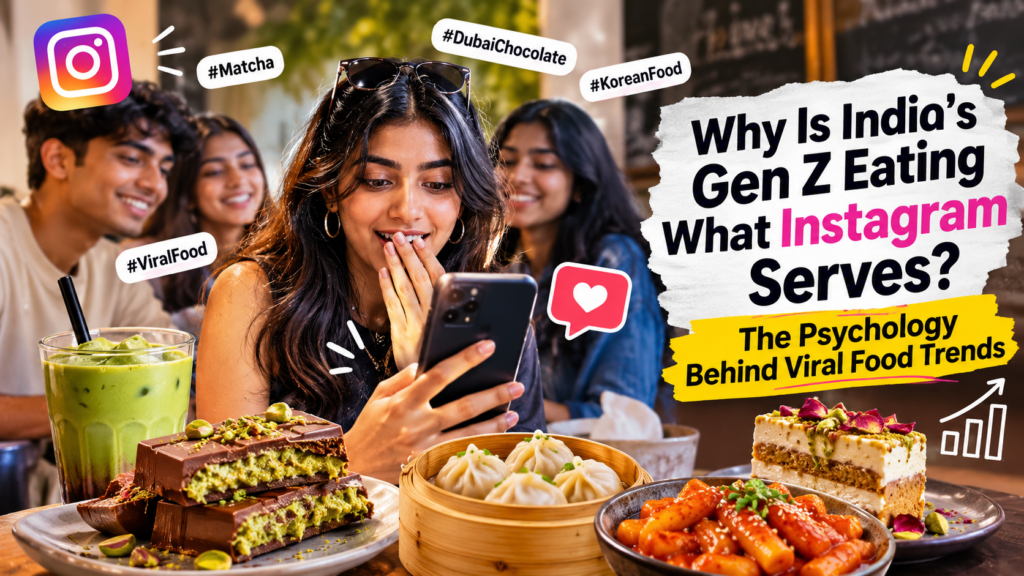
Instagram is increasingly influencing how young Indians discover food, choose cafés and decide what is worth trying. From Dubai chocolate and matcha to Korean street food and experimental Indian desserts, viral food trends reveal a changing relationship between social media, consumer behaviour and spending.
For India’s Gen Z, discovering something new to eat increasingly begins with a scroll through Instagram. A visually appealing Reel featuring a pistachio-filled chocolate bar, an elaborate matcha latte or an unusual street-food combination can turn an unfamiliar dish into something thousands of young consumers suddenly want to experience.
Sometimes, it is a neighbourhood café that appears repeatedly on someone’s Explore page. At other times, it is a food creator enthusiastically reviewing a dessert, a friend sharing a restaurant visit on Stories or a Reel showing the preparation of a dish with an unusually satisfying texture. Before long, the food has become a conversation, and trying it has become an experience in itself.
This is an interesting shift in how India’s young consumers approach food. Traditionally, food discovery was driven largely by family recommendations, local preferences, restaurant reputation and word of mouth. These influences continue to matter, but Instagram has introduced another layer: the ability to make almost any food item discoverable, desirable and potentially viral.
For Gen Z, food is increasingly about more than satisfying hunger. It can represent curiosity, lifestyle, social participation and personal expression. The question, therefore, is not simply why certain foods become popular. It is why young consumers increasingly feel the urge to try something after seeing it repeatedly on their Instagram feeds.
Instagram Is Becoming a Food Discovery Destination
Instagram has evolved considerably from its original identity as a photo-sharing platform. Reels, Explore recommendations, Stories and creator-led content have made it an important discovery channel for restaurants, cafés, food brands and independent businesses.
Unlike traditional advertising, which generally introduces consumers to a product through a promotional message, food content often makes discovery feel organic. A creator films a dessert being cut open, captures the texture of a freshly prepared dish or documents a visit to a relatively unknown café. The viewer gets a glimpse of the product and the experience surrounding it.
The visual nature of food makes it particularly suited to this format. A melting chocolate centre, colourful beverage, elaborate dessert or unusual food combination can communicate its appeal within seconds.
Repeated exposure can make the effect even stronger. When several creators feature the same food item, or when friends and acquaintances begin sharing their experiences, an unfamiliar product starts becoming familiar. Curiosity gradually develops into an intention to try it.
This is where Instagram’s influence becomes particularly interesting. It does not necessarily create every food preference, but it can accelerate awareness and influence what consumers consider worth exploring.
For restaurants and food entrepreneurs, this has changed the importance of discoverability. A small café with an interesting menu item can potentially attract attention beyond its immediate neighbourhood without depending entirely on traditional advertising.
From Dubai Chocolate to Matcha: The Appeal of Trying Something New
The popularity of Dubai chocolate offers an interesting illustration of how food trends travel across markets.
The combination of chocolate, pistachio and crunchy kunafa became widely recognisable through social media videos. Its distinctive appearance and texture made it particularly suited to short-form visual content. As interest spread, variations began appearing in different markets, including India, where bakeries, dessert outlets and home-based businesses explored their own interpretations.
The appeal was not restricted to the taste of chocolate. There was also curiosity about the product itself, the experience of cutting it open and discovering its filling, and the opportunity to try something that had become a talking point.
Matcha offers another example. What was once relatively unfamiliar to many Indian consumers has increasingly become visible in urban café culture. Matcha lattes, iced matcha beverages and matcha-flavoured desserts combine an element of novelty with lifestyle associations around wellness and contemporary café experiences.
Korean food presents a slightly different story. The growing interest in Korean popular culture, including music and entertainment, has also helped introduce younger audiences to Korean cuisine. Ramen, tteokbokki, Korean corn dogs and other dishes offer opportunities for culinary experimentation.
Meanwhile, Indian food businesses are finding ways to reinvent familiar products. Traditional mithai, for instance, can be presented through premium ingredients, contemporary packaging and unexpected flavour combinations. Familiarity and novelty come together, creating products that appeal to both taste and visual curiosity.
These examples demonstrate that food trends do not necessarily need to originate in India to find an audience here. However, their success often depends on how they are interpreted, priced and presented for Indian consumers.
The Psychology Behind the Viral Bite
Why does a young consumer suddenly feel compelled to try a particular food item after watching a few Instagram Reels?
There are several behavioural factors at play.
Curiosity is often the starting point.
When consumers repeatedly encounter something unfamiliar, they naturally want to understand what makes it special. Is the dessert actually delicious? Does the matcha taste as good as people claim? Is the restaurant worth visiting? Trying the product becomes a way of satisfying that curiosity.
Social proof can influence the decision.
When multiple people recommend a food item, consumers may begin perceiving it as something worth experiencing. Positive reviews, comments, creator recommendations and photographs shared by friends collectively create an impression of popularity.
This does not necessarily mean consumers believe every recommendation. Rather, the volume of discussion can make a product appear more relevant and worth investigating.
Fear of Missing Out (FOMO) adds another dimension.
When a particular food item becomes part of conversations among friends or appears repeatedly across social media feeds, some young consumers may feel that they are missing an experience others are enjoying.
The motivation is no longer entirely about the food. It can also be about participating in a shared cultural moment.
Visual appeal creates the initial attraction.
Food is inherently visual, and Instagram makes presentation an important part of discovery. Colour, texture, packaging, plating and preparation can all influence whether someone pauses while scrolling.
However, visual appeal and actual product satisfaction are two different things. A dessert might look extraordinary in a Reel but fail to meet expectations when purchased.
Together, these factors help explain why some food products attract attention much faster than others.
Eating Out Is Becoming a Social Media Experience
For many young Indians, visiting a café or restaurant is increasingly about the overall experience rather than just the food.
Consider a group of college students planning an outing. Their choice of destination may be influenced by a café they discovered on Instagram, a particular dessert they have seen online or a restaurant that has become popular among their friends.
The outing itself then becomes an opportunity to create content. Photographs are taken, Reels are recorded, food is shared and reviews are exchanged. The experience may subsequently reach another circle of consumers through Stories and posts.
This creates an interesting cycle. One consumer discovers a food destination, visits it, shares the experience and introduces it to others. Those consumers may then visit the same place and generate another round of content.
For businesses, the customer is no longer just someone purchasing a meal. The customer can also become a source of visibility and recommendation.
This is particularly relevant for cafés and independent food outlets targeting younger audiences. The ambience, presentation, packaging and overall experience can influence how likely visitors are to share their visit online.
However, there is an important distinction between creating an Instagram-friendly experience and delivering a genuinely satisfying one. A visually attractive café might encourage a first visit, but taste, service, consistency and pricing determine whether customers return.
The Affordability Question: How Much Is Gen Z Willing to Spend?
While curiosity and social influence can encourage experimentation, affordability remains an important consideration in the Indian market.
A college student managing a limited monthly allowance may be interested in trying a premium dessert or an expensive café beverage. However, that does not mean the same consumer is willing to purchase it regularly.
This distinction between trial and repeat consumption is important.
A young consumer might spend ₹300 or ₹500 on a viral food item as a one-time experience. The same consumer may hesitate to spend that amount frequently, particularly when balancing transport, college expenses, entertainment and other discretionary purchases.
For young professionals, the calculation may be different, but the underlying question remains: is the experience worth the price?
This also explains why viral popularity should not automatically be interpreted as evidence of strong or sustainable consumer demand.
A food item can attract significant attention because of its novelty, but consumers may not necessarily develop a lasting preference for it. Once the curiosity is satisfied, the motivation to purchase can decline.
For brands, understanding this difference is essential. The number of views a food Reel generates may indicate awareness, but it does not necessarily tell us how many people are willing to pay for the product, how frequently they will buy it or whether they will recommend it independently.
The Business of Going Viral: What Food Brands Need to Understand
Instagram has created opportunities for food businesses of different sizes.
Large restaurant chains can use creator partnerships, limited-edition menus and visually distinctive products to attract attention. Smaller cafés, independent bakers, cloud kitchens and home-based food entrepreneurs can also use social media to introduce products to audiences that may otherwise have been difficult to reach.
For many small businesses, an interesting Reel can generate awareness without requiring the advertising budgets associated with traditional media.
However, going viral is not the same as building a business.
A restaurant may experience a sudden increase in visitors after a creator features its signature dish. But can it maintain product quality when demand increases? Can it manage waiting times? Is the pricing sustainable? Will consumers return after trying the product once?
These are questions that matter beyond the initial excitement.
Food brands should therefore think about the consumer journey in stages.
The first stage is discovery, where Instagram content introduces the product. The second is trial, where curiosity translates into a purchase. The third is satisfaction, where the actual experience determines whether expectations are met. Finally, there is repeat consumption, where consumers decide whether the product deserves a regular place in their spending habits.
The most successful food businesses will be those that understand how to move consumers through all four stages.
There is also an opportunity to use local preferences more intelligently. International food trends can be adapted through Indian ingredients, regional flavours and familiar formats. Rather than simply reproducing a global trend, businesses can create something that feels relevant to local consumers.
For marketers, the larger lesson is that social media can influence product discovery, but product experience remains central to building lasting demand.
Are Young Consumers Following Trends or Making Their Own Choices?
It would be simplistic to suggest that India’s Gen Z is blindly purchasing everything it sees on Instagram.
Young consumers are exposed to a wide variety of content, recommendations and opinions, but they also make choices based on personal preferences, affordability and individual experiences.
Some try viral foods because they genuinely enjoy experimenting with different cuisines. Others are interested in discovering new cafés and spending time with friends. Some are attracted by the visual appeal, while others simply want to understand what everyone is talking about.
There are also consumers who actively avoid popular trends or prefer familiar food choices.
The more interesting development is how social media has expanded the range of choices available to young consumers while simultaneously influencing what attracts their attention.
This makes digital food discovery an important area for understanding contemporary consumer behaviour.
For young consumers, being aware of trends does not necessarily mean participating in every one of them. The ability to distinguish between genuine interest and temporary excitement is equally important, particularly when discretionary spending is involved.
Beyond the Instagram Feed: What Happens After the Hype?
Viral food trends reveal something important about the relationship between social media and consumption in contemporary India.
Instagram can make a product visible, creators can make it desirable, friends can make it socially relevant, and curiosity can encourage a purchase. But the experience itself ultimately determines whether the consumer feels the decision was worthwhile.
For food businesses, the challenge is to convert digital attention into lasting customer relationships. For marketers, it is to understand that visibility, purchase intent and loyalty are different measures of consumer behaviour.
And for India’s Gen Z, trying a new food trend can simply be an enjoyable way to explore different tastes, discover new places and share experiences with friends.
Not every purchase needs to be driven by necessity, just as not every viral product needs to become a regular part of someone’s lifestyle.
The larger question is how much influence social media should have over everyday consumption decisions.
In a world where the next exciting food experience is only a Reel away, India’s Gen Z is discovering that the appetite for something new is not always about hunger. Sometimes, it is about curiosity, belonging and the experience of being part of something everyone is talking about.
Instagram may decide what catches the eye, but the consumer still decides what deserves a place on the plate.