
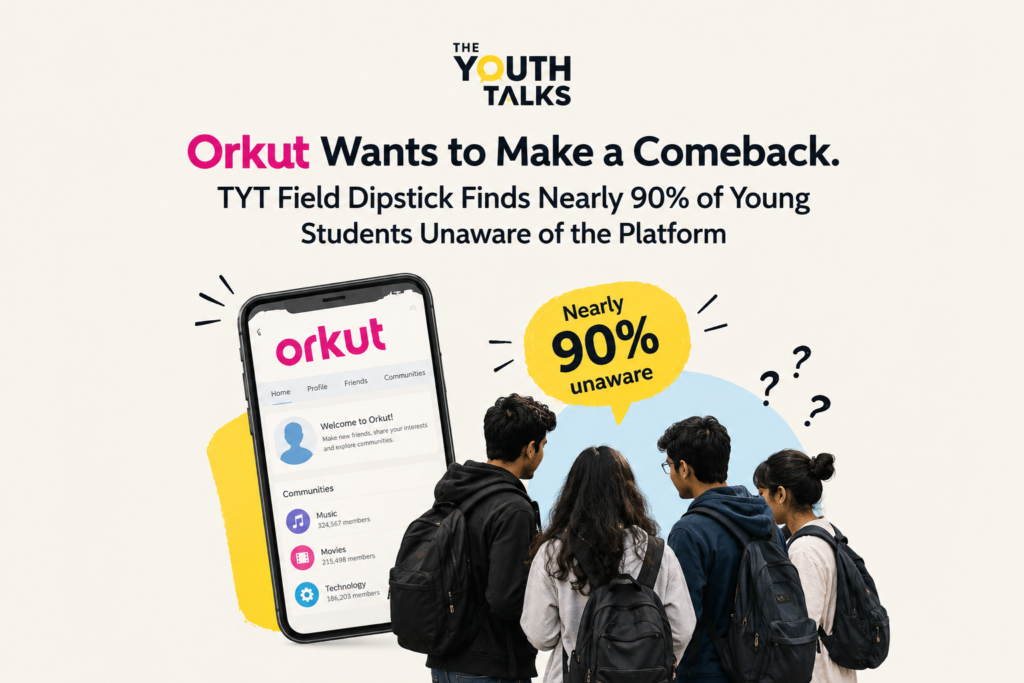
In a dipstick involving 110 students in Delhi, 87 said they would be happy to explore a new social platform. But can Orkut’s proposed revival win over a generation that has never known it?
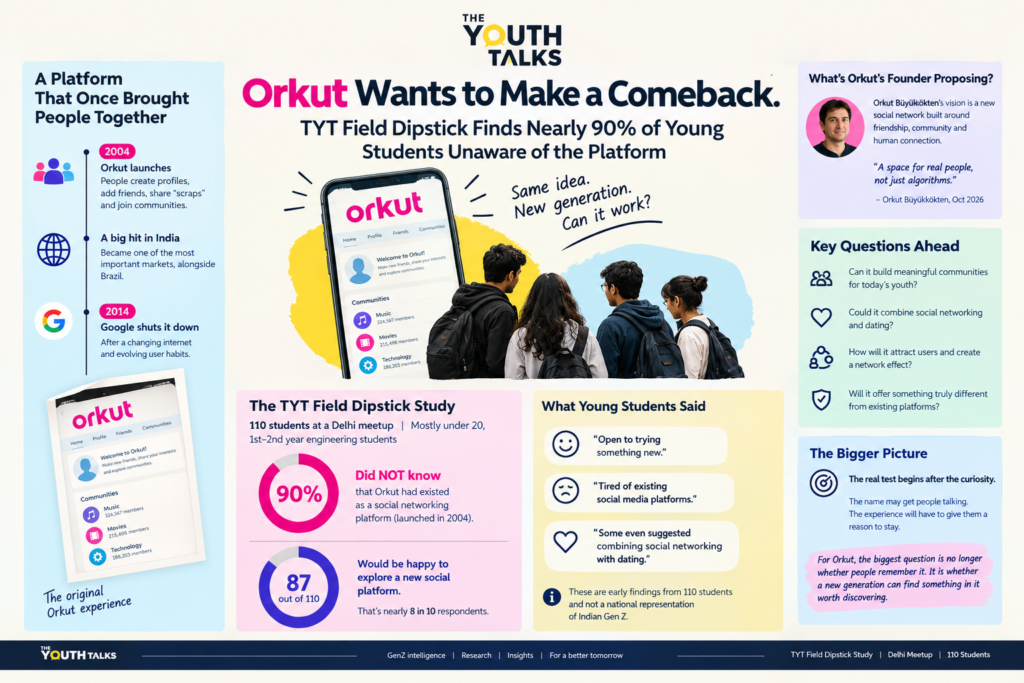
In 2004, when social networking was still a relatively new experience for many Indians, a platform called Orkut began bringing people together online. Users created profiles, added friends, exchanged messages called “scraps” and joined communities built around their colleges, interests, favourite films and music.
For millions of early internet users, Orkut became part of their digital lives. India was among its most important markets, alongside Brazil.
Then the internet changed. New platforms emerged, user habits evolved, and Orkut gradually lost ground. Google shut down the service in September 2014.
More than a decade later, Orkut’s founder wants to bring the idea back.
In October 2026, Orkut Büyükkökten invited people to register their support for a new social network centred on friendship, community and human connection. The campaign, hosted on Orkut.com, has reignited interest in a platform many former users remember fondly.
But there is a catch: the generation that could potentially become its next audience may have little idea what Orkut was.
A TheYouthTalks (TYT) Field Dipstick Study involving 110 students at a Delhi meetup offers an interesting glimpse into this generational divide. Nearly 90% of the students surveyed did not know that Orkut had existed as a social networking platform launched in 2004.
Yet when asked whether they would be happy to explore a new social platform, 87 of the 110 students said yes.
That is nearly eight in ten respondents.
The findings raise a question worth exploring: can a social network associated with the early internet find relevance among young Indians who have never experienced it?
Orkut’s legacy meets a generation gap
For those who used the internet in the 2000s, Orkut needs little introduction. It offered a way to connect with friends, discover people with similar interests and participate in communities that existed beyond one’s immediate social circle.
Its appeal was not limited to posting updates. Communities were an important part of the experience, allowing users to gather around shared interests, colleges, hobbies and cultural identities.
But the students in TYT’s dipstick largely belonged to a different digital generation. They were mostly under 20 and studying in the first or second year of engineering courses. They were too young to have experienced Orkut during its peak years.
The finding that nearly 90% were unaware of the platform illustrates how quickly digital history can fade from the consciousness of younger users.
For Orkut’s founder, this presents a different challenge from simply winning back former users. Nostalgia might generate curiosity among people who remember the original service, but it cannot be the primary reason a new generation joins.
For these students, Orkut would not be a familiar platform making a return. It would be an unfamiliar name attached to a new product.
The opportunity, therefore, is not merely to bring back Orkut. It is to give young people a reason to care about it.
87 out of 110 students are open to exploring a new platform
The more encouraging finding from TYT’s field dipstick was the willingness to experiment.
Of the 110 students surveyed, 87 said they would be happy to explore a new social networking platform if one launched. That represents approximately 79% of the respondents.
This is an expression of openness, not a prediction of adoption. Saying yes to trying something new is very different from creating an account, returning regularly and convincing friends to join.
Still, the result offers a useful starting point for understanding how this particular group of young students might respond to a new entrant in social networking.
Some respondents also mentioned fatigue with their existing social media experience as a reason to consider an alternative. One suggestion that caught TYT’s attention was the possibility of combining social networking with dating.
These responses do not establish that Indian Gen Z as a whole is dissatisfied with existing platforms, nor do they demonstrate that a new service would succeed. The study involved 110 students at one Delhi meetup and is not representative of the country’s entire youth population.
But it does suggest that, among this group, unfamiliarity with Orkut did not prevent an expressed willingness to explore a new platform.
For a prospective revival, that distinction matters. The name may not carry much recognition among these students, but the broader idea of discovering new online spaces is not necessarily unfamiliar to them.
What is Orkut’s founder proposing?
Büyükkökten’s current campaign is built around a vision of online spaces that prioritise authentic people, real connections and a sense of belonging.
In his October 2026 appeal, he argued that algorithms and AI-generated content have changed the nature of social networking, raising questions about whether online interactions still feel genuinely human.
His proposal draws attention to an enduring purpose of social networks: helping people find others with whom they share interests, experiences and relationships.
However, the distinction between a revival campaign and an actual product launch is important. The current initiative asks people to register their support for a new social network. It does not confirm that the original Orkut service has reopened, nor does it provide a definitive launch date or a complete list of features.
It is also not yet clear how the proposed network would operate, how it would attract users or what would distinguish it from existing services.
The idea may be familiar, but its execution will determine whether it can find an audience.
Could community be the key to a new Orkut?
One possible opportunity lies in the idea of communities.
Orkut’s original appeal was partly rooted in its interest-based groups, which gave users a way to connect around shared passions and experiences. A new network could explore how to make such communities useful to today’s young people, whether through college interests, hobbies, professional ambitions or local connections.
That remains a possibility rather than a confirmed feature of the proposed platform.
The larger challenge would be to create spaces where people find meaningful interactions, rather than simply another feed to scroll through.
A new social network also faces a practical obstacle: people are more likely to join when their friends and communities are already there. Without an active user base, even a promising product can struggle to hold attention.
Orkut would need to overcome this network effect while giving people a compelling reason to participate. A familiar name alone cannot guarantee that outcome.
Could social networking and dating come together?
The suggestion from one of TYT’s respondents about combining social networking with dating also opens up an interesting product question.
People can discover potential friendships and relationships through common interests, shared communities and mutual connections. A platform designed around social discovery might explore ways of helping users build different kinds of connections.
But this is not a confirmed direction for Orkut’s proposed revival, and one respondent’s suggestion should not be treated as a widespread demand.
Combining friendship and dating would also require careful consideration of privacy, consent, user expectations and safety. The experience of someone looking for a community may be very different from that of someone seeking a romantic relationship.
For now, the suggestion is best understood as an idea about what future social platforms could explore, rather than an indication of what Orkut will build.
The real test begins after the curiosity
Orkut’s proposed comeback has attracted attention from former users and technology observers. But public interest in a revival is not the same as sustained demand for a new product.
The founder will need to demonstrate what the platform offers, how it will build trust and why people should spend time there. It will also need to give users a reason to return after the initial excitement fades.
For TYT, the field dipstick offers an early, limited insight into this question. Nearly 90% of the 110 students surveyed were unaware of Orkut, while 87 said they would be happy to explore a new social platform.
These findings are specific to the students who participated; they cannot be generalised to all Indian Gen Z. But they highlight an intriguing contrast between a platform’s historical significance and its recognition among a younger audience.
Orkut once helped introduce millions of Indians to social networking. Its proposed second innings would require something different: building a product that earns the interest of people who have no memories of the original.
The name might get people talking. The experience will have to give them a reason to stay.
For Orkut, the biggest question is no longer whether people remember it. It is whether a new generation can find something in it worth discovering.
About the TYT Field Dipstick Study: TheYouthTalks collected responses through a Google Form completed by 110 students at a Delhi meetup. Participants were largely under 20 years of age and in the first or second year of their engineering courses. The exploratory questionnaire covered awareness of Orkut and willingness to explore a new social networking platform. The findings are indicative of this group only and are not representative of Indian Gen Z as a whole.