
Instagram is making a bigger bet on video, and this time, it wants users to stay for more than a scroll. With a new format that supports horizontal videos of up to 90 minutes, experiments with episodic content and a growing push towards television screens, the platform is moving closer to territory long associated with YouTube and streaming services.
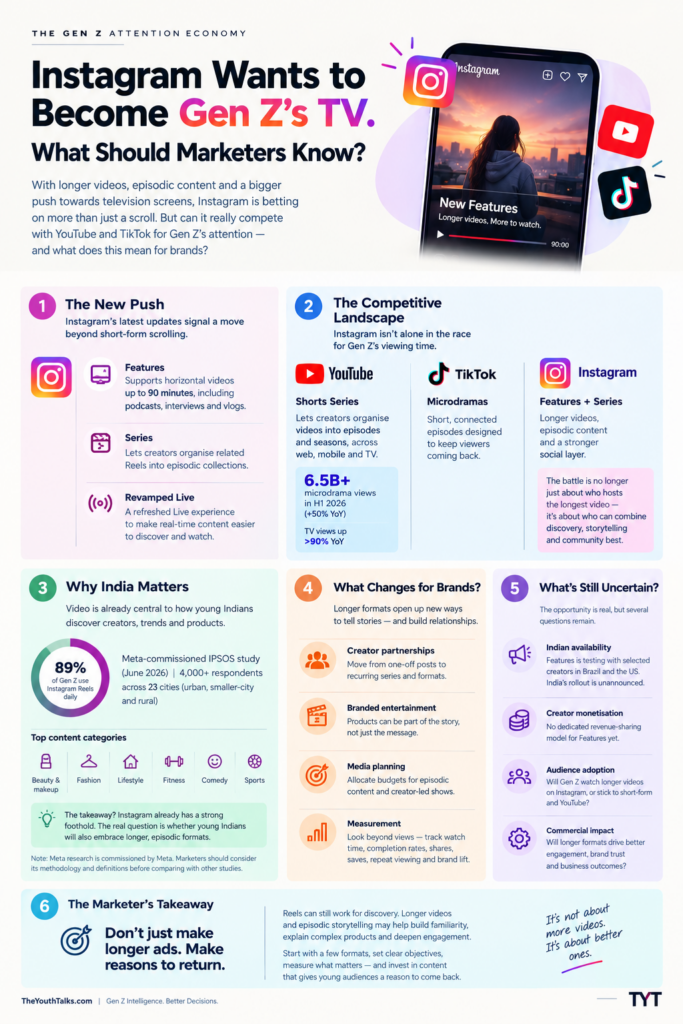
Announced on October 26, 2026, Instagram’s new Features format is designed to accommodate longer videos, including podcasts, interviews and vlogs. The platform is also developing Series, which gives related Reels a dedicated home, making episodic storytelling easier to discover and follow. The changes signal a broader ambition: to make Instagram a destination not just for discovering content, but for spending extended periods watching it.
For marketers, the development raises a consequential question. If Instagram succeeds in turning short-form viewers into audiences for longer entertainment, could it change how brands work with creators, plan campaigns and measure engagement among Gen Z?
The answer will depend on more than video length. It will depend on whether Instagram can give audiences compelling reasons to return, and whether marketers can translate that attention into meaningful business outcomes.
The Battle for Gen Z’s Viewing Time
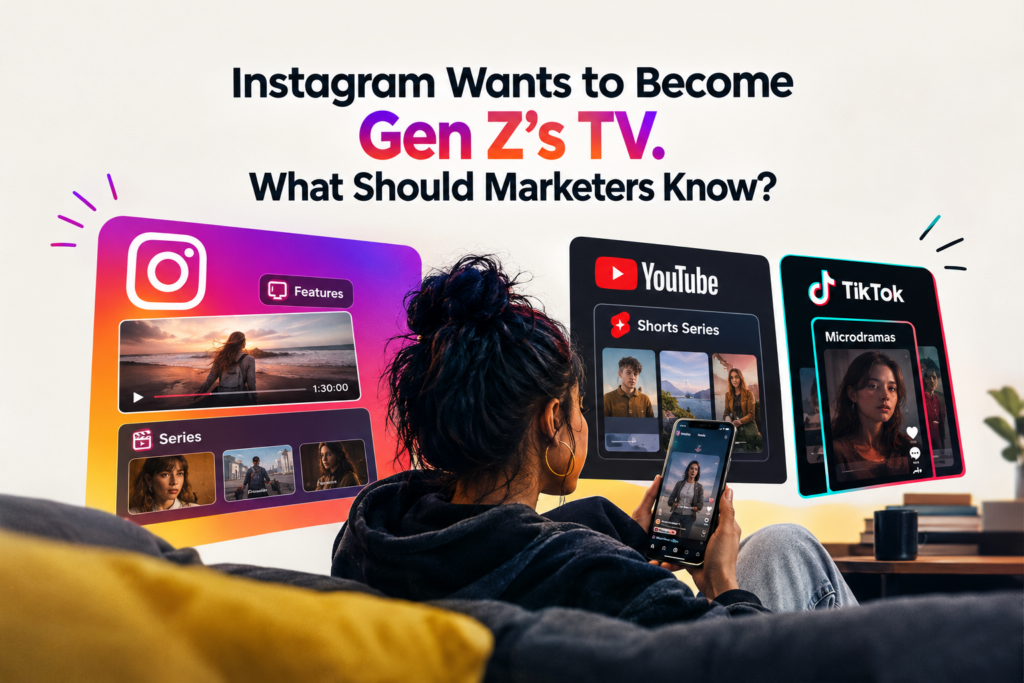
Instagram is not entering an empty market. YouTube has spent years building an ecosystem around long-form videos, creator-led shows, podcasts and Shorts. TikTok, meanwhile, has been expanding into episodic storytelling and microdramas, a format built around short, connected dramatic episodes designed to keep viewers coming back.
YouTube’s latest moves underline the scale of this opportunity. The platform has introduced Shorts Series, allowing creators to organise videos into episodes and seasons across web, mobile and television. YouTube also reported that microdramas generated more than 6.5 billion views during the first half of 2026, with watch time growing by over 50% year on year. Views of microdrama content on television screens increased by more than 90% over the same period, according to the company.
These are platform-reported figures rather than independently audited industry-wide measurements, but they indicate that episodic video is attracting significant attention.
Instagram’s response combines several elements. Features is intended to support longer, horizontal videos, while Series aims to organise episodic Reels. The platform has also been developing ways for viewers to move from short clips to full-length videos.
This creates the possibility of a connected viewing journey: a user discovers a compelling moment in a Reel, watches the complete episode and returns for the next instalment.
The distinction matters. Short-form video is often built around immediate discovery and sharing. Episodic content offers something different: continuity, anticipation and the possibility of a recurring relationship between a creator and an audience.
Instagram also has a potential advantage in its established social environment. Recommendations, direct messages and sharing with friends can help content travel through existing relationships. However, YouTube has its own creator communities and recommendation systems, and it would be premature to assume Instagram has a stronger relationship with viewers.
The competition is therefore not simply about which platform hosts the longest video. It is about which platform can combine discovery, storytelling and repeat viewing most effectively.
Why India Matters to This Shift
India is an important market in this contest because video is already central to how young consumers discover creators, trends and products.
A Meta-commissioned study conducted by IPSOS, published in June 2026, surveyed more than 4,000 respondents across 23 Indian cities, covering metropolitan, smaller-city and rural audiences. The study reported that 89% of surveyed Gen Z respondents used Instagram Reels daily. Meta also reported that beauty and makeup, fashion, lifestyle and fitness, comedy, and sports were among the leading content categories.
These findings suggest that Instagram already occupies a regular place in many young Indians’ media routines. Its challenge is to extend that relationship into new formats without losing the immediacy that makes Reels attractive.
The study also reported that Reels was associated with stronger product discovery and purchase influence. Because the research was commissioned by Meta, marketers should consider its methodology and definitions before comparing its results with independent studies or data from competing platforms.
Nevertheless, the commercial implications are worth examining. When young consumers discover products through creators, recommendations and entertainment, the boundaries between content consumption and brand discovery become less distinct.
Longer video could create new opportunities in categories where explanation, demonstration or narrative adds value. Technology brands, for example, could explore creator-led product explainers or recurring conversations about emerging technologies. Beauty and fashion brands could work with creators on evolving formats rather than relying exclusively on individual promotional posts. Financial services and education companies could use episodic content to address questions that require more than a brief clip.
But none of this means that Indian Gen Z will automatically prefer longer videos on Instagram. Daily Reels usage demonstrates the strength of an existing habit; it does not prove demand for 90-minute videos or a willingness to watch them on television screens.
The opportunity exists. Audience adoption still needs to be demonstrated.
What Changes for Brands and Marketers?
The most immediate opportunity may lie in how brands collaborate with creators. Until now, many campaigns have been designed around a brief appearance in a Reel, a product demonstration or a creator’s endorsement. Longer videos and episodic formats could allow marketers to build relationships with audiences across multiple instalments.
Consider a technology brand partnering with a creator to develop a series on how young Indians use artificial intelligence in their studies and early careers. Instead of a single sponsored video, the partnership could explore different applications, practical challenges and real-world experiments over several episodes. A beauty brand could develop a recurring format around routines, ingredients and consumer questions. A financial services company could commission accessible explainers about budgeting, credit and investing, subject to appropriate regulatory safeguards.
In each case, the product is not necessarily the entire story. It becomes part of a broader conversation that audiences may have a reason to revisit.
This could also encourage marketers to rethink their relationships with creators. Rather than selecting influencers primarily on follower counts and individual campaign reach, brands may increasingly evaluate their ability to develop a consistent format, sustain audience interest and create credible narratives.
However, longer content is not automatically more effective content. A 20-minute branded video that viewers abandon after two minutes may be less valuable than a 30-second Reel that generates meaningful discovery or action.
The commercial question is whether a format produces incremental value, not simply additional minutes watched.
Measurement will therefore become critical. Marketers should look beyond views to examine average watch time, completion rates, repeat viewing, shares, saves, audience retention and brand recall. Where possible, these metrics should be complemented by brand-lift studies, controlled experiments and conversion data.
For episodic campaigns, brands should also assess whether audiences return for subsequent instalments and whether engagement changes over the course of a series. These measures could help distinguish a genuinely compelling format from content that attracts an initial burst of curiosity.
The challenge is to connect entertainment metrics with business outcomes without assuming that one necessarily guarantees the other.
The Questions Instagram Still Needs to Answer
Despite the promise, Instagram’s long-form ambitions remain at an experimental stage.
First, access is limited. As of October 28, 2026, Features is being tested with selected creators in Brazil and the United States, and Instagram has not announced a general launch date for India. Series has a separate testing programme that includes India, according to media reports, but access to that feature should not be confused with availability of the 90-minute format.
Second, creator monetisation remains unresolved. Creators with existing brand partnerships may be able to extend those relationships into longer videos, but Instagram has not announced a dedicated, YouTube-style advertising revenue-sharing programme for Features. Without a clear and attractive economic model, some creators may prefer to keep their full-length programmes on platforms where monetisation arrangements are more established.
Third, audience behaviour remains an open question. Instagram’s success with short-form video does not guarantee that users will embrace lengthy interviews, podcasts or episodic shows within the same app. The company must demonstrate that longer viewing can coexist with the quick discovery and social sharing that define the Instagram experience.
There is also a historical lesson. Instagram previously launched IGTV in 2018 before discontinuing the standalone product in 2022. Features benefits from an established Instagram audience and a different approach to connecting short clips with full-length videos, but its eventual success is far from assured.
Finally, brands need to consider the costs of production. Building a credible series requires stronger concepts, consistent execution and a commitment to quality. Simply extending existing promotional content could increase production expenses without generating corresponding improvements in audience engagement.
The Marketer’s Takeaway: Build Stories, Not Longer Ads
Instagram’s latest experiments point towards a wider change in digital entertainment. The distinction between social media, creator platforms and television is becoming less rigid as companies compete to offer both discovery and sustained viewing.
For marketers, the opportunity is not to abandon short-form video or immediately redirect budgets towards longer formats. Reels can remain effective for discovery, while longer videos and episodic storytelling may serve different purposes, from building familiarity to explaining complex products.
A sensible approach is to experiment with a small number of recurring formats, establish clear objectives and compare their performance against existing campaigns. Brands should test whether audiences return, whether creator partnerships feel credible and whether the additional investment produces measurable benefits.
They should also avoid treating every platform feature as a new marketing mandate. A format deserves investment when it serves the audience and the brand’s objectives, not simply because a platform has introduced it.
Instagram may eventually become a stronger destination for longer entertainment. YouTube already has considerable momentum in episodic video, while creators and audiences will continue to decide where their time is best spent.
The lesson for marketers is straightforward: the next competitive advantage may not come from producing more videos, but from creating content that gives young audiences a reason to come back.