






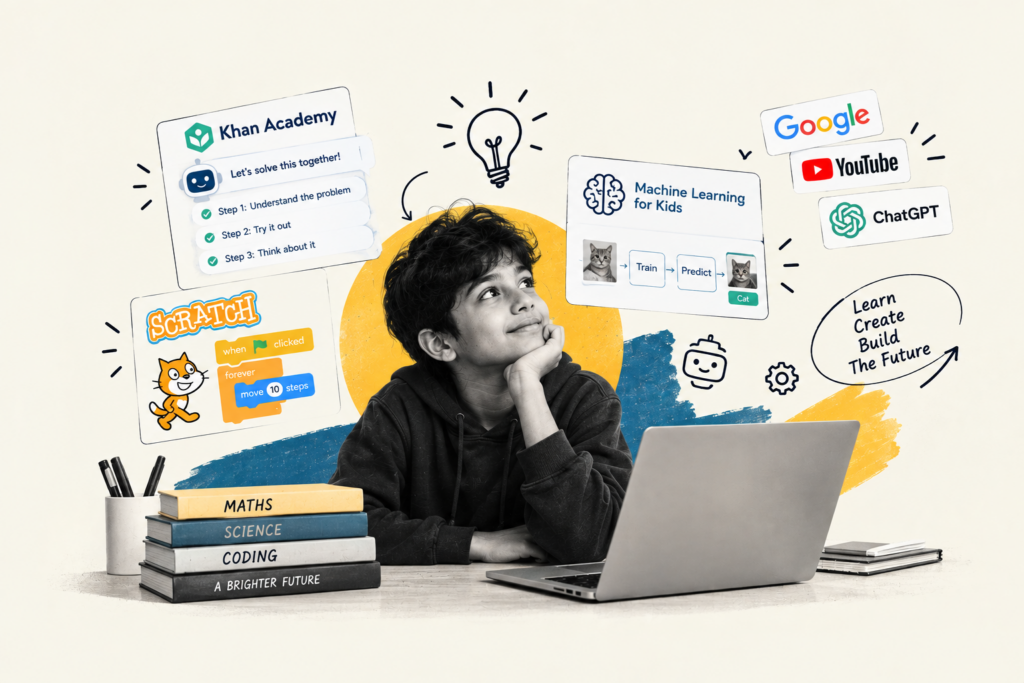
From AI tutors to tools that teach children how machine learning works, a new generation of educational technology is changing the possibilities of learning. But the real question for parents is not simply which tools children should use. It is what they should learn from using them.
For generations of Indian students, learning has followed a familiar pattern. A textbook explains the concept, a teacher breaks it down, homework reinforces the lesson, and an examination tests whether the student has understood it.
Technology has gradually changed this process. YouTube made explanations available beyond the classroom. Search engines made information easier to find. Educational apps turned practice into games, while online learning platforms brought lectures from teachers and institutions to students who might never have encountered them otherwise.

Artificial intelligence could change the next part of this story.
For Generation Alpha, broadly referring to children born from 2010 onwards, AI is arriving at a particularly formative stage of life. A child struggling with algebra can ask for another explanation. A young reader can practise aloud with a digital reading assistant. A student interested in coding can experiment with a machine-learning project without first mastering complex programming languages.

These possibilities are exciting, particularly in a country like India, where students experience widely different levels of access to teachers, educational resources and personalised academic support.
But access to technology is not the same as access to good education. Nor does an educational purpose automatically make an AI tool safe for children.

For parents, the challenge is to distinguish between technology that helps children develop their abilities and technology that simply makes it easier to complete a task.
Here are five tools worth understanding, along with the questions parents should ask before introducing them at home.
1. Khanmigo: An AI Tutor That Can Encourage Children to Think
One of the most interesting applications of AI in education is its potential to make learning more interactive.
Khanmigo, developed by Khan Academy, is an AI-powered learning assistant designed to support students and teachers. Rather than functioning solely as an answer machine, it is designed to guide learners through problems, offer explanations and encourage them to work towards solutions.
Imagine a student who understands the basic principles of algebra but repeatedly makes mistakes when solving equations. In a conventional homework setting, the student might have to wait until the next class to get individual attention.
An AI tutor can potentially offer another explanation, work through a similar example and help the student identify where their reasoning went wrong.
That is the opportunity: not merely delivering information, but providing additional support when a learner gets stuck.
What parents should know
The distinction between tutoring and answer generation is important. A tool is more educationally useful when it encourages a child to explain their reasoning, attempt a problem independently and learn from mistakes.
However, AI-generated explanations can also contain errors. Parents should check the product’s current age requirements, account eligibility, pricing and availability in India before signing up. They should also understand what information is collected and what parental or educator controls are available.
The takeaway: An AI tutor should help children become more capable of solving problems independently, not more dependent on asking a machine for every answer.
2. Scratch and Machine Learning for Kids: Teaching Children How AI Works
Most conversations about AI focus on what the technology can do for us. A more fundamental question is whether children should also learn how it works.
Scratch, the visual programming platform developed by the MIT Media Lab, allows children to create animations, games and interactive stories using blocks of code. Machine Learning for Kids introduces activities through which learners can explore machine-learning concepts and use trained models in projects, including Scratch-based projects.
Together, these tools offer a different way of approaching AI education.
Instead of simply asking an AI system to generate a picture or answer a question, a child can experiment with how a machine learns to recognise patterns. They might train a model using examples, test its predictions and discover what happens when the examples are incomplete or misleading.
This can introduce an important concept early: AI systems do not possess perfect knowledge. Their outputs depend, in part, on the data, examples and methods used to develop them.
A child who sees a model misclassify something may begin to ask better questions about accuracy, bias and reliability.
That is a valuable foundation for a world in which AI-generated answers and recommendations are likely to become increasingly common.
What parents should know
These are learning environments rather than general-purpose AI companions. Their educational value comes from experimentation and creation, not from having a chatbot available for unrestricted conversation.
Parents and teachers should nevertheless review the particular activity, the information children upload and any external services involved. The privacy and safety characteristics of a project can depend on how it is configured and which additional tools it uses.
The takeaway: Children should not grow up merely knowing how to use AI. They should have opportunities to question it, experiment with it and understand its limitations.
3. Tynker: Making Coding and AI More Approachable
For a child who enjoys games, puzzles and interactive challenges, Tynker offers another entry point into computational thinking.
The platform provides structured coding activities, creative projects and learning experiences that introduce concepts such as programming, logic and, in relevant courses, artificial intelligence and machine learning.
The appeal is straightforward. Coding can initially appear abstract, particularly to younger learners who have not yet developed an intuitive understanding of how software works.
Interactive projects make these ideas more tangible. A child can create a game, modify how a character behaves, test a sequence of instructions and understand the consequences of changing the underlying logic.
AI-related activities can extend this learning by introducing concepts such as patterns, classification and data-driven predictions.
For parents, the bigger benefit is not necessarily that a child will become a software engineer. It is that structured experimentation can help develop problem-solving skills and the confidence to build something independently.
These abilities can be useful across disciplines, whether a student eventually chooses engineering, design, business, science or another field.
What parents should know
Tynker’s courses, features, age suitability and subscription arrangements can vary. Parents should review the specific offering rather than assume every course includes AI or that all features are available under one plan.
They should also examine account settings, data practices and any community or sharing features associated with the selected experience.
The takeaway: The best technology-led learning experiences encourage children to create, experiment and solve problems rather than remain passive consumers of digital content.
4. Osmo: Bringing Hands-On Learning Into the Digital Experience
Not every child learns best by looking at a screen and typing a response.
Some learn through physical objects, movement, drawing and trial and error. This is where Osmo’s approach to interactive learning becomes interesting.
Osmo is known for learning systems that combine compatible tablets and physical play materials. Depending on the product and activity, children can manipulate tangible objects while the accompanying software responds to what they do.
Activities have included spelling, mathematics, drawing and problem-solving.
The important distinction is that Osmo should not automatically be described as an AI companion. Its core appeal is the integration of physical play with digital feedback; the precise technology and capabilities depend on the particular product.
For parents worried about the amount of time children spend interacting with screens, this approach offers an alternative to purely digital activities. Children can engage with physical pieces while receiving instructions and responses through a device.
It also illustrates a broader principle in educational technology: digital tools do not have to replace familiar forms of play to make learning more engaging.
What parents should know
Osmo is a hardware-and-software learning system, so parents need to check device compatibility, product availability in India, the cost of the required equipment and the suitability of individual activities for their child.
They should also review any associated apps, account requirements and data policies. Physical interaction does not, by itself, guarantee that an app has no internet connectivity or data-collection features.
The takeaway: The goal should not be to move every learning activity onto a screen. It should be to use technology where it adds something useful to the experience.
5. Bookbot: Helping Children Practise Reading
Learning to read is not just about recognising letters or understanding the meaning of words. It also involves pronunciation, fluency, confidence and the willingness to keep practising when a passage becomes difficult.
Bookbot is a reading-support tool designed to help children practise reading aloud with technology that listens to their speech and provides feedback.
For a young learner who feels self-conscious about making mistakes in front of classmates or adults, a patient practice environment may offer another opportunity to develop confidence.
Repeated practice can help children become more comfortable with unfamiliar words and the mechanics of reading. A digital reading assistant can supplement this process by allowing learners to practise outside formal classroom sessions.
But the role of such a tool needs to be understood clearly. Reading is not simply a speech-recognition problem. Comprehension, vocabulary, interpretation and a genuine interest in stories remain essential.
A child may pronounce a sentence correctly without understanding its meaning. Equally, a reading application may struggle with accents, pronunciation differences or words it does not recognise accurately.
What parents should know
Before choosing Bookbot or any similar reading assistant, parents should check its current availability, supported languages, age suitability, pricing and privacy policy. They should pay particular attention to how children’s voice recordings or other reading data are processed and retained.
For Indian families, language support is especially important. A tool that works well for English reading practice may not serve a child whose strongest language is Hindi or another Indian language.
The takeaway: AI-assisted reading should complement conversations, books, storytelling and shared reading with parents or teachers. It should not replace them.
The Question Parents Should Ask Before Choosing Any AI Tool
The five tools serve different purposes. Some help children practise academic skills, some introduce programming, and others combine digital interaction with physical learning.
Their common value lies in the possibility of making learning more accessible, interactive and responsive to a child’s needs.
But parents should look beyond a polished interface or an impressive demonstration.
Before introducing any AI-enabled educational product, consider five questions:
1. What will my child learn?
Look for a clear educational purpose. Does the tool develop understanding, encourage experimentation or improve a specific skill? Or does it simply make an assignment easier to complete?
2. Is it appropriate for my child’s age?
Check the product’s current minimum-age requirements, terms of service and account eligibility. A tool suitable for a teenager may not be appropriate for a seven-year-old.
3. What happens to my child’s data?
Review what information is collected, whether voice recordings or conversations are processed, how long data is retained, whether information is used to improve AI systems and what deletion options exist.
4. What safeguards are available?
Look for parental controls, clear privacy settings, appropriate content restrictions and transparent reporting mechanisms. Determine whether the experience involves open-ended conversation or a more limited educational activity.
5. Does the tool encourage independent thinking?
This may be the most important question of all. A child should have opportunities to attempt a problem, make mistakes, ask questions and reach their own conclusions. AI should support that process rather than quietly take it over.
Parents should also remember that product safeguards vary and can change. No checklist guarantees complete safety, and supervision remains important, particularly when children use conversational systems.
India’s Gen Alpha Has More to Learn Than How to Use AI
India’s relationship with educational technology has always involved a tension between opportunity and access.
Digital platforms can expose students to new ideas, explanations and learning experiences. AI could extend these possibilities by making certain kinds of personalised practice available beyond the classroom.
Yet the benefits will depend on more than the availability of applications. Device access, connectivity, language support, affordability, teacher preparedness and parental awareness will all influence how children experience these tools.
There is also a risk that children with access to well-designed educational technology and informed adult guidance will benefit more than those who receive technology without adequate support.
Schools and families therefore have an important role in ensuring that AI complements education rather than becoming another source of inequality.
Teachers will continue to matter because education involves much more than delivering information. They recognise confusion, encourage curiosity, manage classroom dynamics and help children develop social and emotional skills. Parents, too, contribute something no product description can promise: an understanding of the individual child.
AI may offer another explanation of a difficult concept. It cannot automatically know when a child needs reassurance, when a question reflects a deeper misunderstanding or when the most useful response is to put the device away and try something different.
These distinctions will become increasingly important as AI tools grow more conversational and personalised.
The Future of Learning Should Not Be About Replacing Thinking
For Generation Alpha, AI is unlikely to remain a separate category of technology that children encounter only in special lessons. It may increasingly become part of how they research, practise, create and solve problems.
That makes the choices parents and educators make today significant.
The objective should not be to introduce children to as many AI tools as possible, nor to treat every new technology as a threat. It should be to help them develop the judgement to use these systems thoughtfully.
A child who uses AI to understand a difficult mathematics concept has gained a potentially useful learning resource. A child who asks AI to complete every mathematics problem may have missed the opportunity to learn.
The difference is not necessarily the technology. It is the way the technology is used, the boundaries around it and the understanding that develops through the experience.
For parents, the best starting point may be simple: choose one age-appropriate tool, explore it together, ask the child to explain what they learned and discuss where the technology might be wrong.
The future of education will not be determined by how early children start using AI. It will be shaped, in part, by whether they learn to think critically while using it.
The real promise of AI in education is not that children will need to think less. It is that, when designed and used well, they may have more opportunities to think, explore and learn.