
For years, businesses have built their understanding of loyalty around a relatively simple expectation: consumers who trust a brand should continue buying from it, employees who join an organisation should demonstrate commitment, and relationships should become stronger with time. But India’s Gen Z is challenging this traditional understanding. They are willing to switch brands, reconsider career choices, question workplace cultures and explore alternatives even when they have been associated with a particular product or organisation for years.
Does that make them disloyal?
Not necessarily. It may simply mean that loyalty is no longer unconditional.
For a generation that has grown up with unlimited choices, instant access to information and the ability to compare almost everything, staying with a brand or an employer is increasingly a conscious decision rather than an inherited habit. Young consumers want products that remain relevant to their needs. Young professionals want workplaces that continue to offer learning, flexibility and a sense of purpose. When those expectations are no longer met, they are more willing to reconsider the relationship.
This distinction could have significant implications for businesses trying to attract, engage and retain India’s next generation of consumers and employees.
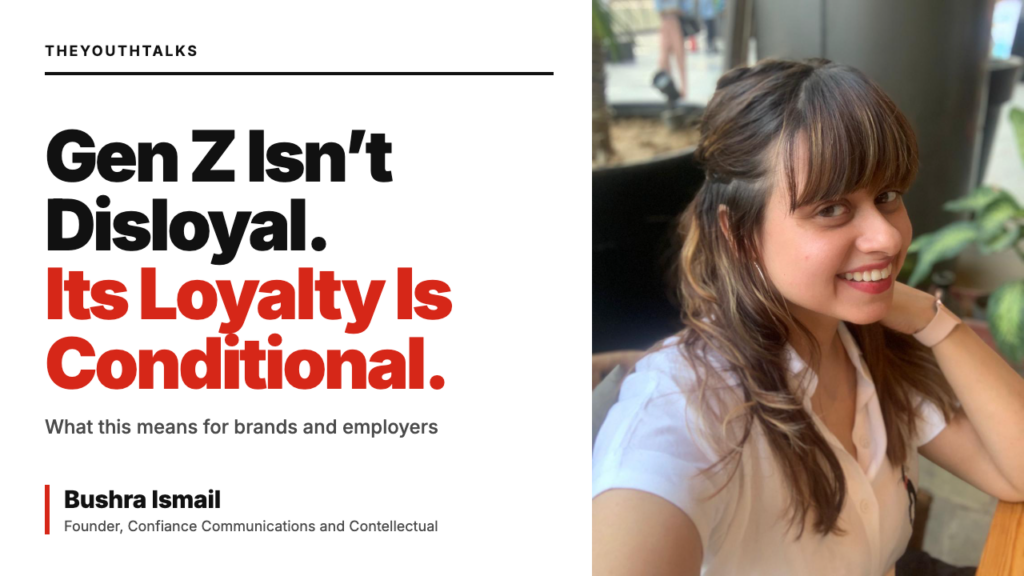
In a conversation on De:Code Podcast, Bushra Ismail, Confiance Communications & Contellectual, offered an interesting perspective on this changing relationship. Drawing on her experience across journalism, communications and brand strategy, she suggested that Gen Z’s loyalty is better understood as conditional rather than absent.
It is an observation that deserves closer attention, particularly at a time when organisations are trying to understand why traditional approaches to customer retention and employee engagement are not always delivering the expected results.
The Loyalty Question: Why Is Gen Z So Difficult to Retain?
Ask a marketer about Gen Z, and some familiar descriptions are likely to emerge. They are experimental, easily distracted, quick to move on and constantly looking for something new. Ask an employer, and the conversation may turn towards shorter tenures, changing expectations, demands for flexibility and a perceived lack of patience.
But these observations often describe the behaviour without examining what drives it.
Gen Z has grown up in an environment where switching is relatively easy. A consumer dissatisfied with a product can discover alternatives, compare prices and read reviews within minutes. A professional unhappy with a workplace can explore opportunities through LinkedIn and other job platforms without necessarily waiting for a formal career transition.
The availability of alternatives has changed the dynamics of relationships.
Previous generations often developed brand preferences through family influence, familiarity, availability and years of repeated exposure. Employment relationships were also frequently shaped by long-term career planning, organisational hierarchy and the expectation that staying with one employer was an important marker of professional stability.
These considerations have not disappeared. However, Gen Z is evaluating relationships through a different set of expectations.
A brand may have been popular for decades, but does it offer something relevant today? An employer may have an established reputation, but does the working environment support professional growth? A product may have a strong advertising presence, but what do actual users say about it?
The questions are changing, and businesses need to recognise that.
Conditional Loyalty: Gen Z Will Stay, But It Needs a Reason
Bushra’s description of Gen Z loyalty as conditional offers a useful way to understand this behaviour.
Conditional loyalty does not mean that young consumers or employees are unwilling to commit. It means their commitment is closely linked to whether the relationship continues to deliver value.
For consumers, that value could come from product quality, affordability, convenience, customer experience, brand values or simply the ability of a product to make everyday life easier.
For employees, it could mean meaningful work, learning opportunities, professional recognition, a supportive manager, flexibility and the possibility of career progression.
The relationship is therefore not necessarily permanent. It is continuously evaluated.
Consider a young consumer who has purchased from the same fashion brand for several years. If the brand begins offering products that no longer match their preferences, becomes significantly more expensive or fails to deliver a satisfactory experience, the consumer may explore another option. The previous relationship does not automatically guarantee the next purchase.
Similarly, a young professional may join an organisation with enthusiasm, invest time in learning and contribute meaningfully to the team. But if the role stops offering opportunities to grow, or the workplace culture becomes inconsistent with their expectations, the employee may begin looking elsewhere.
The important distinction is that switching does not automatically indicate that the original relationship was meaningless.
It may simply indicate that the relationship has stopped working.
For brands and employers, this creates a different challenge. Retention cannot depend entirely on past goodwill. It must be supported by present relevance.
Brand Relationships: Why Relevance Matters More Than Legacy
One of the biggest challenges for established brands is understanding that historical reputation does not automatically translate into contemporary relevance.
A brand may have spent decades building trust, recognition and familiarity. These are valuable assets. However, younger consumers are not necessarily going to purchase a product simply because their parents or older siblings have always used it.
They want to understand what the product offers them.
Does it solve a problem? Is it worth the money? Does it fit their lifestyle? Is the experience consistent with what the brand promises?
These questions are particularly important in categories where consumers have numerous alternatives, including fashion, personal care, electronics, food delivery, entertainment and financial services.
This does not mean that legacy brands are disadvantaged. In fact, established businesses often have significant advantages in distribution, product development, consumer trust and operational scale.
The opportunity lies in translating those advantages into experiences that younger consumers find meaningful.
Brands must also recognise that Gen Z is not one homogeneous consumer group. As Bushra pointed out in the conversation, the expectations of a 19-year-old college student can be very different from those of a 29-year-old working professional.
Their financial circumstances, responsibilities, purchasing priorities and aspirations may differ considerably.
A marketing strategy that treats both as one uniform audience risks missing important distinctions.
The lesson is straightforward: brands should build relationships around evolving consumer needs rather than assuming that a generational label explains everything.
Authenticity Over Internet Slang: Stop Trying So Hard to Sound Like Gen Z
There is another mistake brands frequently make when attempting to connect with younger audiences: confusing cultural relevance with the ability to imitate internet language.
A campaign featuring trending slang, popular memes or references to viral moments may generate initial attention. But attention and affinity are not the same thing.
Gen Z has spent much of its life navigating digital platforms. It understands internet culture, recognises trends and can often distinguish between brands participating in a conversation naturally and those attempting to manufacture relevance.
This is where authenticity becomes important.
A brand does not necessarily need to use the latest slang to communicate with a 22-year-old consumer. It needs to understand what that consumer values and demonstrate how its product or service fits into their life.
A personal care brand, for example, should focus on product performance, ingredient transparency, affordability and the actual consumer experience. A technology brand should demonstrate how its products improve productivity, entertainment or everyday convenience.
The communication should emerge from the product’s relevance, rather than from an attempt to make the brand appear younger.
There is also a wider consideration for marketers. In trying to attract Gen Z, brands should be careful not to alienate their existing customers.
A business serving multiple generations cannot afford to abandon the consumers who helped build its reputation simply to appear culturally current.
The challenge is not to become a Gen Z brand overnight. It is to become a brand that Gen Z has a reason to choose.
Gen Z Doesn’t Just Discover Brands. It Investigates Them.
The traditional marketing funnel often assumed that brands could create awareness, communicate product benefits and gradually influence purchase decisions through advertising.
That journey has become considerably more complicated.
Before making a purchase, a young consumer may watch a product demonstration on YouTube, search for opinions on Reddit, explore Instagram content, ask friends for recommendations and compare alternatives across shopping platforms.
The brand’s own communication is only one part of the decision-making process.
This is an important change because it shifts some influence away from the advertiser and towards communities, creators and existing consumers.
A campaign can generate awareness, but the final purchase decision may depend on what other people are saying about the product.
For marketers, this means that brand communication can no longer be treated as a one-way monologue.
Young consumers want opportunities to engage, question, compare and participate. They are interested in what a brand says, but they are equally interested in whether its actions support those claims.
It also explains why a negative customer experience can travel much further than a brand might anticipate. Reviews, comments and personal experiences can become part of the public conversation around a product.
Interestingly, the assumption that Gen Z does not read also deserves reconsideration.
As Bushra observed, young people may not necessarily consume information through traditional newspapers, but they do engage with longer discussions and detailed content on platforms such as Reddit and LinkedIn.
The format and destination may have changed, but the appetite for information has not disappeared.
For brands, the implication is clear: being visible is no longer enough. They must also be credible when consumers start looking for answers.
India’s Gen Z: The Digital Divide Is Not Necessarily a Cultural Divide
India presents another important dimension to this conversation.
For a long time, marketers have approached Tier 1 and Tier 2 markets as though they represent fundamentally different consumer cultures. While differences in infrastructure, language, media consumption and purchasing behaviour certainly exist, digital access has changed the way young Indians discover culture and participate in conversations.
A young consumer in a smaller Indian city can follow the same creators, watch the same YouTube videos, discover the same fashion trends and participate in conversations on Instagram or Reddit as someone living in Mumbai, Bengaluru or Delhi.
Geography does not necessarily determine cultural awareness in the way it once did.
However, there is an important distinction between knowing about a product and being able to afford it.
A young consumer in Jaipur, Lucknow, Indore or Coimbatore may aspire to own the same smartphone, fashion product or lifestyle accessory as someone in a metropolitan city. Their awareness and preferences may be similar, but their purchasing power and spending priorities could be different.
This is where brands need to rethink their regional marketing strategies.
Simply changing the language of an advertisement or introducing more local references may not be sufficient to unlock demand.
Product portfolios, entry-level pricing, pack sizes, distribution and accessibility may matter considerably more.
The opportunity for brands is to recognise that young consumers across India can share cultural aspirations while having very different economic realities.
For businesses looking to expand beyond metropolitan markets, understanding this distinction could be particularly important.
The Workplace Question: Are Employers Misreading Gen Z?
Perhaps the most interesting extension of the conditional loyalty argument is its relevance to employment.
Much of the discussion around Gen Z in the workplace has focused on what employers believe young professionals are doing differently. They are perceived to question authority more frequently, seek flexibility, prioritise personal well-being and reconsider career choices more readily.
But there is another side to this conversation.
Are organisations adapting their management practices to the expectations of a changing workforce?
The traditional employer-employee relationship often placed considerable emphasis on tenure, hierarchy and the expectation that professional commitment would be demonstrated through consistency and long working relationships.
For younger professionals, commitment may be expressed differently.
They may want challenging assignments, opportunities to acquire new skills, constructive feedback and managers who recognise that professional growth is not always linear.
This does not mean that accountability, discipline or performance expectations should disappear. Organisations have legitimate business requirements, and employees must be willing to meet them.
But there is a difference between maintaining high standards and assuming that every individual must fit into an identical model of professional behaviour.
Bushra shared an interesting example from her own experience. When a Gen Z employee was struggling, rather than immediately allowing the relationship to end through resignation, she offered the individual a 10-week sabbatical. The employee eventually returned refreshed and committed.
It is a small but revealing example of what a different approach to people management can look like.
Not every struggling employee needs to leave. Sometimes, the right intervention may be to understand what is going wrong and create the space for the individual to recover.
Of course, one experience cannot establish a universal employee retention strategy. But it raises a worthwhile question for employers: are organisations sometimes losing capable young professionals because they are unwilling to reconsider how they manage, support and develop them?
Giving Gen Z room to grow does not mean lowering expectations. It means recognising that people may need different kinds of support at different stages of their careers.
The Future of Loyalty Will Be Earned, Not Assumed
For brands, employers and businesses, the emergence of conditional loyalty should not necessarily be viewed as a threat.
It is an invitation to examine the quality of the relationships they are building.
Consumers will continue to look for products that deliver value. Employees will continue to seek workplaces where they can develop professionally. Both groups will have access to alternatives, information and communities that allow them to evaluate their choices.
The businesses that understand this shift will be better positioned to build lasting relationships.
That requires moving beyond short-term engagement tactics, fashionable marketing language and traditional assumptions about commitment.
Brands must deliver what they promise, listen to their consumers and remain relevant as needs evolve. Employers must create environments where young professionals can learn, contribute and see a future for themselves.
There is also a need to recognise that Gen Z is not a single personality type. A college student, a first-time employee and a 29-year-old professional may have very different expectations. Understanding these differences requires listening, research and meaningful engagement rather than relying on stereotypes.
Ultimately, perhaps the biggest misconception about Gen Z is that its willingness to move on reflects an inability to build lasting relationships.
It may instead reflect a generation that expects relationships to remain meaningful.
And that changes the definition of loyalty.
For brands, it is no longer enough to say that consumers have trusted them for decades. For employers, it is no longer enough to point to an established organisational reputation.
Both must continually demonstrate why the relationship is worth maintaining.
Gen Z isn’t necessarily asking for unconditional loyalty. It is asking for a reason to stay. And in the years ahead, that may be the most important lesson businesses need to learn.
Based on a conversation with Bushra, founder of Confiance Communications, on De:Code. Watch the full interaction