
From buying a new pair of sneakers after completing an important project to treating themselves to skincare, gadgets or a weekend experience during festivals, young Indians are increasingly including themselves in the gifting economy. Is self-gifting becoming a new expression of self-love, personal achievement and independence?
Festive shopping in India has traditionally followed a familiar pattern. Families buy gifts for one another, friends exchange presents, and people spend considerable time choosing something meaningful for those they care about.
But there appears to be a new addition to the festive shopping list: the person doing the shopping.
For a growing number of young Indians, buying a gift is no longer necessarily dependent on a birthday, anniversary or someone else’s appreciation. It could simply be a way of rewarding themselves after a difficult week, celebrating a personal milestone or purchasing something they have wanted for months.
A new study suggests that this behaviour is becoming part of India’s Gen Z consumption habits.
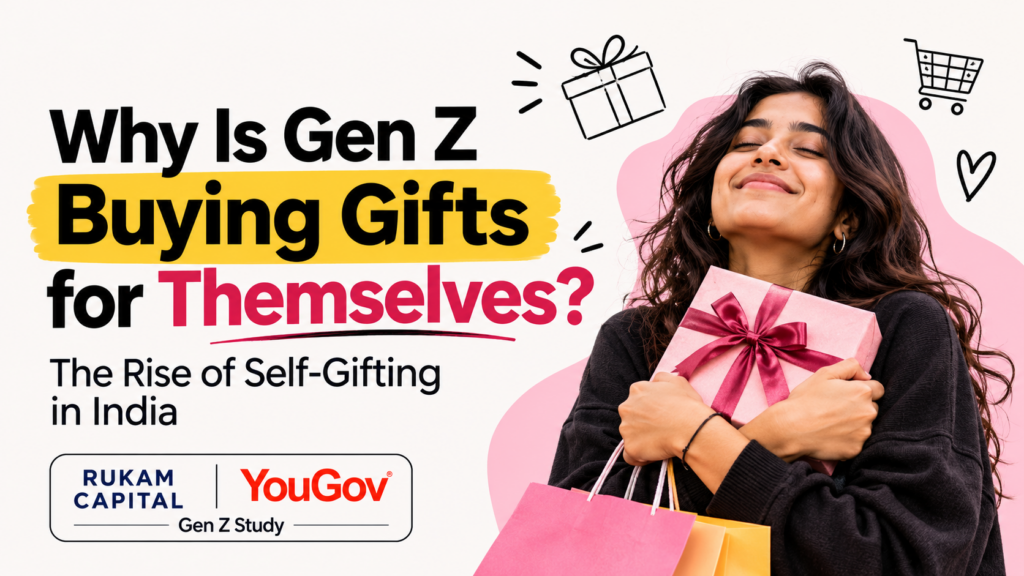
According to a Rukam Capital–YouGov study involving 4,002 respondents aged 18–29 across 18 Indian states, nearly three in ten Gen Z respondents buy gifts for themselves during festivals.
The findings, reported by The Economic Times in November 2026, suggest that self-gifting is becoming part of festive consumption alongside traditional gifting for family and friends.
Interestingly, 74% of respondents said they buy gifts for parents and family members, while 61% buy gifts for friends.
The numbers point towards an interesting shift. Gen Z is not necessarily moving away from traditional gifting. Instead, it is making room for personal indulgence within an established cultural practice.
The question is no longer just what to buy for others. It is also what to buy for oneself.
Self-gifting is becoming more than an occasional indulgence
One of the interesting aspects of self-gifting is that it does not always require a special occasion.
For previous generations, purchasing something expensive for oneself might have been associated with a birthday, a salary bonus or a major achievement.
For younger consumers, the motivation could be considerably more personal.
A student might buy a pair of headphones after completing an important examination. A young professional might purchase a smartwatch after receiving their first salary. Someone else might invest in skincare, clothing or a short holiday simply because they feel they deserve a break.
The purchase becomes a personal reward rather than an obligation.
The Rukam Capital–YouGov findings offer another perspective on this behaviour. Around 25% of respondents identified the desire to treat themselves as a reason for spending more during festivals.
Family expectations were the biggest trigger for festive overspending at 34%, followed by discounts at 29% and emotional connections at 28%.
This suggests that self-indulgence is becoming one of several motivations influencing young Indians’ festive spending decisions.
It is also important to distinguish between buying something for oneself and buying something because of social pressure. Self-gifting can be an entirely private experience, with no expectation of displaying the purchase or receiving validation from others.
For some, the satisfaction may come simply from being able to afford something they previously could not.
Is self-gifting Gen Z’s way of celebrating personal milestones?
The rise of self-gifting also connects with the changing relationship young Indians have with money, independence and achievement.
For a generation entering the workforce amid economic uncertainty and rising living costs, small purchases can carry emotional significance.
The first salary, an internship conversion, completing a demanding academic year or achieving a personal fitness goal can all become reasons to celebrate.
A gift purchased for oneself becomes a tangible reminder of progress.
This is particularly relevant for young professionals who are beginning to exercise greater financial independence. Spending on something personally meaningful can represent a small but important milestone in their transition into adulthood.
However, self-gifting should not automatically be interpreted as a sign of financial independence. Many students still depend on their families for money, and purchasing decisions are influenced by affordability, disposable income and household circumstances.
The more interesting shift is perhaps psychological: young consumers are increasingly comfortable identifying their own needs and desires as legitimate reasons to make a purchase.
What is Gen Z buying for itself?
The categories associated with self-gifting are as diverse as the generation itself.
Fashion, beauty, electronics, accessories, books, gaming products, food experiences and wellness purchases can all become personal rewards.
For some, it could be a new pair of sneakers or a branded bag. For others, it might be a skincare product, a coffee machine, a gaming accessory or a concert ticket.
The Rukam Capital–YouGov research also points towards the importance of personalisation in younger consumers’ gifting preferences.
At gifting platform IGP, personalised mugs, tumblers, photo cakes and other customised products are among the choices highlighted by its founder. The average order value for such purchases was reported at approximately ₹1,000–₹1,200.
This is interesting because it suggests that gifting is becoming increasingly connected to individual interests and personality rather than simply the monetary value of the product.
For Gen Z, a gift does not necessarily need to be expensive to feel special. It needs to feel relevant.
The same principle applies when the recipient is the buyer themselves.
Social media is making personal indulgence more visible
There is another dimension worth examining: the influence of social media on the way young Indians consume.
Instagram, YouTube and other digital platforms constantly expose young consumers to new products, lifestyle choices, beauty routines, fashion trends and experiences.
A product that someone may not have considered purchasing can suddenly become desirable after watching a creator review it or seeing someone use it.
The idea of treating oneself also fits naturally into the visual language of social media.
Unboxing videos, shopping hauls, monthly favourites, birthday purchases and personal reward posts make individual consumption more visible.
However, it would be simplistic to suggest that social media is solely responsible for the rise of self-gifting.
The Rukam Capital–YouGov study found that online search was the leading source of gift ideas for 41% of respondents, while 25% said they already use AI to suggest gifts.
This indicates that digital discovery is influencing gifting decisions, although it does not establish that social media directly causes self-gifting.
For brands, the distinction matters. Young consumers may discover a product online, but the purchase still needs to offer personal value.
Is self-love becoming a marketing opportunity?
The growing acceptance of self-gifting presents an interesting opportunity for brands across several categories.
Beauty and personal care companies can position products around personal rewards and self-care. Fashion and lifestyle brands can connect purchases with milestones and individual expression. Electronics companies can tap into aspirations around productivity, entertainment and personal interests.
Even food and beverage brands can participate through limited-edition products, indulgent experiences and smaller celebratory purchases.
For the gifting industry, the opportunity is particularly interesting.
Traditionally, gifting platforms have focused on occasions such as birthdays, anniversaries, weddings and festivals.
Self-gifting creates an additional consumption occasion that does not necessarily require a calendar event.
A consumer does not need to wait for Valentine’s Day to purchase something special. Nor do they need to wait for a birthday to justify buying a product they have wanted for a while.
This could encourage brands to rethink how they communicate gifting products, moving beyond the conventional buyer-recipient relationship.
The buyer and recipient can now be the same person.
However, brands should be careful not to turn self-love into another form of consumption pressure. Young consumers may appreciate the idea of rewarding themselves, but they are also increasingly conscious of affordability, value and the usefulness of what they purchase.
Is treating yourself always a good thing?
There is a less glamorous side to the self-gifting conversation.
When personal purchases are increasingly framed as rewards for working hard, surviving a difficult week or simply deserving something better, there is a possibility that emotional satisfaction becomes closely tied to spending.
A new purchase can provide temporary excitement, but it does not necessarily address the underlying reasons someone feels stressed, exhausted or dissatisfied.
There is also the question of financial discipline.
Young consumers navigating their first salaries, education expenses, rent and other financial responsibilities may need to balance personal indulgence with savings and longer-term goals.
Self-gifting, therefore, is not necessarily about spending more. It could also mean making smaller, more intentional purchases that carry personal meaning.
The difference between rewarding oneself and spending impulsively is an important distinction for brands trying to understand this audience.
Gen Z is changing who gets to be on the gift list
Perhaps the most interesting takeaway from the emerging self-gifting trend is that it does not necessarily represent a rejection of traditional Indian gifting culture.
The Rukam Capital–YouGov study shows that family remains the most important gifting recipient, with 74% buying presents for parents and family members.
Young Indians continue to participate in familiar festive traditions. They are simply making room for their own preferences within them.
This is consistent with a broader shift in how Gen Z approaches consumption. Products are increasingly expected to reflect individual identity, interests and aspirations rather than simply fulfil a functional need.
A gift can be an expression of affection for someone else. It can also be an expression of appreciation for oneself.
For brands, this creates a new way to think about occasions, consumer motivation and purchase behaviour.
For young Indians, it may be something much simpler.
Sometimes, the person they most want to surprise with a gift is themselves.