
Why brand partnerships, creator alliances and community-led experiences are becoming powerful ways to earn young consumers’ attention—and what marketers need to get right.
What happens when a soft-drink brand and a dating app decide that they have something in common?
At first glance, Sprite and Tinder may not appear to be obvious partners. One sells a lemon-lime beverage; the other helps people make connections. Yet both operate in spaces where youth culture, social experiences and self-expression matter.
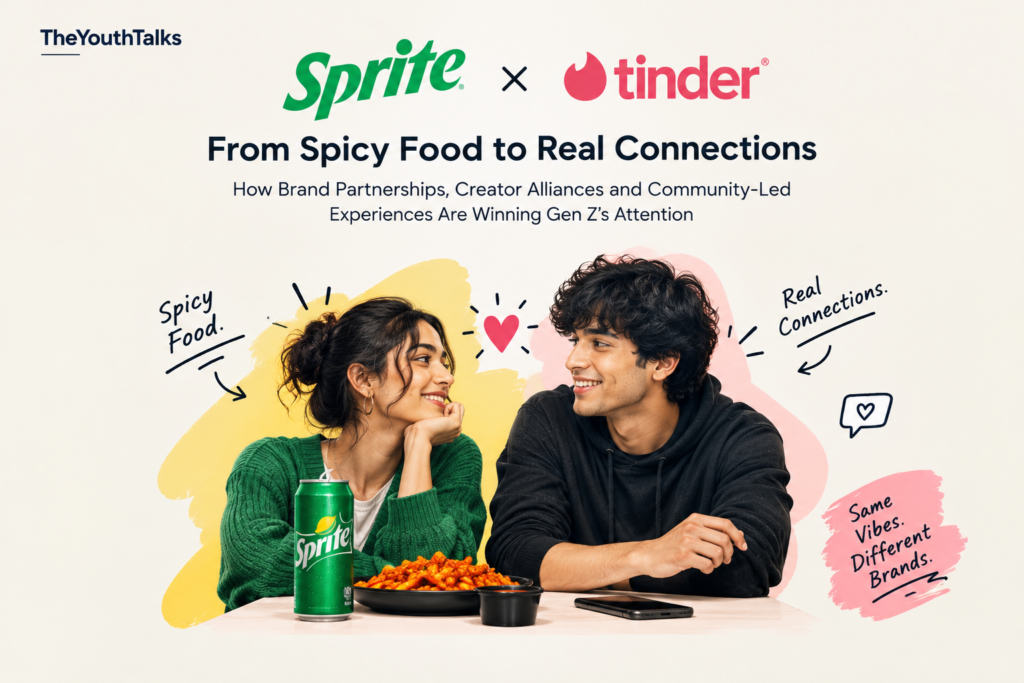
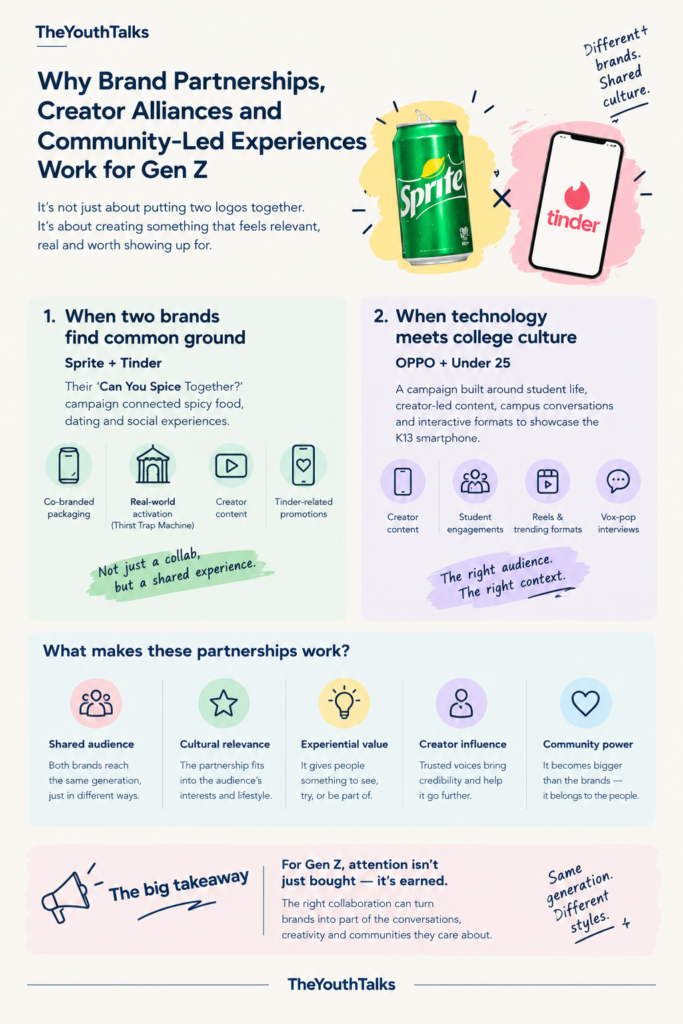
Their European collaboration, Can You Spice Together?, brought the brands together around spicy food, dating culture and interactive experiences. The campaign included co-branded packaging, a real-world activation called the “Thirst Trap Machine”, creator content and Tinder-related promotional features.
In India, a separate Sprite digital series, Truth & Spice, has also featured episodes presented in association with Tinder, according to industry reporting in September 2026.
The interesting part is not simply that two brands shared a logo. It is that they found a cultural space where their identities could intersect.
For marketers trying to engage Generation Z, that distinction matters. In a crowded media environment, brands cannot always expect young consumers to make room for another advertisement. But a well-designed collaboration can give them a reason to participate in something they already find interesting.
The opportunity is to stop treating attention as something brands can buy and start thinking about how they can earn it together.
Why collaboration matters now
India’s creator economy provides an indication of how much the landscape is changing.
A 2025 Boston Consulting Group report estimated that India’s 2–2.5 million monetised creators influenced $350–400 billion in consumer spending. It projected that creator-influenced consumption could exceed $1 trillion by 2030.
These are estimates of spending influenced by creators, not a measure of sales attributable to any single campaign. Nevertheless, they show why marketers are increasingly looking beyond conventional advertising to creators, communities and cultural partnerships.
Source: BCG, From Content to Commerce: Mapping India’s Creator Economy.
The underlying opportunity is straightforward. A brand may have a product, a marketing budget and a distribution strategy. Another brand may have a complementary audience. A creator may have earned a community’s trust. A youth platform may understand the conversations taking place on college campuses.
A collaboration can bring these strengths together.
But collaboration is not automatically effective. Two large brands appearing in the same advertisement do not necessarily create a compelling reason for consumers to care. The partnership must make sense to the audience, not just to the marketing teams that negotiated it.
1. When two brands find common ground: Sprite and Tinder
Sprite and Tinder offer a useful example of how apparently unrelated brands can meet around a shared cultural context.
The European Can You Spice Together? campaign connected spicy food with dating and social interaction. Its activations gave consumers something to experience, rather than simply asking them to notice two logos.
The Indian Truth & Spice association offers a related but distinct example of how the brands can use spicy-food challenges and candid conversations to create entertainment.
The lesson is not that every beverage brand should partner with a dating app. It is that brands should look beyond their product categories to identify occasions, interests and behaviours they share with their intended audiences.
A beverage can be part of a social occasion. A dating app is concerned with making connections. Food challenges and playful conversations provide a bridge between the two.
For marketers, the question becomes: what does the partnership allow the audience to do, experience or enjoy that neither brand could deliver as naturally on its own?
That is a more useful starting point than asking whether the two logos will look good together.
2. When technology meets college culture: OPPO and Under 25
In June 2025, OPPO India partnered with youth-focused platform Under 25 to promote its K13 smartphone through a campaign rooted in college culture, creator-led content, vox-pop interviews, trend-led reels and interactive formats.
The partnership was designed to connect the product with the way young Indians discover and discuss technology, rather than relying exclusively on conventional product advertising.
Source: PTI, OPPO India collaborates with Under 25 to roll out a Gen Z-first digital campaign for K13.
The strategic logic is worth examining. A smartphone brand has technical features to communicate: battery life, camera performance, processing power and design. But students may encounter those features in the context of their everyday lives—recording college events, creating videos, gaming or communicating with friends.
A youth platform can help connect the product’s functional benefits to those situations.
This is where partnerships with college communities, student organisations and youth-focused platforms can be valuable. They offer a way to understand local context and create participation around the product.
For marketers, however, access should not be confused with influence. A campaign reaching students does not automatically establish that they trust the brand or intend to purchase its product. Those outcomes need to be measured separately.
3. When a smartphone brand enters a passion community: realme and Hip Hop India
Another example comes from realme’s collaboration with Amazon MX Player around the second season of Hip Hop Indiain 2025.
The partnership placed the smartphone brand inside a dance and entertainment property, using show integrations, product placements, promotional content and opportunities to demonstrate features such as camera capability, processing power and gaming performance.
According to the platform’s published case study, the campaign delivered an 8.7% increase in brand awareness and a 13.9% increase in purchase intent, based on its reported measurement. These are campaign-specific results, not a guarantee that sponsorship produces similar outcomes for every brand.
Source: Amazon Ads, realme GT 7’s Amazon MX Player campaign.
The important idea is that the brand did not have to manufacture an entirely new reason for young people to engage. It entered an entertainment environment that already had a cultural proposition.
The partnership also connected entertainment to the product. A smartphone’s camera, speed and gaming features could be demonstrated in a setting where performance and creativity were relevant.
This offers marketers a useful distinction: sponsorship is most valuable when the brand can contribute to the experience, not merely place its name on it.
4. When entertainment becomes the bridge: Maybelline and The Archies
Brand collaborations can also connect a product to a cultural moment.
Maybelline’s partnership with the Netflix film The Archies combined beauty products, the film’s retro aesthetic, celebrity associations and a multi-platform promotional campaign aimed at young consumers.
A 2025 WARC case study reported that the campaign achieved a 15% increase in sales of regular products and a 30% increase in website traffic, alongside improvements in brand awareness. These are reported campaign outcomes and should be understood in the context of the case study’s methodology.
Source: WARC, Maybelline: The Archies x Maybelline – A glamorous retro revolution.
The collaboration illustrates how entertainment can create a context for product discovery. A film has its own visual identity, characters and audience; a beauty brand has products that can be integrated into that world.
When the association feels natural, the product can become part of the wider experience rather than an interruption to it.
The risk, of course, is that the cultural moment may attract more attention than the product. A successful launch, trending hashtag or celebrity appearance is not sufficient evidence of lasting brand preference.
Marketers need to establish whether the collaboration helped consumers discover, remember or choose the product.
What makes a Gen Z collaboration work?
These examples point to four practical principles.
First, start with the audience, not the partner. Identify a genuine interest, need or behaviour among the young consumers you want to reach. Choose partners because they help you serve that interest—not simply because they have large followings.
Second, create something worth participating in. This might be a useful demonstration, an entertaining experience, a creative challenge or a community-led initiative. A logo exchange can generate visibility; an engaging experience gives people a reason to remember it.
Third, make the connection credible. Consumers should be able to understand why the brands belong together. If the partnership requires a lengthy explanation, or the product feels awkwardly inserted into the experience, the idea may be stronger on a presentation slide than in the real world.
Fourth, measure what matters. Track reach and engagement, but also examine brand recall, consideration, qualified traffic, trials and sales where appropriate. Establish the objective before the campaign begins and compare outcomes against a suitable baseline.
The opportunity for Indian marketers
India offers a particularly broad canvas for collaboration. Brands can work with creators, campus communities, gaming groups, music and entertainment properties, regional-language storytellers and organisations that already understand specific youth audiences.
But there is no single Gen Z culture that every brand can tap into. Interests, spending power and aspirations vary across cities, languages and consumer segments. A collaboration that resonates with one community may mean very little to another.
The answer is not to pursue every trend or partner with every popular creator. It is to identify where a brand has something meaningful to contribute and find partners who can help bring that contribution to life.
The most effective collaborations may not always involve the biggest names. Sometimes a smaller, highly relevant community can provide a more credible environment for product discovery than a much larger but less connected audience.
For marketers, that means treating collaboration as a strategic discipline rather than a campaign accessory.
Sprite and Tinder are a reminder that brands do not need to share a product category to find common ground. OPPO and Under 25 show how technology can be brought into college culture. realme and Hip Hop India illustrate the potential of passion-led entertainment. Maybelline and The Archies demonstrate how products can connect with a wider cultural moment.
Each takes a different route, but the underlying question is the same: what can these partners create together that makes the experience more relevant to the audience?
Gen Z does not owe brands its attention. Collaboration offers a way to earn some of it—by making the brand part of something young consumers already want to discover, discuss or experience.
The future of youth marketing may not belong only to brands that speak louder. It may belong to those that find the right people, communities and cultural spaces to speak with.