
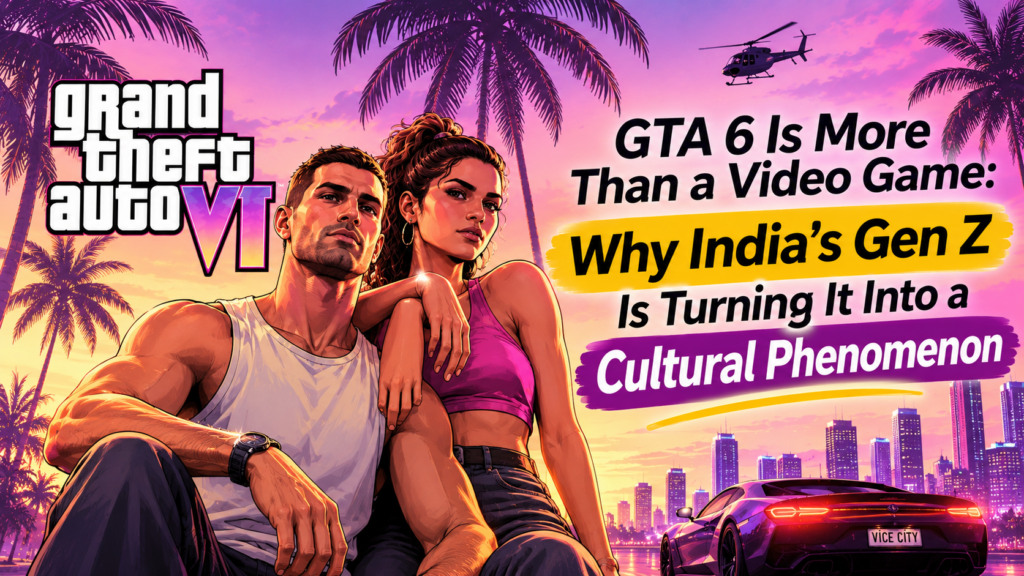
After a 13-year wait, Grand Theft Auto VI has arrived with billion-dollar expectations, millions of online views and an unexpected Indian connection. With more than 1,600 developers reportedly contributing from Bengaluru, the game’s biggest impact could extend beyond gaming into content creation, technology careers and India’s growing digital entertainment economy.
There are video games that people play, and then there are video games that become part of popular culture. Grand Theft Auto has managed to do both.
For millions of Indians who grew up in the 2000s, GTA Vice City and GTA San Andreas were more than entertainment. They were experiences shared with friends, played in cybercafes, discussed in college corridors and revisited long after the original games had been released.
More than a decade after the launch of Grand Theft Auto V in 2013, Rockstar Games has returned with its next major instalment, Grand Theft Auto VI. And the excitement surrounding the release suggests that this is no ordinary gaming launch.
The scale of anticipation is reflected in the commercial expectations surrounding the game, the millions of views being generated by gaming creators and the growing attention being paid to its development.
But there is another reason why GTA 6 deserves attention in India.
A significant part of the game’s development has reportedly involved more than 1,600 developers at Rockstar India’s Bengaluru operations. The contribution places Indian talent within one of the most closely watched entertainment projects in the world.
For Gen Z, GTA 6 represents something bigger than a new gaming experience. It brings together gaming, digital entertainment, internet culture, content creation and the growing possibility of building careers around interactive media.
The question is no longer simply why young Indians want to play GTA 6. It is why an entire generation is watching, discussing, streaming and building businesses around a video game.
From Vice City to GTA 6: A generation has grown up with the franchise
To understand the excitement surrounding GTA 6, it is important to understand the relationship India has developed with the franchise.
For millennials, GTA Vice City was often an introduction to open-world gaming. The ability to explore a virtual city, drive different vehicles, discover missions and interact with an environment without following a fixed sequence of activities was revolutionary.
San Andreas expanded that experience further, creating a world in which players could explore different neighbourhoods, customise characters and spend hours discovering things beyond the central storyline.
India Today Tech’s June 2026 feature on the franchise’s Indian history describes how GTA became part of the country’s gaming DNA, particularly through PC gaming and the affordability of older titles.
The transition from cybercafes and physical game discs to online gaming communities and livestreaming changed how people experienced the franchise.
GTA V, released in 2013, took the experience further. Its online ecosystem, modifications and roleplay communities created opportunities for gamers to build their own stories within the game.
For many Indian gaming creators, GTA gradually became a content format in its own right.
Now, GTA 6 arrives at a time when the audience has evolved from players sitting in front of computer screens to communities watching gaming content across YouTube, livestreaming platforms and social media.
The franchise has effectively grown alongside an entire generation of Indian internet users.
The Bengaluru connection: 1,600 Indian developers behind a global gaming phenomenon
One of the most interesting developments surrounding GTA 6 is the contribution of Indian technology and creative talent.
Bengaluru has long been associated with India’s IT and startup ecosystem. However, its contribution to global entertainment technology is another story that deserves greater attention.
According to the statement highlighted by Bengaluru MP Tejasvi Surya, more than 1,600 developers at Rockstar India’s Bengaluru studio have worked on a significant part of GTA 6.
The development also connects with the history of Dhruva Interactive, founded by Rajesh Rao in Bengaluru in 1995. The company became an important part of India’s early game development ecosystem before being acquired by Rockstar Games in 2019.
The significance of this contribution goes beyond the number of people involved.
Modern AAA games require expertise across several disciplines, including 3D modelling, animation, environment creation, quality assurance, technical art, programming and game production.
Indian studios have increasingly become part of these global development pipelines.
The FICCI-EY Media and Entertainment Report 2026 also identifies Rockstar India’s contribution to GTA 6 as an example of India’s growing participation in high-end global game development and co-creation.
For Indian Gen Z, this opens up a different way of looking at the gaming industry.
A video game is not simply a product created by a handful of programmers. It is the outcome of large multidisciplinary teams combining technology, art, storytelling, design and engineering.
For students studying computer science, animation, visual effects, design and related disciplines, projects of this scale demonstrate the range of careers that exist within the global gaming ecosystem.
The Bengaluru connection also challenges the assumption that Indian technology professionals primarily contribute to software services or enterprise technology.
They are increasingly participating in the creation of global entertainment experiences.
Why is GTA 6 expected to generate Hollywood-sized business?
The financial expectations surrounding GTA 6 are extraordinary.
One of the News18 reports examines the possibility of the game generating more than $1.5 billion and potentially outperforming some of Hollywood’s biggest blockbusters.
While the actual development budget has not been officially disclosed by Rockstar, estimates running into billions of dollars have circulated around the project.
To understand the commercial expectations, consider what happened with its predecessor.
Grand Theft Auto V generated $1 billion in worldwide retail sales within its first three days of release in 2013, according to figures reported at the time by Take-Two Interactive.
The franchise has since become one of the biggest commercial properties in the global entertainment industry.
The expectations surrounding GTA 6 are also connected to the changing economics of entertainment.
A major Hollywood film typically generates revenue through theatrical releases, streaming rights, licensing and other commercial arrangements.
A major video game can generate revenue through initial purchases, subsequent editions, downloadable content, online ecosystems and long-term player engagement.
The commercial life of a successful game can extend over several years.
This is one reason why GTA 6 is being discussed alongside the world’s biggest entertainment releases rather than simply as another software launch.
India is also part of this conversation, although affordability and access remain important considerations.
The game is available on PlayStation 5 and Xbox Series X|S, with India Today reporting launch pricing of ₹5,999 for the Standard Edition and ₹7,499 for the Ultimate Edition.
That is a significant purchase for many young Indians, particularly students who may not have their own disposable income.
The console requirement adds another layer of expense.
Consequently, the number of Indians watching GTA 6 content could be considerably larger than the number who can immediately purchase and play the game.
And that brings us to perhaps the most interesting part of the story.
India’s gaming creators are turning GTA into entertainment
For a growing number of Indian youngsters, gaming is no longer limited to playing.
It is also something they watch, discuss, react to and increasingly consume as entertainment.
The popularity of gaming creators such as Techno Gamerz, CarryMinati, Mythpat, Live Insaan and others demonstrates how gaming content has developed its own audience in India.
GTA has been particularly important in this evolution.
The game’s open-world format allows creators to experiment with challenges, characters, missions, humour and storytelling.
GTA roleplay has taken this further by allowing players to create characters and participate in virtual communities with their own narratives.
Rather than simply watching someone complete a mission, audiences follow characters, relationships, conflicts and unexpected developments.
The format can resemble an episodic entertainment series.
A November 19, 2026 Moneycontrol report highlights how Indian creators are already generating significant attention around GTA 6.
CarryMinati’s GTA 6 video on CarryisLive had crossed 13 million views, while Mythpat’s livestream had generated more than 12 million views at the time of reporting.
These numbers demonstrate that gaming is competing for attention alongside conventional digital entertainment.
Importantly, viewers do not necessarily need to own the game to participate in the excitement.
They can watch a livestream, follow a creator’s experience, discuss discoveries and engage with gaming communities.
The creator becomes an important part of the gaming experience.
For Gen Z, this changes the definition of entertainment consumption. They are not simply consuming a finished product. They are following people who interpret, personalise and extend the experience.
GTA roleplay: When a video game becomes a storytelling platform
One of the biggest developments in the Indian GTA ecosystem has been the popularity of roleplay communities.
In conventional gaming, the player follows the rules and objectives established by the developer.
Roleplay creates another possibility.
Players assume different identities within the virtual world. They can become police officers, business owners, criminals, taxi drivers or other characters and interact with other players.
The resulting experiences can be unpredictable.
The audience might follow a creator’s character over several livestreams, becoming invested in the relationships, conflicts and evolving storylines.
Indian gaming communities have already experimented with this format.
S8UL Esports, for example, has developed SoulCity as a GTA roleplay ecosystem where creators build characters and narratives.
This is an important distinction because it suggests that the value of a game is not restricted to the experience designed by its developer.
The community can create an additional layer of entertainment around it.
GTA 6 could potentially expand this opportunity, although the extent of its roleplay ecosystem will depend on the game’s eventual online features, creator tools and support for community experiences.
For aspiring creators, the opportunity may not always require being the best gamer.
It could be about being a good entertainer, storyteller or community builder.
That is a very different proposition from traditional competitive gaming.
India’s 525 million gamers: But can everyone participate in GTA 6?
The excitement surrounding GTA 6 arrives at a time when India has one of the world’s largest gaming populations.
The FICCI-EY Media and Entertainment Report 2026 estimates India’s gamer base at approximately 515–525 million in 2025, with a projection of around 548 million for 2026.
However, the size of India’s gaming audience should not be confused with the size of its premium gaming market.
A substantial proportion of Indian gamers access games through smartphones. Casual and social gaming formats account for a significant part of participation.
GTA 6, on the other hand, currently requires a current-generation console.
This creates a significant access barrier.
The cost of the game is only one part of the purchase decision. A PlayStation 5 or Xbox Series X|S represents an additional investment, making the complete gaming experience expensive for many college students and young professionals.
The absence of a confirmed PC release date is another important factor for India’s PC-heavy gaming community.
This creates an interesting contradiction.
Millions of young Indians can participate in the GTA 6 conversation through YouTube and other digital platforms, but a much smaller segment can immediately experience the game themselves.
In other words, GTA 6 could become a mass entertainment phenomenon in India without becoming a mass-market gaming purchase.
For gaming brands and hardware companies, this distinction is important.
The audience interested in gaming content is not necessarily identical to the audience willing or able to spend money on premium gaming hardware.
Is gaming becoming a career aspiration for Gen Z?
The growing popularity of GTA 6 also raises a larger question about career opportunities.
For earlier generations, gaming was often considered a recreational activity, with limited recognition as a serious career pathway.
That perception is changing.
The gaming ecosystem now supports a range of professional opportunities, including game development, programming, animation, character design, sound engineering, esports management, content creation, community management, event production and gaming marketing.
The Bengaluru development connection is particularly relevant here.
A project involving thousands of developers demonstrates how global gaming companies require a combination of technical and creative capabilities.
At the same time, the rise of Indian gaming creators has opened another professional pathway.
Young people can build audiences around gaming content, livestreaming, commentary, entertainment and community-led formats.
However, it is important to distinguish between a visible success story and a sustainable career opportunity.
Not every gaming creator will build a large audience, and content creation requires consistency, commercial understanding and considerable effort.
Similarly, game development requires specialised technical and creative skills.
The opportunity is real, but it is not an easy shortcut to earning money.
For students exploring technology and creative careers, GTA 6 could nevertheless become a useful reference point for understanding how multiple disciplines come together to create a global entertainment product.
Gaming, creators and brands: A new entertainment opportunity
The commercial implications of GTA 6 extend beyond Rockstar Games.
For brands, the game offers an opportunity to understand how deeply gaming communities are integrated into young people’s entertainment habits.
Gaming creators have audiences that return regularly, follow ongoing narratives and engage with communities.
This creates opportunities for brand integrations, livestream sponsorships, creator collaborations, gaming events and interactive campaigns.
Unlike conventional advertising, gaming-related marketing can become part of an ongoing entertainment experience.
However, brands need to understand the audience before entering these communities.
A sponsorship that feels disconnected from the creator or gaming environment can be counterproductive.
There is also a distinction between marketing to people who play games and marketing to people who watch gaming content.
Both audiences are valuable, but their motivations and behaviours can be very different.
For companies looking to connect with India’s younger consumers, the GTA 6 phenomenon offers an opportunity to understand gaming as a broader entertainment and community ecosystem.
GTA 6 is a cultural moment, not just a launch
Perhaps the most interesting aspect of GTA 6 is the way it connects different generations.
For millennials, the franchise brings back memories of Vice City, San Andreas and the early days of PC gaming.
For Gen Z, it arrives in a completely different digital environment, where gaming creators, livestreams, online communities and social media are integral to the experience.
For Indian developers, it represents an opportunity to participate in the creation of one of the world’s most ambitious entertainment properties.
For aspiring creators, it offers another opportunity to build audiences around gaming, storytelling and digital entertainment.
And for the gaming industry, it demonstrates how a successful franchise can remain relevant for more than a decade while generating enormous anticipation for its next instalment.
There is also a larger lesson for India’s digital economy.
The country has a massive gaming audience, a growing pool of development talent and an increasingly sophisticated creator ecosystem.
The next opportunity may lie in connecting these three strengths.
GTA 6 may have been created by a global team, but its Indian story is significant.
It is a reminder that young Indians are not just consumers of global entertainment. They are also helping build it, distributing it, creating communities around it and finding new careers within the ecosystem.
The real question, therefore, is not just how many Indians will play GTA 6.
It is how many young Indians will find their next opportunity because of it.