





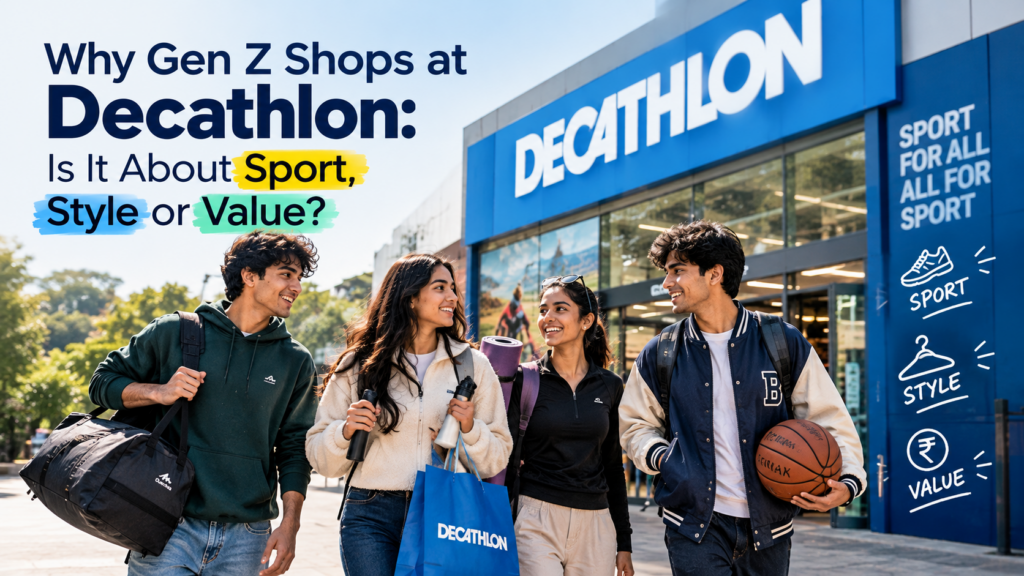
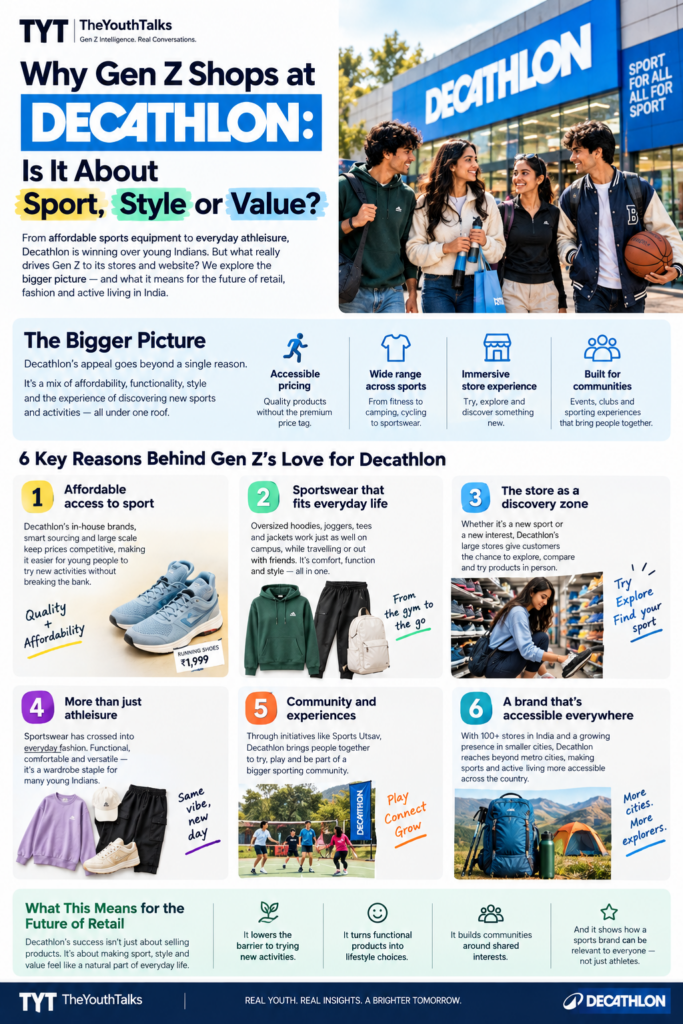
From affordable sports equipment to everyday athleisure, Decathlon is benefiting from a shift in how Indians approach fitness, fashion and leisure. Its appeal to younger consumers may lie in the space between what they need, what they can afford and how they want to live.
A pair of running shoes does not necessarily begin with a running goal. A sweatshirt bought for the gym may end up becoming a college staple. A visit to a sports store to pick up a badminton racket can turn into an afternoon spent exploring camping gear, cycling accessories and fitness equipment.
These everyday possibilities help explain why Decathlon occupies an interesting position in India’s retail landscape. The French sporting goods retailer has built a business around making products for multiple sports accessible under one roof. But its proposition increasingly intersects with something broader: the way young Indians dress, spend their leisure time and think about staying active.

For Generation Z, the attraction may not be limited to sport itself. It could also be about affordability, comfort, experimentation and the freedom to explore activities without committing to an expensive lifestyle.
The question, therefore, is not simply why young consumers buy from Decathlon. It is whether the brand is selling sports equipment, everyday utility or an accessible version of an aspirational lifestyle.

From a sports store to a wider retail proposition
When Decathlon entered India in 2009, organised access to sporting goods was more fragmented than it is today. Consumers looking for equipment for a particular sport often had to navigate specialist neighbourhood shops or pay premium prices for products from established international brands.
Decathlon introduced a different model: a broad selection of products across sports, its own product brands, large-format stores and a focus on balancing functionality with affordability. An analysis published by India Briefing in September 2025 identified these elements, alongside local sourcing and digital expansion, as important parts of the company’s India strategy.

The significance of this model goes beyond offering customers more products to choose from. It reduces the effort involved in discovering a sport. A first-time cyclist, amateur badminton player or aspiring trekker can explore equipment without necessarily entering a premium specialist retail environment.
Decathlon’s official Indian store locator lists more than 100 stores and describes experience stores as offering approximately 5,000 products across 60 sports. Its smaller Connect format provides a more limited range, with additional products accessible through its wider network.
This combination of physical retail and digital access gives the brand multiple ways to reach consumers. The store helps customers discover and evaluate products; online channels can extend access beyond the items stocked at a particular location.
For younger shoppers who are still figuring out their interests, that breadth can be valuable. They do not need to know exactly which sport they want to pursue before entering the store.
Value: Making it easier to get started
Price is an important part of Decathlon’s proposition, particularly in a market where affordability can influence whether someone participates in an activity at all.
Starting a new sport can involve several purchases: footwear, clothing, equipment and accessories. For a college student or someone beginning their career, these costs can quickly become a barrier. An accessible entry-level option makes experimentation more practical.
Decathlon’s business model helps it compete on this front. Its emphasis on in-house brands, product design and sourcing allows it to approach categories differently from companies whose positioning relies heavily on premium branding. India Briefing’s analysis also highlights the role of local sourcing and supply-chain adaptation in its Indian operations.
Value, however, should not be reduced to the lowest possible price. A product that performs adequately, lasts through repeated use and serves more than one purpose can offer a more compelling proposition than a cheaper alternative that needs frequent replacement.
This is particularly relevant to products such as basic sports shoes, training apparel, backpacks and fitness accessories. Consumers may assess them not just by how they look on the shelf, but by how often they expect to use them.
For Gen Z, the potential appeal is straightforward: spending on an interest without necessarily spending at a premium-brand price point.
That does not mean all young consumers prioritise affordability equally, or that Decathlon wins every purchase on price. Rather, its model gives shoppers an additional option between unbranded products and expensive specialist labels.
Style: When sportswear leaves the gym
One of the most interesting developments in apparel is the growing overlap between sportswear and everyday clothing.
A recent Hindustan Times feature, published on August 21, 2026, explored this shift through a conversation with Decathlon India’s Sports Director, Hans Peter Jensen. The article described the growing use of performance-inspired footwear, breathable fabrics, relaxed silhouettes and oversized clothing beyond conventional sporting settings.
This matters because clothing designed for physical activity can also fit into everyday routines. Joggers, sweatshirts, lightweight jackets and comfortable trainers can be worn to college, while travelling or during casual outings.
For younger consumers, the distinction between gymwear, streetwear and casualwear may be less rigid than traditional retail categories suggest. A product can serve a functional purpose and still fit a preferred personal style.
Decathlon is well positioned to participate in this crossover, although it is not the only brand competing for it. Nike, Adidas, Puma, specialist activewear labels and fashion retailers all offer products that combine comfort and appearance.
The competitive question is whether consumers see Decathlon’s apparel as stylish enough for everyday use while retaining the practical benefits associated with sportswear.
That is a different challenge from selling a product designed for a specific sporting activity. A customer shopping for running shoes may prioritise cushioning, fit and durability. Someone buying sneakers for everyday wear may place greater emphasis on appearance, versatility and how the shoes work with the rest of their wardrobe.
The same product can appeal to both groups, but the reasons for buying it may be different.
The experience: Shopping as discovery
Decathlon’s large stores offer something that can be difficult to replicate through an online product listing alone: the opportunity to browse a wide range of activities and try selected products in person.
The format encourages exploration. Customers can compare equipment, examine product features and discover categories they had not originally intended to shop for. The store can become a destination rather than simply a place to complete a planned purchase.
This approach also connects with Decathlon’s emphasis on sports participation. In May 2026, the company reported that its Sports Utsav initiative brought more than 200,000 participants across 60 Indian cities into activities hosted through 125 stores, with over 650 sporting events and experiences conducted across two days. These figures were reported by the company in a press release distributed through PR Newswire.
The initiative illustrates how a sporting goods retailer can extend its presence beyond transactions and into participation. Community runs, cycling activities, racket sports and fitness sessions give people opportunities to experience activities rather than simply purchase the equipment associated with them.
For younger consumers, this could be particularly relevant when trying something unfamiliar. Buying equipment is one decision; finding the confidence, motivation or social setting to use it is another.
A retailer that helps reduce both barriers has an opportunity to build a relationship that extends beyond an individual purchase.
However, event participation should not automatically be interpreted as evidence of long-term customer loyalty. The more important question is whether these experiences encourage people to take up activities, return to stores and continue buying products over time.
More than an athlete’s wardrobe
The broader opportunity for Decathlon lies in the fact that consumers do not have to be committed athletes to find its products useful.
Someone may purchase a backpack for college, a fleece for winter, a pair of trainers for walking or a bottle for everyday use. These purchases may have little to do with formal participation in sport, even if the products originate in a sporting goods portfolio.
This gives the brand a wider addressable set of occasions. It can serve the person who runs regularly, the student who plays badminton occasionally and the consumer who simply wants comfortable, functional products.
For Gen Z, this creates the possibility of entering the brand through one need and discovering other uses over time. A customer who first buys a basic T-shirt may later explore fitness accessories or outdoor equipment.
The opportunity is not unique to Decathlon. The wider apparel market is also seeing casualwear and athleisure blur the boundaries between categories. A report on India’s apparel market published by Financial Express in October 2026 identified casualwear as the largest apparel segment by consumption in 2025, with demand for comfortable and versatile clothing contributing to the shift.
The implication for retailers is that consumers increasingly evaluate products across situations rather than only within the category in which they are sold.
A sportswear product must compete not only with other sportswear, but sometimes with the everyday clothing already in a consumer’s wardrobe.
Is Decathlon a lifestyle brand for Gen Z?
There is a temptation to describe Decathlon as a lifestyle brand because its products can move between sport and everyday life. But that interpretation needs nuance.
A lifestyle brand typically sells more than utility: it can also represent identity, aspiration or membership of a particular community. Decathlon’s broad assortment and participation-led initiatives give it some of these characteristics, but its central proposition remains rooted in sports products and accessibility.
Its appeal may therefore be more practical than symbolic. Consumers can buy something useful without having to buy into an expensive sporting identity.
That distinction could be an advantage. Not every young consumer wants premium labels or highly curated fashion. Some want equipment that works, clothing they can wear repeatedly and the flexibility to explore an interest without making a large financial commitment.
Others may still prefer established sportswear brands for design, status or specific performance requirements. Decathlon does not need to win every consumer or every occasion to remain relevant.
Its challenge is to preserve the trust associated with functional value while responding to consumers who increasingly expect products to perform well and look good.
What brands can learn from Decathlon
Decathlon offers several lessons for companies trying to understand younger consumers in India.
First, accessibility can expand a category rather than simply redistribute existing demand. When products become easier to discover and afford, more consumers can consider trying an activity.
Second, utility and style do not have to be competing propositions. Products that work across multiple settings can justify their place in a consumer’s budget.
Third, the retail experience can help people discover needs they had not already identified. A store that encourages exploration may create demand in ways that a narrow product catalogue cannot.
Finally, community can give a brand a role beyond the transaction. Helping people participate in an activity creates a different kind of relationship from simply advertising the equipment required for it.
These principles are relevant well beyond sports retail. They apply to fashion, travel, fitness, consumer electronics and other categories where young people are balancing aspirations with practical budgets.
The verdict: Sport, style or value?
Decathlon’s appeal is unlikely to be explained by a single factor. Its range and product design help address functional needs; its price positioning makes experimentation more accessible; its stores encourage discovery; and the crossover between sportswear and casualwear creates additional everyday uses.
For some consumers, value may be the starting point. For others, a sporting interest or a preference for comfortable clothing may come first. The same customer may also have different motivations when buying shoes, winterwear and sporting equipment.
That is why the most useful way to understand Decathlon is not to force its appeal into a choice between sport, style and value. The three can reinforce one another.
The larger opportunity is that a brand built around sports can become relevant to people who do not necessarily think of themselves as athletes. If it makes trying an activity easier, provides products that work in everyday life and remains accessible to consumers at different spending levels, it can occupy a space that extends beyond traditional sports retail.
For India’s younger consumers, the question may not be whether they are shopping at Decathlon because they love sport, fashion or a good deal.
It may be that the brand gives them a way to pursue all three without having to choose just one.
TYT takeaway: The most important lesson from Decathlon is how a functional retail proposition can stretch into everyday consumer behaviour. Its opportunity with young Indians lies not merely in selling sports products, but in making sport, comfort and exploration feel more accessible.