




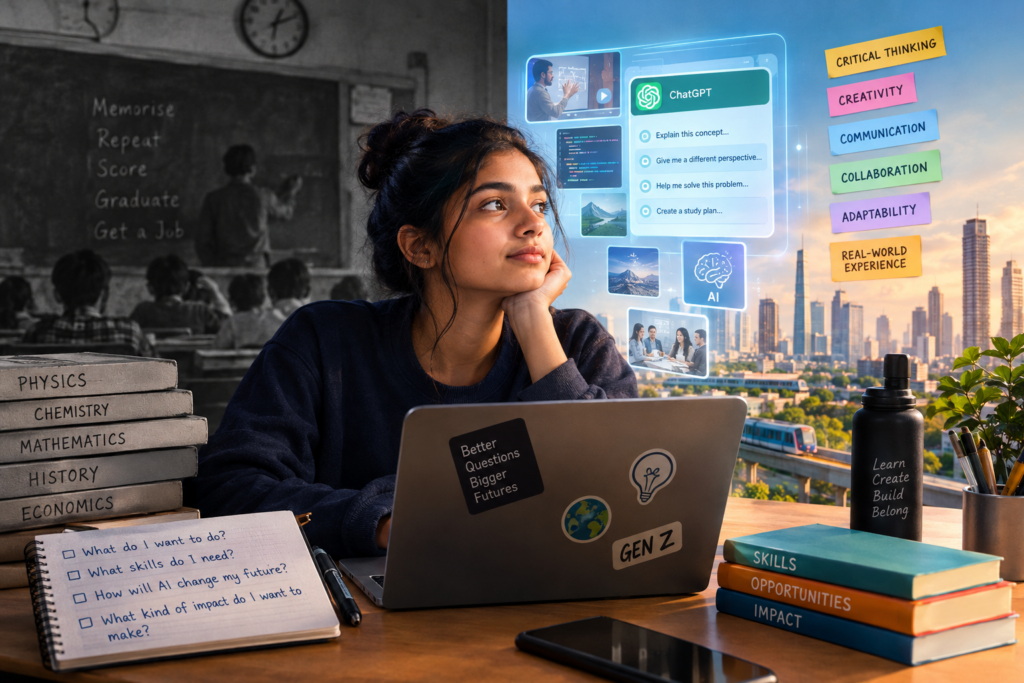
Gen Z isn’t rejecting education. It is entering a world where information is abundant, careers are changing faster, and the value of learning increasingly depends on what students can do with knowledge.
For generations, education operated on a relatively simple bargain.
Go to school. Study hard. Get good grades. Go to college. Earn a degree. Find a job. Build a career.

The formula was never perfect, but it was understandable.
Today, that formula is beginning to look less certain.

A student can learn coding from YouTube, understand a difficult concept through an AI tutor, take a university course from another country, build a portfolio without waiting for a degree and use generative AI to turn an idea into a working prototype in hours.
At the same time, employers are asking for skills that many traditional curricula struggle to teach: analytical thinking, creativity, adaptability, communication, technological literacy and the ability to keep learning.

The World Economic Forum’s Future of Jobs Report 2025 estimates that 39% of workers’ existing skill sets could be transformed or become outdated between 2025 and 2030. It also identifies AI and big data, networks and cybersecurity, technological literacy, creative thinking and lifelong learning among the skills rising in importance.
So perhaps the question isn’t whether traditional education is “failing” Gen Z.
Perhaps the more uncomfortable question is this:
If information is no longer scarce, what exactly should education be responsible for teaching?
The classroom was built for a different world
The traditional classroom was designed around scarcity.
Teachers had knowledge. Textbooks contained knowledge. Libraries contained knowledge. Students were expected to absorb that knowledge and demonstrate that they had retained it.
Technology has changed the equation.
A student today can ask an AI system to explain a physics concept in three different ways. They can watch a video demonstration, find a discussion by another student, practise with an interactive tool and ask follow-up questions until the concept makes sense.
The problem is no longer simply access to information.
The problem is knowing what to do with it.
That is a very different educational challenge.
And it is one that cannot be solved simply by putting more technology into classrooms.
UNESCO’s recent work on AI and education makes a similar distinction. Its approach argues for human-centred, equitable use of AI rather than treating technology as a substitute for education itself. UNESCO has also developed AI competency frameworks for both students and teachers, covering areas such as human-centred thinking, ethics, AI applications and system design.
In other words, the future isn’t necessarily a classroom without teachers.
It may be a classroom where teachers do something different.
From remembering answers to asking better questions
For decades, academic success has often depended on the ability to remember.
Remember the formula.
Remember the date.
Remember the definition.
Remember the process.
But AI changes the value of simple recall.
When a machine can retrieve, summarise or generate information almost instantly, human value increasingly shifts towards judgement.
Is this information correct?
What is missing?
Which answer is better?
What question should I be asking?
Can this idea actually work in the real world?
What are the ethical consequences?
These are harder questions.
And they are precisely the questions education needs to become better at asking.
This does not mean facts no longer matter. They do. A student cannot think critically about a subject they know nothing about.
But knowledge and memorisation are no longer the same thing.
The goal should not be to create students who can reproduce the textbook perfectly.
It should be to create students who can understand, question, connect and apply what they know.
The Gen Z student doesn’t necessarily want less education
This is where the conversation around Gen Z often goes wrong.
There is a tendency to portray young people as impatient students who don’t want lectures, don’t want exams and don’t want to work hard.
That is too simplistic.
A student preparing for an engineering entrance examination can spend years working towards one goal.
A medical student can commit to an extraordinarily demanding academic journey.
A young founder can work through the night building a product.
A student preparing for a competitive government examination can spend months studying material that has little immediate entertainment value.
The issue isn’t that young people don’t want to learn.
They increasingly want to understand why they are learning something and where it will take them.
That distinction matters.
Gen Z is growing up in an environment where the relationship between education and employment is becoming more complicated.
A degree still matters enormously. But increasingly, so do portfolios, projects, internships, communication skills, digital fluency and evidence of what someone can actually do.
For young Indians, this tension is particularly visible.
The question isn’t simply:
“What degree should I get?”
It is becoming:
“What will this degree allow me to do?”
The college-to-career bridge needs rebuilding
For many students, the biggest frustration isn’t the classroom itself.
It is what happens after the classroom.
A student can spend three or four years completing a degree and still discover that employers expect practical experience they never had the opportunity to acquire.
They may have completed examinations in programming without building a meaningful software project.
Studied marketing without running a campaign.
Studied finance without managing a real budget.
Studied design without working with a real client.
Studied journalism without publishing consistently.
Studied business without ever having to sell anything.
There is an enormous difference between knowing about something and being able to do it.
Education needs to close that gap.
That could mean more industry projects, apprenticeships, internships, student-led ventures, research, community projects and interdisciplinary challenges.
A student studying economics could work with a small business.
A computer science student could build a solution for a local problem.
A communications student could work on a real campaign.
An engineering student could be given an actual problem rather than another theoretical assignment.
The objective isn’t to turn every classroom into a corporate training centre.
It is to make learning more connected to reality.
AI makes this shift even more urgent
Generative AI has introduced an uncomfortable problem for education.
If a student can ask AI to write an essay, solve a mathematical problem, create a presentation or generate code, what does an assignment actually measure?
The easy response is to ban AI.
But that won’t solve the underlying problem.
Students are entering workplaces where AI will increasingly be part of how work gets done.
UNESCO’s guidance recognises both sides of this challenge: AI can support personalised learning and expand educational opportunities, but it also creates concerns around inequality, privacy, safety, ethics and over-reliance.
The answer, therefore, may not be to keep AI outside the classroom.
It may be to teach students how to use it without becoming dependent on it.
Imagine an assignment where students are allowed to use AI but must disclose how they used it.
Imagine an examination where the question isn’t “Can you produce an answer?” but “Can you evaluate three AI-generated answers and explain which one is strongest?”
Imagine students being assessed on how they challenge an AI system’s assumptions.
That would test something much closer to the skills they will need outside college.
The teacher’s role will matter more, not less
There is another misconception worth challenging.
If AI can tutor students, will teachers become unnecessary?
Probably not.
In fact, the opposite may happen.
When information becomes abundant, good guidance becomes more valuable.
A teacher can notice that a student has stopped participating.
A mentor can understand why someone lacks confidence.
A professor can challenge an argument.
A teacher can push a student beyond the answer they initially thought was sufficient.
AI can provide information.
Education must also provide context, judgement, relationships and human connection.
UNESCO has similarly emphasised that teachers remain fundamental because AI cannot replicate the human understanding involved in students’ emotions and socialisation.
The future teacher may therefore spend less time being the person who has all the answers and more time being the person who helps students ask better questions.
That is not a smaller role.
It may be a more important one.
We also need to stop treating every student as the same
The traditional education system often operates on a common template.
Same syllabus.
Same classroom.
Same pace.
Same examination.
Same definition of achievement.
But students aren’t identical.
One student may be brilliant at mathematics and terrible at public speaking.
Another may struggle with conventional examinations but excel when given a real-world problem.
Another may discover an entrepreneurial instinct at 18.
Another may want to become a researcher.
Another may need more time to understand a concept but eventually develop a deeper understanding of it.
Personalised education doesn’t mean giving every student a completely different school.
It means creating more room for different ways of learning, exploring and demonstrating competence.
Technology can help with that.
But technology alone cannot create it.
The philosophy of education has to change first.
And access cannot become an afterthought
There is one major danger in all this optimism about AI-powered education.
The future classroom cannot become a luxury available only to students who can afford the best devices, connectivity, tools and private institutions.
If AI improves education, it must improve access too.
Otherwise, the same technology that promises to democratise learning could widen the gap between students who have access to high-quality digital tools and those who don’t.
UNESCO has repeatedly warned that AI adoption in education must address equity, inclusion, privacy and safety rather than allowing technological progress to deepen existing inequalities.
For India, that question is especially important.
The future of education cannot be designed only around students in India’s best-funded schools and colleges.
It has to work for the student in a Tier-2 city.
The student in a government college.
The student whose first language isn’t English.
The student who has a smartphone but not a laptop.
The student whose college doesn’t have a sophisticated placement office.
Technology can help close these gaps.
But only if access is treated as infrastructure, not privilege.
So, what should education actually teach?
Perhaps the answer is simpler than we think.
Education should still teach knowledge.
It should still teach mathematics, science, history, literature, economics and technology.
But around that foundation, it needs to build something bigger.
How to think.
How to communicate.
How to collaborate.
How to solve problems.
How to distinguish fact from fiction.
How to use technology responsibly.
How to work with AI without surrendering judgement to it.
How to learn something new when the thing you learned yesterday becomes obsolete tomorrow.
That last skill may be the most important of all.
The World Economic Forum’s 2025 research points towards precisely this combination: technology skills are rising rapidly, but creative thinking, resilience, flexibility, analytical thinking, leadership and collaboration remain critical.
The future worker won’t be purely technical.
Nor will they succeed simply because they possess “soft skills.”
They will need to combine the two.
The real education revolution may be about redefining success
For a long time, education measured success through marks.
Then came degrees.
Then rankings.
Then placements.
Now, perhaps, we need a broader definition.
Can a student think independently?
Can they build something?
Can they work with others?
Can they communicate an idea?
Can they use technology intelligently?
Can they adapt when their original plan fails?
Can they continue learning without being told what to learn next?
These are harder things to measure than marks.
But they may be much closer to what determines whether a young person thrives in the real world.
Gen Z isn’t asking education to become easier.
It is asking education to become more relevant to the world it is actually entering.
And that world is changing quickly.
AI is changing the workplace. Employers are redefining skills. Careers are becoming less linear. Knowledge is becoming easier to access. The value of continuous learning is rising.
Education cannot remain frozen while everything around it moves.
The answer isn’t to throw away the classroom.
It is to rethink what happens inside it.
Because if AI can increasingly provide answers, education’s greatest responsibility may no longer be teaching young people what to think.
It may be teaching them how to think, what to question, what to create — and when not to trust the answer in front of them.
Gen Z doesn’t need an education system designed for the world their parents entered.
They need one that prepares them to build the world they are about to inherit.