






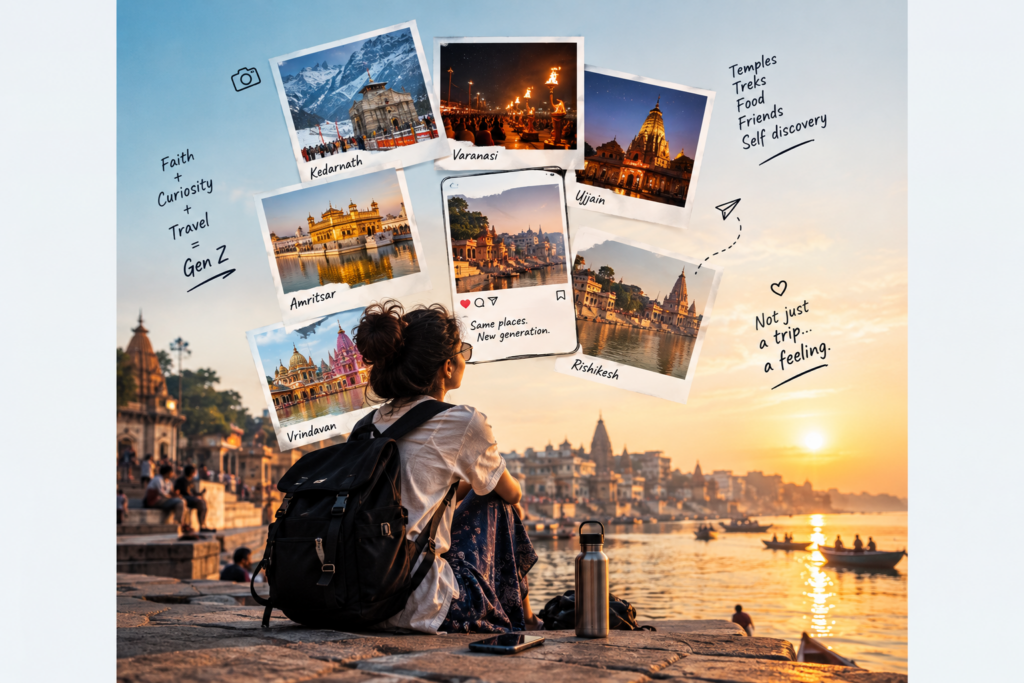
For a generation that grew up with Instagram, food delivery apps, Spotify playlists and weekend getaways, the traditional pilgrimage may seem like an unlikely travel choice.
And yet, India’s young travellers are increasingly heading to temples, ghats, gurudwaras, monasteries and mountain shrines.
They are travelling to Varanasi. They are making the journey to Kedarnath. They are lining up at Mahakaleshwar in Ujjain. They are visiting the Golden Temple in Amritsar, exploring Rishikesh and travelling to Tirupati.

Sometimes they go because of faith.
Sometimes because their families have always gone.

Sometimes because they are curious.
Sometimes because they need a break from the noise of everyday life.

And, yes, sometimes they first discover the destination through an Instagram Reel.
Recent travel data suggests this isn’t a fringe phenomenon. According to FY26 data from redBus, Gen Z and young travellers accounted for more than 53% of journeys to spiritual destinations in India. The same data points to strong younger participation on routes such as Bengaluru–Tirupati, Hyderabad–Tirupati, Rishikesh–Delhi and Indore–Ujjain.
That changes the way we should look at spiritual travel.
Gen Z isn’t necessarily abandoning modern travel for traditional pilgrimage.
It may be doing something more interesting.
It is mixing the two.
A temple visit can become a road trip. A pilgrimage can become a trek. A spiritual destination can become a cultural exploration. A family tradition can become a personal experience.
And the journey may begin with a scroll.
Here are 10 spiritual destinations that are finding a particularly strong resonance among India’s younger travellers.
1. Varanasi: Where the Feed Meets the Faith
If there is one Indian city that perfectly captures the changing face of spiritual travel, it is Varanasi.
Kashi has been a centre of faith for centuries. But its appeal to younger travellers extends well beyond the temple.
There are sunrise boat rides on the Ganga, evening aartis, narrow lanes, local food, music, architecture, photography, conversations with locals and an atmosphere that is difficult to replicate anywhere else.
And then there is social media.
A young Indian may first encounter Varanasi through a Reel of the Ganga at sunrise or a video of the evening aarti. But once they arrive, the experience can become much larger than the content that brought them there.
Research from the Delhi School of Economics has found young visitors to Varanasi increasingly engaging with the city through experiences such as walking, photography, local food, interaction with residents and riverside experiences alongside more conventional spiritual activities.
That makes Varanasi particularly interesting for Gen Z.
They don’t necessarily have to choose between spirituality and exploration. Kashi gives them both.
2. Ujjain: Mahakal, Ritual and the Experience Economy
Ujjain has always been an important pilgrimage destination.
But the experience of visiting the city is changing.
Mahakaleshwar is obviously at the centre of the journey, but younger travellers are also encountering the redesigned Mahakal Lok, the city’s visual spectacle, its food, its streets and the larger cultural experience surrounding the temple.
The Bhasma Aarti, in particular, has become one of those experiences that young travellers discover online long before they experience it in person.
Ujjain also benefits from something Gen Z understands particularly well:
an experience that can be experienced, photographed, remembered and shared.
But reducing the visit to Instagram would be unfair.
For many young travellers, the attraction is the ritual itself—the feeling of being part of something much older than themselves.
That combination of ancient tradition and contemporary discovery makes Ujjain one of the more interesting examples of India’s changing spiritual travel landscape.

3. Kedarnath: The Pilgrimage That Became a Personal Challenge
Kedarnath is perhaps the clearest example of how pilgrimage can become an adventure for Gen Z.
The destination is spiritual, but getting there is also physically demanding.
There is a trek. There are mountains. There is unpredictable weather. There is the feeling of pushing your body beyond its comfort zone.
For some young travellers, that becomes part of the attraction.
Recent reporting has highlighted younger couples and travellers choosing Kedarnath not simply as a religious obligation but as a journey of curiosity, challenge and introspection.
The smartphone may be in the backpack.
The Instagram Story may come later.
But for several hours on the trail, the experience can become surprisingly offline.
Perhaps that is part of the appeal.
In a generation constantly connected to screens, a journey that demands walking, waiting and enduring can feel like a reset.
Kedarnath isn’t just about reaching the temple. For many young travellers, the journey itself becomes the experience.
4. Rishikesh: Spirituality Without the Formality
If Varanasi represents India’s ancient spiritual identity, Rishikesh represents a more fluid, contemporary version of it.
Yoga, meditation, the Ganga, ashrams, cafés, hostels, rafting, trekking and wellness retreats coexist here.
That makes Rishikesh particularly compatible with the way Gen Z travels.
A young traveller might come for yoga, spend an afternoon rafting, sit beside the Ganga in the evening, explore cafés at night and leave with a very personal understanding of what “spiritual travel” means.
There is no requirement to experience the city in only one way.
And perhaps that is exactly why it works.
For Gen Z, spirituality doesn’t necessarily have to look formal.
It can mean meditation.
It can mean nature.
It can mean silence.
It can mean sitting beside a river for an hour without doing anything.
Rishikesh allows all of those interpretations to coexist.
5. Amritsar: Faith, Food and Community
The Golden Temple offers a very different kind of spiritual experience.
It is visually striking, but its appeal isn’t simply aesthetic.
The sense of community, the langar, the music, the architecture and the atmosphere of collective participation make the experience distinct.
For young travellers, Amritsar also offers something that matters increasingly in travel: a destination with layers.
You can visit the Golden Temple, experience langar, explore the city’s history, eat local food and visit sites such as Jallianwala Bagh and the Wagah-Attari border in the same trip.
The result isn’t simply a pilgrimage.
It is a cultural journey.
And that distinction matters because Gen Z increasingly appears comfortable with spirituality being part of a broader experience rather than the only purpose of travel.
6. Ayodhya: A New Destination for a New Generation
Ayodhya has undergone a remarkable transformation in the public imagination.
The opening of the Ram Mandir turned the city into one of India’s most visible religious destinations, while improved connectivity and infrastructure have made it increasingly accessible to travellers.
For Gen Z, Ayodhya is also a destination discovered through a very modern information ecosystem.
Videos, Reels, travel guides and creator content have brought the city’s transformation into millions of screens.
But the appeal isn’t only digital.
For many young Indians, Ayodhya represents a significant part of India’s cultural and religious identity.
For others, it is simply a place they want to see for themselves.
That distinction is important.
Young Indians do not always travel with a single motivation.
Faith, curiosity, culture and the desire to experience a major national moment can all exist in the same journey.
7. Vrindavan: Where Devotion Meets Youth Culture
Vrindavan has long been associated with Krishna devotion.
But the town has also become increasingly visible among younger travellers, particularly around festivals such as Holi.
The colours, music, temples, streets and devotional atmosphere make Vrindavan one of India’s most visually distinctive spiritual destinations.
For Gen Z, the experience can be deeply social.
Friends travel together. Photos are taken. Videos are created. Music becomes part of the experience.
But underneath the spectacle is a very old tradition.
That contrast is what makes Vrindavan fascinating.
A young person can arrive looking for an experience they have seen online and leave having encountered a religious tradition that is far more complex than a 30-second Reel can communicate.
8. Tirupati: Tradition That Has Gone Digital
Tirupati is one of India’s most established pilgrimage destinations, and its popularity among young travellers is not exactly a new phenomenon.
What is changing is how the journey is organised.
Digital booking, online information, mobile navigation and travel platforms have made pilgrimage planning considerably more accessible to younger travellers.
The Bengaluru–Tirupati and Hyderabad–Tirupati corridors are among those showing particularly strong younger demand.
That matters because it challenges an old stereotype of pilgrimage as something organised entirely by parents or grandparents.
Gen Z can now research the destination, plan transport, book accommodation and manage parts of the pilgrimage experience independently.
The faith may be ancient.
The infrastructure around the journey is increasingly digital.
9. Haridwar: The Familiar Pilgrimage Gets a Younger Audience
Haridwar is hardly a new destination.
Millions have travelled there for generations.
But its proximity to Delhi and other North Indian cities, combined with its connection to the Ganga and easy access to Rishikesh, makes it particularly relevant to younger travellers.
For a college student or young professional, Haridwar can be part of a broader weekend journey.
A group of friends can travel together, attend Ganga Aarti, explore the city, eat local food and continue towards Rishikesh.
This is an important shift in how pilgrimage can work.
The spiritual destination doesn’t always have to be the entire trip.
It can be one chapter of the trip.
And perhaps that is increasingly how Gen Z approaches travel generally.
10. Bodh Gaya: A Different Kind of Spiritual Journey
Bodh Gaya gives us a reminder that India’s spiritual travel story is much broader than temple tourism.
Associated with the Buddha’s enlightenment, the destination attracts visitors interested in Buddhism, history, meditation and cultural exploration.
For young travellers, particularly those looking for something quieter, the experience can be very different from the intensity of major temple cities.
There is less emphasis on spectacle and more room for reflection.
And that makes it an interesting fit for a generation increasingly talking openly about burnout, mental health, mindfulness and the need to disconnect.
Spiritual travel doesn’t always mean seeking a dramatic religious experience.
Sometimes it simply means finding somewhere that allows you to slow down.
The Pilgrimage May Start With a Reel. But It Doesn’t End There.
There is an easy narrative to tell about all of this.
Gen Z sees a beautiful temple on Instagram.
They want the picture.
They book a ticket.
They go.
They post.
And they move on.
But that explanation is too simple.
Social media may influence where young Indians discover places, but it doesn’t fully explain why they return to them.
Recent reporting from India has repeatedly found younger travellers describing spiritual destinations in terms of peace, curiosity, belonging, cultural connection and emotional renewal. Research on young visitors to Varanasi similarly points towards experiences that combine spirituality with heritage, food, nature, photography and personal reflection.
The smartphone may get them to the destination.
It doesn’t necessarily determine what they feel once they arrive.
That distinction is important.
Because perhaps Gen Z isn’t making spirituality less serious.
Perhaps it is simply making the journey more personal.
From Pilgrimage to “Shrinecation”
There is a new kind of Indian travel emerging somewhere between the traditional pilgrimage and the modern holiday.
Call it a shrinecation.
It could involve a temple visit, a road trip, a trek, local food, a few photographs, a cultural experience and some time to simply switch off.
It might be planned around faith.
Or curiosity.
Or friendship.
Or a need for a mental reset.
Or all of them at once.
And that is perhaps what makes Gen Z’s relationship with spiritual travel so interesting.
They aren’t necessarily asking:
“Am I religious enough to go?”
They are asking:
“What might I experience if I go?”
That is a very different starting point.
India’s Sacred Destinations Are Entering a New Era
India’s temples, ghats, gurudwaras, monasteries and pilgrimage towns aren’t becoming relevant to Gen Z because they have suddenly become trendy.
They were always relevant.
What has changed is the way young Indians discover them, plan their journeys and talk about their experiences afterwards.
The pilgrimage can now begin with a Reel.
The itinerary can be built through Google.
The booking can happen on a phone.
The journey can be documented on Instagram.
And the memory can live on YouTube.
But somewhere between the notification and the temple bell, something else can happen.
A young traveller might find silence.
A family might rediscover a tradition.
A group of friends might experience something together.
Someone might simply stand beside the Ganga and realise they needed a break more than they knew.
That is the real Gen Z spiritual travel story.
India’s youngest travellers aren’t necessarily choosing between modernity and tradition.
They are carrying both with them.
And perhaps the most interesting thing about India’s new pilgrimage isn’t that Gen Z has started going to sacred places.
It’s that they are beginning to decide for themselves what the journey means.