





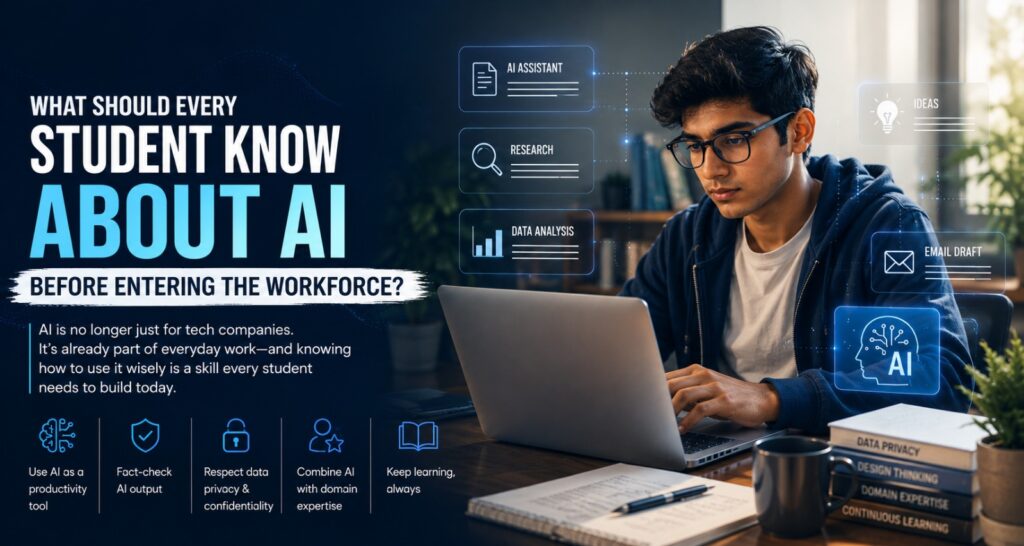
With regard to apprentices about to step into the workforce, it is essential to recognise that artificial intelligence is no longer limited to technology enterprises or the computer science domain. Rather, AI is integrated into everyday work activities, assisting people with creating emails, conducting analysis, making presentations, and conducting research. As AI becomes increasingly common, mastering the skill of working effectively with AI is becoming a professional necessity. Akshesh Shah, Founder and CEO of Cogniify.ai, emphasises that being ready to work with AI technology is not only about knowing how to write a good prompt, but also about discerning where AI is helpful and where human judgment is irreplaceable. Thus, the future workforce will not be confronted by AI; it will feature AI-aware people.
- Learn to use AI as a productivity tool, not a replacement for thinking: Students should never assume that AI will provide them with all the answers. AI may help generate ideas, summarise data, organise research, compose text, analyse facts, or perform repetitive tasks. When applied correctly, it can save considerable time, but productivity is not about becoming dependent on technology. The real benefit lies in employing AI to improve efficiency while retaining the human ability to exercise judgment and think creatively and critically.
- Fact-checking AI output is non-negotiable: Students should never assume that AI-generated information is always accurate. AI may help generate ideas, summarise data, organise research, compose text, analyse facts, or perform repetitive tasks. However, a student may ask AI to create a presentation but still needs to understand the topic, choose the relevant material, verify the information, and make the presentation their own. The real benefit lies in using AI to improve efficiency while retaining the human ability to exercise judgment and think creatively and critically.
- Understand data privacy and confidentiality: Although an AI tool can be highly beneficial, this does not mean that all kinds of information can be entered into it. In the workplace, students may encounter sensitive business information, customer information, financial documents, internal strategies, and personal data. Privacy is more than an information technology issue; it is part of professional responsibility. Responsible AI practices also emphasise the importance of privacy, security, transparency, and accountability in developing trustworthy AI.
- AI should complement domain expertise: AI technology can generate information that sounds credible even when it is inaccurate. It may also produce outdated information, invalid citations, or conclusions that appear credible but are, in fact, incorrect. Therefore, it is important for students to develop the habit of verifying information generated by AI before using it, especially in professional applications.
- Continuous learning will become part of the job: AI may be knowledgeable, but it does not understand the context of every industry, company, or situation without human intervention. Whatever a marketing professional knows about people or brand strategy will continue to be useful. Finance requires financial knowledge, just as design requires an understanding of visual communication. Some fields, such as healthcare, rely heavily on domain knowledge and professional judgment. Students should learn one of the most important lessons: learning does not stop after finishing school. The technologies, advantages, and tools available one year from now may no longer be the same as they are today. Solutions that are widely used today may look completely different in a year.
One does not need to be an AI professional to be prepared for the workplace of the future. Instead, one must become a careful and responsible user of AI technology. AI can certainly help reduce working hours, but it is human judgment, context, creativity, accountability, and the willingness to learn that will contribute most to the quality of work.
About the Author

Akshesh Shah is an AI entrepreneur and applied machine learning leader with extensive experience building scalable, production-grade intelligent systems. As Co-Founder and CEO of Cogniify.ai, he leads a stealth-mode venture focused on enterprise AI, responsible innovation, secure system design, and measurable business impact. He has held senior machine learning roles at Google, C3 AI, Fractal, and VideoAmp, where he has worked across NLP, LLM optimization, predictive modelling, anomaly detection, and industrial AI, delivering measurable improvements in areas ranging from operational efficiency and customer experience to cost savings and reduced downtime. Akshesh holds a Master’s degree in Mechanical Engineering with a specialization in Machine Learning from Arizona State University, where his research focused on adversarial machine learning and recommendation systems. Combining deep technical expertise with hands-on industry experience, he is passionate about building secure, ethical, and human-centric AI systems that augment human potential.