





For generations, skincare in India was a category built on familiarity. The products on a bathroom shelf were often the same ones mothers had used for years, recommended to their daughters and trusted without much questioning.
That relationship is changing.
Young Indian women are increasingly discovering skincare through social media, ingredient explainers, reviews and creators rather than simply following what their families have always bought. And the latest TheYouthTalks survey offers an interesting glimpse into just how far that shift may have gone.
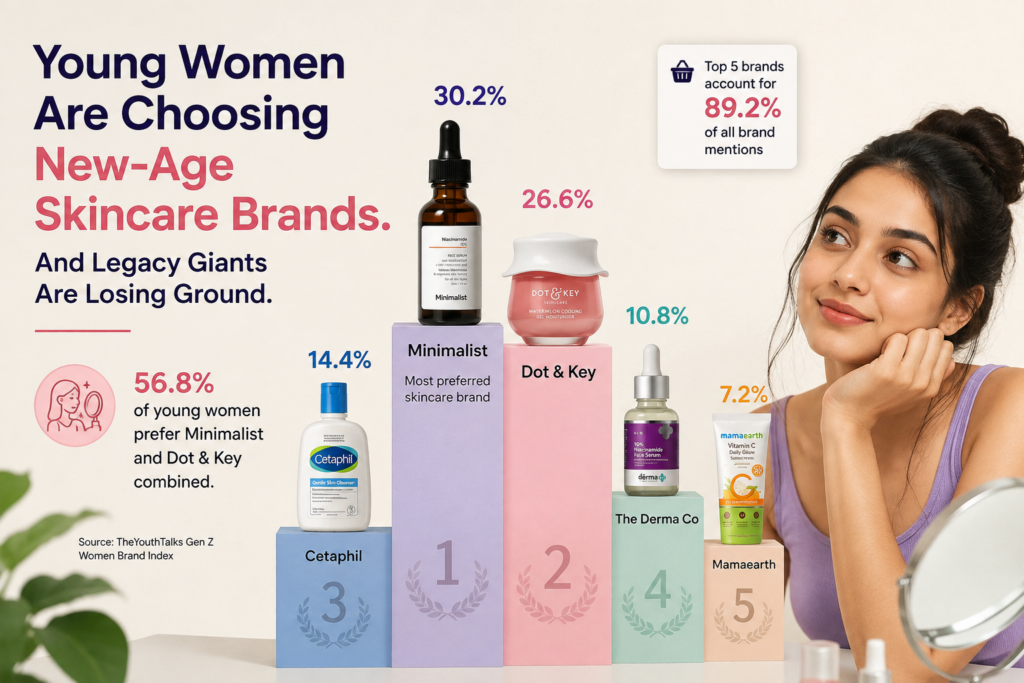
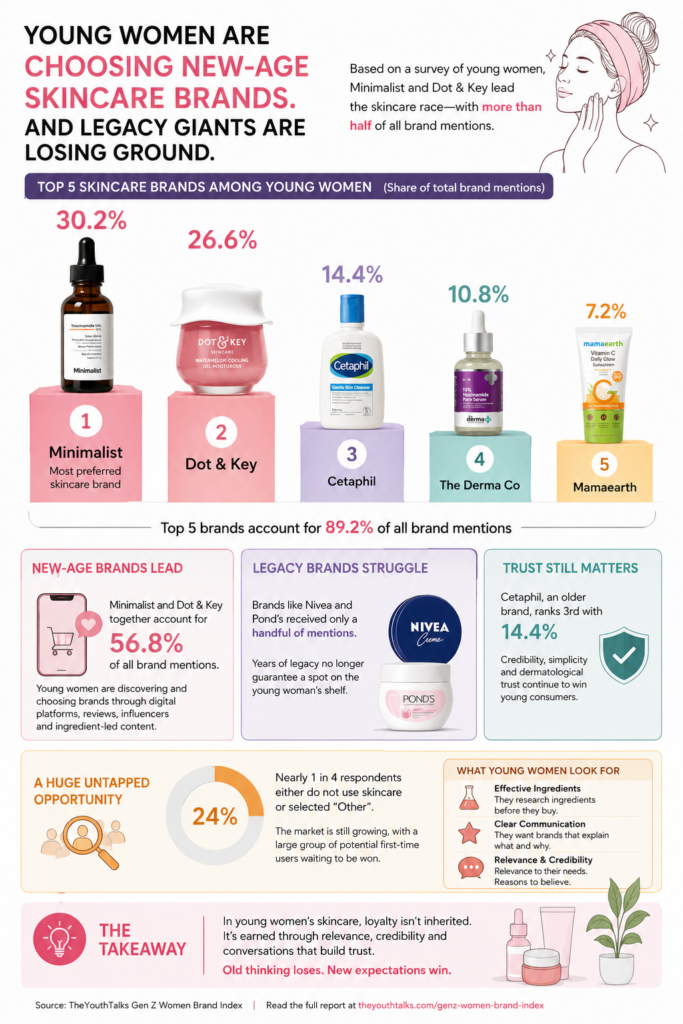
Among the brands named by respondents, Minimalist emerged as the most preferred skincare brand, with 30.2% of responses, followed closely by Dot & Key at 26.6%. Together, the two new-age brands accounted for 56.8% of all brand mentions.

For a category historically associated with household names, that is difficult to ignore.


The skincare shelf is being rewritten
The rise of Minimalist and Dot & Key reflects more than changing brand preferences. It signals a fundamental shift in how young consumers approach skincare.
Earlier, buying a skincare product could be relatively straightforward: pick a familiar brand, choose a product for your skin type and stick with it.
Today, the decision-making process can look very different.
A young consumer might discover a serum on Instagram, watch a YouTube review, search for its ingredients, compare it with two competing products and read customer feedback before making a purchase.
Even everyday skincare conversations have become more technical.
Niacinamide. Salicylic acid. Retinol. Ceramides. SPF. Skin barrier.
These terms have moved from dermatology clinics and beauty counters into everyday consumer vocabulary.
That creates a powerful advantage for brands that can explain their products clearly. Instead of simply selling the promise of “better skin”, they can tell consumers why a particular formulation is supposed to work.
Familiarity still matters — but it isn’t enough
Interestingly, the survey does not suggest that young women have abandoned established brands altogether.
Cetaphil ranked third, with 14.4% of responses, demonstrating that an older brand can still remain relevant with younger consumers. The Derma Co followed at 10.8%, while Mamaearth accounted for 7.2%.
Together, these five brands represented 89.2% of all brand mentions.
Cetaphil is particularly revealing because its proposition is not built around being the newest or trendiest brand in the market. Its strength lies in simplicity, dermatological credibility and a perception of efficacy.
That distinction matters.
Young consumers may not necessarily be rejecting legacy brands. They may simply be rejecting brands that fail to give them a compelling reason to choose them.
The real divide, therefore, may not be old versus new. It may be relevant versus irrelevant.
What happened to the household names?
Perhaps the most surprising part of the ranking is found at the other end.
Brands such as Nivea and Pond’s, both deeply embedded in Indian consumer culture, received comparatively few mentions in the survey.
Their challenge is not a lack of awareness. Quite the opposite.
Almost everyone knows these names.
But awareness and preference are no longer the same thing.
A brand can occupy a consumer’s memory without occupying her shopping cart. For younger audiences who have grown accustomed to researching products and questioning marketing claims, decades of existence may no longer provide the automatic advantage it once did.
There is another finding that deserves attention.
Nearly one in four respondents either said they do not use skincare or selected “Other.”
That suggests the market may be considerably less mature than the brand rankings initially imply.
The next major skincare success story may not necessarily come from persuading a Minimalist customer to switch to another serum. It could come from convincing someone who currently has no skincare routine that they need one in the first place.
For marketers, that changes the question from “How do we beat the market leader?” to “How do we grow the category?”
Young consumers are not loyal to history
The skincare market is ultimately revealing a broader truth about young Indian consumers.
They don’t automatically reward a brand because it has existed for 50 years. Nor do they automatically choose something new simply because it is new.
They want relevance, credibility, clarity and a reason to believe.
Minimalist currently leads the survey at 30.2%, but its advantage over Dot & Key is only 3.6 percentage points. In a fast-moving category shaped by creators, trends, product launches and changing consumer preferences, that lead can shift quickly.
The message for legacy skincare giants is therefore not to “act younger” for the sake of it.
It is to understand younger consumers better.
Because in today’s skincare market, loyalty isn’t inherited.
It is earned — one product, one recommendation and one credible conversation at a time.
This article is based on findings from TheYouthTalks’ latest research on brands preferred by young women. Read the full report: TheYouthTalks Gen Z Women Brand Index