






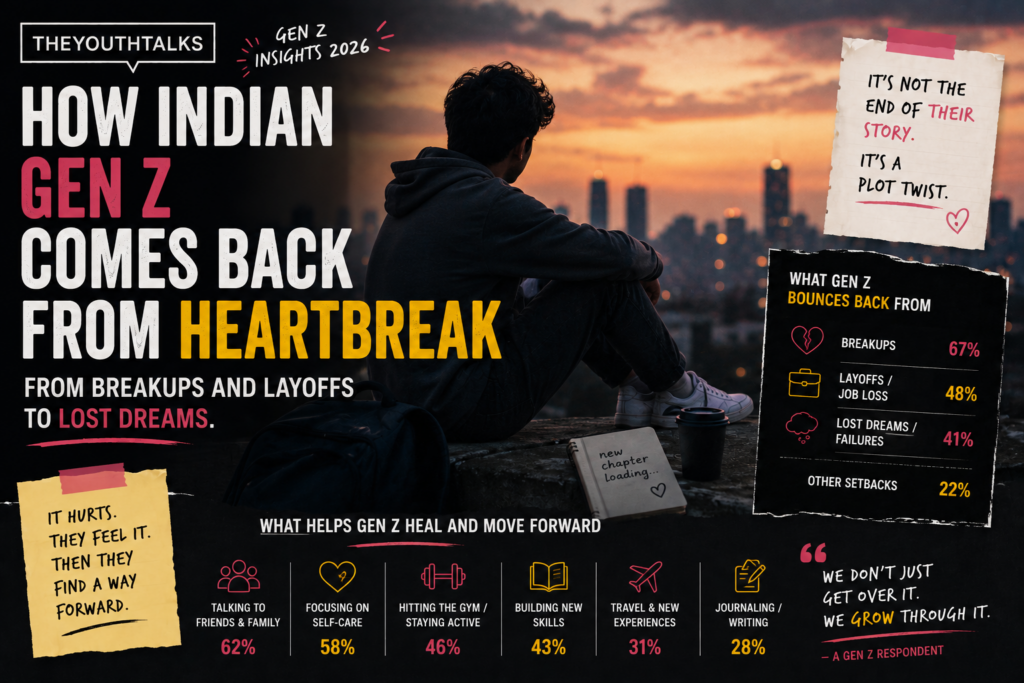
For India’s youngest generation, heartbreak isn’t always about an ex. It can be a failed exam, a lost job, a broken friendship, a family loss or the future they thought they were going to have. So how does Indian Gen Z actually recover?
There is a particular kind of heartbreak that doesn’t look like heartbreak.
It can arrive as an HR email.

A JEE result that doesn’t go the way you hoped.
A NEET score that isn’t enough.

A rejection from the university you spent months dreaming about.
A breakup your parents don’t even know about.

A best friend who suddenly becomes a stranger.
A startup that runs out of money.
Or a phone call telling you that someone you love is no longer coming back.
For Indian Gen Z, heartbreak has become a much bigger word than romantic disappointment.
And perhaps that makes sense.
This is a generation coming of age in a country where academic competition is intense, career paths are changing rapidly, relationships are becoming more complicated and social media provides a front-row seat to everyone else’s apparently perfect life.
A 21-year-old can be dealing with a breakup while preparing for an entrance exam, worrying about placements and watching a school friend announce a new job on LinkedIn.
The pain isn’t necessarily one dramatic event.
Sometimes, it is several disappointments arriving at once.
So how does Indian Gen Z come back?
Research on young people’s adjustment to breakups, grief and major life setbacks points towards a few recurring themes: talking to people, rebuilding routines, reducing avoidance, finding a sense of control and, increasingly, asking for professional help. A 2025 study of 560 adolescents and young adults aged 17–22, for instance, found that rumination and avoidance were associated with poorer adjustment following romantic breakups, while positive-attitude and problem-solving approaches were associated with better outcomes.
But the Indian experience adds another layer.
Sometimes the person you’re trying to recover from is also the person your parents expected you to marry.
Sometimes the job you lost was the reason you were finally going to become financially independent.
Sometimes the “dream” wasn’t entirely yours to begin with.
And sometimes healing means figuring out what you actually want.
In India, Heartbreak Often Has an Audience
One of the defining characteristics of heartbreak in India is that it rarely affects just two people.
A relationship can involve families.
A career decision can involve parents.
A failed exam can feel like a family event.
A job loss can be difficult to discuss at home because financial independence is often tied closely to adulthood and self-worth.
Consider a young person in their early twenties who has been dating someone for three years.
For them, the breakup isn’t simply:
I lost my boyfriend or girlfriend.
It may also mean:
I lost the person I thought I would marry.
And then comes the uncomfortable question from home:
“What happened to that person you were always talking about?”
There is no easy answer.
The relationship may have ended. The expectations surrounding it haven’t necessarily ended.
That is one reason Indian Gen Z’s recovery from romantic heartbreak can be more complicated than the simple Western idea of “move on.”
The breakup is personal.
The consequences can be social.
The First Person Gen Z Calls May Be a Friend
When something goes wrong, young Indians often turn first to their peer group.
The friend who knows the entire story.
The college roommate who has heard every detail.
The cousin who is close enough to understand but distant enough to remain outside the family drama.
The group chat that suddenly becomes an emergency counselling room at 1 a.m.
There is something deeply practical about this.
When you are hurting, you don’t always need someone to solve the problem. Sometimes you need someone to sit with the problem.
Research on young adults recovering from romantic breakups suggests that the way people cope can influence how well they adjust. The 2025 study mentioned above found that repeatedly dwelling on the breakup was associated with poorer outcomes, while more constructive, problem-solving approaches were linked to better adjustment.
In India, that peer network can be particularly important because many young adults still find it difficult to discuss romantic relationships openly with their parents.
Your friends may know the story long before your family does.
And sometimes, they are the people who help you survive the first week.
Then There Is the Digital Ex
Indian Gen Z has another problem previous generations never had to deal with at this scale.
The relationship can end.
The internet doesn’t.
The photographs remain on Instagram.
The WhatsApp chat remains.
Mutual friends continue uploading stories.
Old playlists survive.
And the algorithm occasionally decides that you should see the person you are desperately trying not to think about.
There is also the temptation to investigate.
Who are they following?
Have they moved on?
Why did they like that post?
Who is that person in their story?
A breakup can therefore become an endless cycle of information.
And sometimes the healthiest decision isn’t to understand more.
It’s to see less.
Mute.
Unfollow.
Archive.
Delete.
Block, if necessary.
For Indian Gen Z, digital boundaries are increasingly becoming emotional boundaries. The original research framing similarly identifies the continued digital presence of an ex as a distinct complication of modern breakups.
There is a strange irony here.
Technology makes it easier than ever to stay connected.
Sometimes healing requires the opposite.
Job Loss Can Feel Like Losing Your Identity
Romantic heartbreak gets most of the attention.
Career heartbreak may be just as significant.
Imagine a 23-year-old who has finally got their first job after years of education.
The salary isn’t extraordinary, but it represents something enormous:
independence.
They can contribute at home.
Buy something for their parents.
Pay their own bills.
Move into a better apartment.
Perhaps even stop asking for money.
Then comes the layoff.
Suddenly, the emotional loss isn’t simply unemployment.
It is the loss of identity.
The loss of routine.
The loss of financial independence.
And sometimes, the fear of having to tell your parents:
“I don’t have a job anymore.”
This is particularly relevant in India, where the first job can carry significance well beyond the workplace. It may represent the transition from student to adult, from dependent to independent.
A job title can become part of how a young person introduces themselves.
“I work at…”
It can feel strange when that sentence disappears.
Recovery therefore isn’t simply about updating a résumé.
It is about rebuilding a sense of competence.
One application.
One interview.
One freelance project.
One course.
One conversation at a time.
The first objective isn’t necessarily to “fix your career.”
It is to remind yourself that you are still capable of building one.
The Indian Student Has a Different Kind of Heartbreak
There is another category that deserves far more attention:
academic heartbreak.
India has built an enormous culture around competitive examinations and educational achievement.
For some students, an exam result doesn’t feel like one result.
It feels like a verdict.
A JEE rank.
A NEET score.
A CUET result.
A CAT percentile.
A UPSC attempt.
A college rejection.
Young people can spend years preparing for a single outcome.
When it doesn’t happen, the grief can be profound.
And because the disappointment is visible to everyone around them, it can be difficult to hide.
The student who didn’t make it into IIT may see classmates celebrating their admissions.
The person who missed their preferred medical college may watch school friends begin their first semester.
Someone who didn’t get the college they wanted may have to sit through relatives asking, “So, what happened?”
Then social media adds another layer.
Someone else’s celebration can become a reminder of your own disappointment.
That doesn’t necessarily mean you resent their success.
It means their success reminds you of the future you thought you were going to have.
The Heartbreak of a Dream You Didn’t Choose
This may be one of the most distinctly Indian forms of heartbreak.
The dream that belongs partly to your parents.
Become an engineer.
Become a doctor.
Get an MBA.
Clear the government examination.
Go abroad.
Get a “stable” job.
Buy a house.
Get married.
For many young Indians, adulthood arrives with a blueprint already prepared.
But Gen Z is increasingly questioning that blueprint.
And when a prescribed path fails, there can be an unexpected opportunity hidden inside the disappointment.
Perhaps the student who didn’t get into medical school discovers design.
Perhaps the engineer who gets laid off discovers entrepreneurship.
Perhaps the person whose relationship ends realises they had been designing their future around somebody else’s expectations.
Heartbreak can therefore become a strange form of identity discovery.
Not immediately.
Usually not pleasantly.
But sometimes, eventually.
The question changes from:
“Why didn’t I get what I wanted?”
to:
“What do I want now?”
That is a much harder question.
It can also be a much more important one.
When Grief Is More Than a Breakup
There is, of course, a form of heartbreak that cannot be reduced to career setbacks or relationship endings.
Loss.
The death of a parent.
A grandparent.
A sibling.
A close friend.
Someone whose absence permanently changes the shape of everyday life.
Young Indians are also developing new ways of grieving. Digital photographs, old WhatsApp messages, social-media profiles and online communities can keep memories of someone accessible long after they are gone.
That can be comforting.
It can also make grief complicated.
Research among bereaved college students has found that avoidant-emotional coping was associated with complicated grief, while problem-focused coping was associated with post-traumatic growth.
The lesson isn’t that people should simply “move on.”
Grief doesn’t work like that.
It is about finding ways to continue living while carrying what has happened.
Sometimes that means talking.
Sometimes writing.
Sometimes therapy.
Sometimes returning to ordinary routines.
And sometimes simply allowing yourself to have a bad day without interpreting it as failure.
India Is Becoming More Comfortable Saying “I’m Not Okay”
There is another important generational shift happening.
Mental health is no longer entirely confined to private conversations.
Therapy, counselling, emotional wellbeing, burnout and boundaries have entered mainstream vocabulary among young Indians, even though stigma, accessibility and affordability remain significant barriers.
That doesn’t mean Indian Gen Z is necessarily mentally healthier.
It means they may be more willing to name what they are experiencing.
“I’m not okay.”
That sentence matters.
For generations, emotional resilience was often confused with emotional silence.
You were expected to be strong.
Keep going.
Don’t talk about it.
Don’t make a fuss.
Indian Gen Z appears increasingly willing to challenge that model.
Talking about pain doesn’t eliminate it.
But it can prevent pain from becoming invisible.
So What Actually Helps Indian Gen Z Heal?
There is no universal formula.
But several patterns emerge.
Talk to someone
Don’t carry the entire story alone.
A trusted friend can sometimes provide the first bit of emotional stability when everything feels chaotic.
Get your routine back
Wake up.
Go to class.
Go to work.
Exercise.
Eat properly.
Meet people.
Do the boring things.
Routine can provide structure when your emotional world has none.
Stop checking
Your ex’s Instagram isn’t going to give you closure.
Neither is your former employer’s LinkedIn page.
Nor the admission list you already know you didn’t make.
Sometimes recovery begins by refusing to repeatedly reopen the wound.
Don’t make one setback your identity
You are not your exam rank.
You are not your salary.
You are not the person who rejected you.
You are not the company that laid you off.
You are not the relationship that ended.
These things can be part of your story without becoming the definition of your story.
Build something small
Indian Gen Z is often told to “figure out your life.”
That’s an impossible instruction when you’re already hurting.
Instead, figure out tomorrow.
Send one application.
Go for one walk.
Finish one assignment.
Call one friend.
Make one plan.
Small actions create momentum.
Momentum creates confidence.
And confidence eventually makes the future feel imaginable again.
Perhaps “Moving On” Is the Wrong Phrase
We use the phrase move on as though healing means forgetting.
But perhaps that’s not how heartbreak works.
You don’t necessarily stop caring about someone you loved.
You don’t forget the job that changed your life.
You don’t stop thinking about the college you wanted.
You don’t erase the dream you once had.
You simply reach a point where those things no longer control what happens next.
That may be the more useful definition of recovery.
Not forgetting.
Not pretending.
Not becoming stronger overnight.
Rebuilding the ability to imagine a future again.
For Indian Gen Z, that future can be particularly complicated.
It may involve parents, money, marriage, exams, careers, social expectations and the constant comparison machine of social media.
But perhaps this generation’s greatest advantage is that it is becoming increasingly comfortable admitting that life hurts.
And that admission matters.
Because a breakup isn’t necessarily the end of a love story.
A failed entrance exam isn’t necessarily the end of ambition.
A layoff isn’t necessarily the end of a career.
A friendship ending isn’t necessarily proof that you are difficult to love.
And losing a dream isn’t necessarily the end of the road.
Sometimes, heartbreak doesn’t give you your old life back.
It gives you the uncomfortable opportunity to build a different one.
You don’t always get to choose what breaks your heart. But, eventually, you get to decide what you build around it.