Some survey findings confirm what you expect.
Others make you stop, go back to the spreadsheet, and check the numbers one more time.
Banking was one of those findings.
When TheYouthTalks set out to understand the brands that resonate most strongly with young Indian women, there was an obvious assumption sitting quietly in the background: a generation that has grown up with smartphones, UPI, Instagram, quick commerce and app-based everything would probably gravitate towards a private-sector or digital-first bank.
The data had other plans.
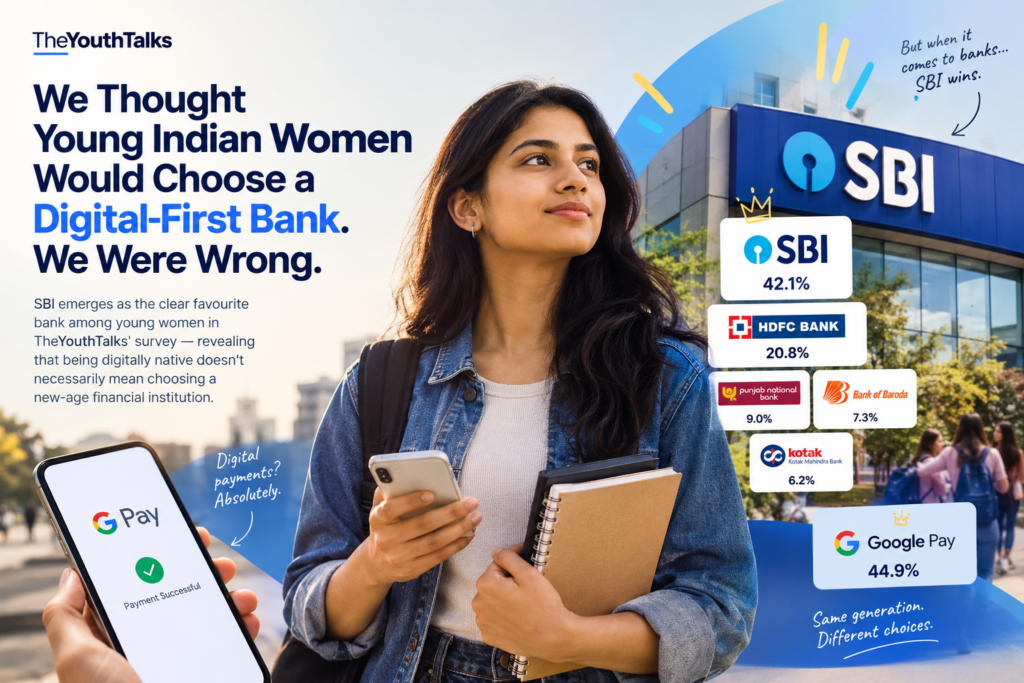
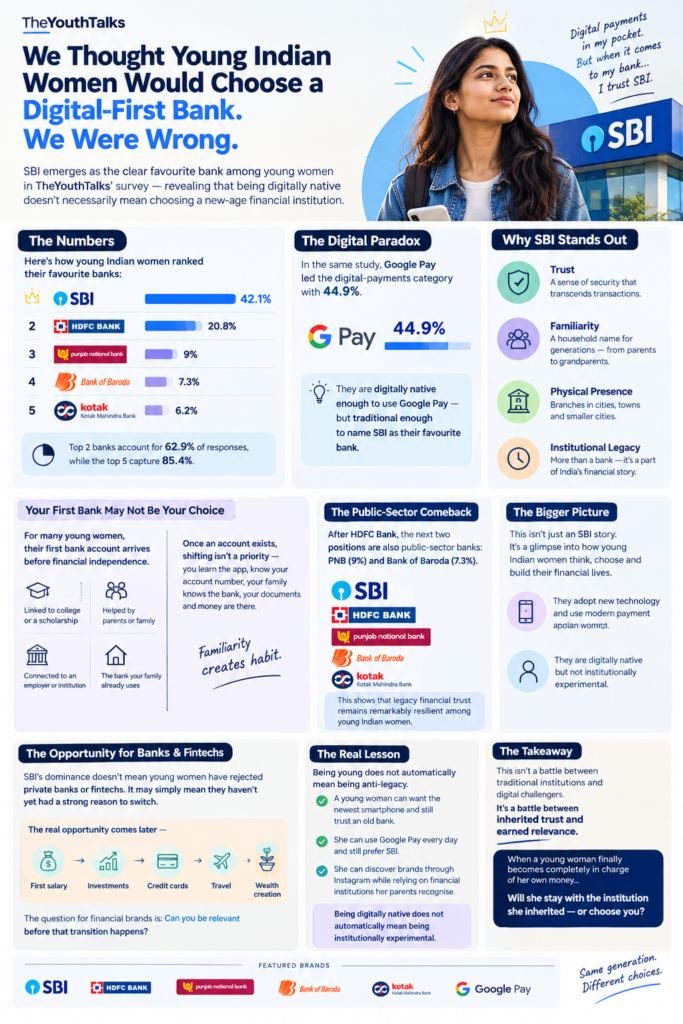
State Bank of India emerged as the clear favourite bank among young women surveyed, with 42.1% naming it as their preferred brand.
HDFC Bank followed at 20.8%. Punjab National Bank stood at 9%, Bank of Baroda at 7.3%, and Kotak Mahindra Bank at 6.2%.
That means the top two banks alone accounted for 62.9% of responses, while the top five captured 85.4%.
The result was surprising.
But the more interesting question isn’t why did SBI win?
It is this:
Why does a digitally native generation continue to place so much trust in a traditional financial institution?
The Digital-First Generation That Still Chooses a Traditional Bank
There is an apparent contradiction in the findings.
In the same broader study, Google Pay led the digital-payments category with 44.9% among the young women surveyed.
Put those two findings next to each other and the picture becomes fascinating.
The same consumer who is comfortable using a digital payment platform for everyday transactions is also significantly more likely to identify SBI as her preferred bank.
At first glance, that seems inconsistent.
It probably isn’t.
A payment platform and a bank may both sit inside the financial ecosystem, but they occupy very different psychological spaces.
Google Pay is a utility. It helps you pay for dinner, split a cab fare, send money to a friend or complete a purchase.
A bank is different.
A bank holds your savings. It is connected to your salary, education loan, credit history, investments and sometimes even your family’s financial history.
One is something you download.
The other can be something you inherit.
And that distinction matters enormously when trying to understand young Indian consumers.
Your First Bank May Not Actually Be Your Choice
Think about how many young people get their first bank account.
It may happen when they enter college.
Perhaps a parent takes them to a branch. Maybe the account is linked to a scholarship. It could be the bank where the family already has an account. Sometimes the institution is connected to an employer, educational institution or government programme.
The young consumer may technically become the account holder, but that does not necessarily mean she actively selected the bank.
Her relationship with the institution may have started before she had meaningful financial independence.
That creates a very different kind of brand relationship.
Imagine a young woman leaving her hometown for college. Her parents help her open an SBI account. Her scholarship gets deposited there. She learns the mobile banking application. Her family already knows the bank.
A few years later, she starts working.
She has a salary account. She starts investing. She gets a credit card. Perhaps she eventually takes a home or education loan.
At every stage, switching banks is possible.
But is there a compelling reason to do it?
That is the crucial question.
Convenience can create inertia. Familiarity can create loyalty.
And financial services are particularly susceptible to both.
SBI’s Advantage May Be Bigger Than Banking
The obvious explanation for SBI’s performance is trust.
But trust in this context is not simply about whether consumers believe a bank will safeguard their money.
It is also about familiarity.
SBI has been woven into the Indian financial landscape for generations. Its branches and branding are familiar to parents and grandparents. For consumers who grew up in smaller cities and towns, that physical and cultural presence can matter as much as the quality of a mobile application.
This gives SBI a form of brand equity that cannot simply be replicated by launching a beautifully designed fintech app.
A young woman can spend hours on Instagram.
She can order groceries in minutes.
She can discover a new fashion brand through a creator.
She can make a payment without carrying cash.
But when she thinks about where her money should formally reside, the name she has heard throughout her life can still carry enormous weight.
That is perhaps the most important lesson in this finding.
Digital behaviour and institutional behaviour do not necessarily evolve at the same pace.
The Public-Sector Banks Complicate the Story Further
If this were simply an SBI phenomenon, it would be easy to dismiss the result as the strength of one exceptionally powerful legacy brand.
But the rest of the ranking makes the finding more intriguing.
HDFC Bank occupies the second position at 20.8%.
Then come two more public-sector institutions: Punjab National Bank at 9% and Bank of Baroda at 7.3%.
Kotak Mahindra Bank follows at 6.2%.
Taken together, the ranking suggests that traditional banking relationships remain highly relevant to young Indian women.
The new-age financial ecosystem may have transformed how this audience pays, shops, saves and discovers financial products.
But that transformation has not necessarily displaced the institutions they associate with formal banking.
This distinction is easy to overlook.
Young consumers are often described as impatient, experimental and willing to switch brands quickly.
And in many categories, they probably are.
But banking is not food delivery.
If a new restaurant disappoints you, you order somewhere else tomorrow.
If you dislike a shopping app, another one is a download away.
Changing your primary financial relationship is psychologically different.
There are forms, documentation, account history, recurring payments, salary credits, family familiarity and years of accumulated financial behaviour.
The switching cost isn’t always monetary.
Sometimes, the biggest switching cost is simply the absence of a strong reason to switch.
The First Bank Is Inherited. The Second Bank Is Chosen.
This may be the most commercially interesting implication of the research.
SBI’s strong position should not automatically be interpreted as young women consciously rejecting private banks or fintech companies.
The data tells us what brands respondents named as favourites. It does not, by itself, establish why each individual chose that brand or whether she actively considered alternatives.
That distinction matters.
There is another possibility.
Many young women may simply not have reached the point where changing their banking relationship feels important.
Their first bank was established when someone else was helping make financial decisions.
Their second bank could be different.
The transition happens when income starts flowing regularly.
When the first salary arrives.
When investments begin.
When a credit card becomes useful.
When international travel enters the picture.
When someone starts thinking seriously about wealth creation.
When financial decisions move from “What does my family use?” to “What works for me?”
That is where the competitive opportunity becomes much larger.
The Real Battle May Begin After the First Salary
For private-sector banks and fintech companies, the implication is not necessarily that they need to win the first account.
They need to be present when the consumer begins exercising financial agency.
That could mean building products around first salaries, first investments, first credit cards, first international transactions or first serious savings goals.
And the proposition cannot simply be: We have a better app.
The consumer already lives in a world of excellent apps.
The harder challenge is earning enough trust to become the institution behind the app.
That requires a different kind of relationship.
A bank has to become useful without becoming intrusive. Modern without appearing frivolous. Personalised without becoming uncomfortable. Accessible without sacrificing credibility.
For young women especially, there may also be an opportunity around financial confidence and independence—not merely financial transactions.
The question is no longer only:
“Can we make banking digital?”
It is:
“Can we make young consumers want to move their financial lives to us?”
Being Young Does Not Mean Rejecting Legacy
Perhaps the biggest lesson from this finding extends well beyond banking.
There is a tendency in youth marketing to equate being young with being new.
That can be a dangerous assumption.
Young Indians may discover new brands faster than previous generations. They may be more comfortable experimenting with technology. Their media consumption is fundamentally different.
But that does not mean they reject legacy institutions across every category.
A young woman can want the newest smartphone and still trust an old bank.
She can use Google Pay every day and still prefer SBI.
She can discover brands through Instagram while relying on financial institutions her parents recognise.
Being digitally native does not automatically mean being institutionally experimental.
And perhaps that is precisely what makes the SBI finding so revealing.
What Young Indian Women Are Really Telling Financial Brands
The headline number is impressive: 42.1% chose SBI in TheYouthTalks’ survey.
But the more important insight sits underneath it.
The next generation of consumers may not be starting from a blank sheet.
They arrive in adulthood carrying brands with them.
Some are discovered through algorithms. Some through influencers. Some through friends.
And some are introduced at home.
Financial brands have to understand the difference.
Because the opportunity may not be to convince a 19-year-old to abandon the bank her parents helped her open.
It may be to ensure that, by the time she is 25 and making independent financial decisions, your brand is the one she actively chooses.
That is a much harder proposition.
It is also a much more interesting one.
The future of banking among young Indians may therefore not be a simple battle between traditional institutions and digital challengers.
It may be a battle between inherited trust and earned relevance.
And the question for every financial brand is worth asking:
When a young woman finally becomes completely in charge of her own money, will she stay with the institution she inherited—or choose you?